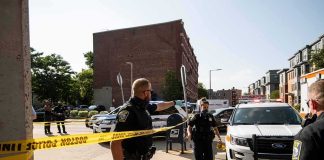
A small-town Oklahoma principal with 35 years of service took a bullet to the leg after rushing toward—not away from—an armed intruder, a split-second decision that likely saved dozens of young lives.
Story Snapshot
- Kirk Moore, principal of Pauls Valley High School, confronted a 20-year-old former student who entered the school lobby armed with a gun on April 7, 2026
- Moore was shot once in the leg during the confrontation; no students or other staff were injured despite multiple rounds fired
- The suspect was taken into custody immediately; Moore remains in stable condition
- Law enforcement and Governor Kevin Stitt praised Moore and staff for life-saving actions that prevented a mass casualty event
- The suspect’s motive and whether Moore was specifically targeted remain under investigation by Oklahoma authorities
When Instinct Trumps Self-Preservation
Kirk Moore graduated from Pauls Valley High School in 1984, a local kid who returned home to shape young minds. He spent three and a half decades in the district—teaching special education, directing athletics, serving as assistant principal—before ascending to principal in 2021. On an ordinary Tuesday morning, his deep roots in that small Oklahoma community and his protective instinct converged in the school lobby. A 20-year-old former student walked through the doors carrying a gun, and Moore, alongside other staff members, made an instantaneous choice to run toward danger.
The confrontation was swift and chaotic. Multiple gunshots rang out in the confined space of the lobby. Moore took a bullet to the leg. The intruder fired additional rounds, but the immediate response by Moore and his colleagues prevented the gunman from advancing deeper into the building where classrooms full of students sat vulnerable. The suspect was subdued and arrested on site. When the smoke cleared, the grim arithmetic of school violence had been rewritten: one injury, zero student casualties, and a community spared unimaginable grief.
What Law Enforcement Saw in the Aftermath
Oklahoma State Bureau of Investigation spokesman Hunter McKee did not mince words during the April 8 press conference. The actions of Moore and the staff, he stated plainly, saved lives. Governor Kevin Stitt echoed that sentiment on social media, praising Moore for acting bravely to protect students and offering prayers for his recovery. These were not polite political platitudes. Every official who reviewed the timeline understood the thin margin between this outcome and a tragedy that fills cable news for weeks. The lobby confrontation created a choke point that the gunman could not bypass.
The suspect’s identity was confirmed—a 20-year-old former student—but investigators have released few details about motive or grievance. Authorities have not disclosed whether Moore was a specific target or if the attack was indiscriminate. The absence of a clear narrative leaves troubling questions. Was this a grudge nurtured over months after leaving the school? A mental health crisis that exploded into violence? The investigation continues, but the suspect sits in custody, and the school remains secure.
The Uncomfortable Calculus of School Safety
Pauls Valley is not a sprawling urban district with metal detectors and resource officers on every corner. It is a small-town school where familiarity breeds a certain openness, where locked doors and surveillance can feel like admissions of defeat. The lobby, where Moore confronted the gunman, represents a persistent vulnerability in school design: an entry point accessible before deeper security layers engage. This incident exposes the harsh reality that even in tight-knit communities, former students can return as threats, and the first line of defense is often a educator with no body armor and no weapon.
Moore’s response—and the broader staff reaction—underscores the value of active shooter training and a culture that prioritizes immediate intervention over evacuation alone. The instinct to engage rather than retreat bought critical seconds. Yet it also highlights an uncomfortable truth: we are asking teachers and administrators to absorb risks that would make seasoned law enforcement officers pause. Moore was lucky; the bullet struck his leg, not his chest or head. Heroism should be honored, but it should not be the only failsafe in our schools.
A Community Rallies Around Its Own
Pauls Valley is the kind of place where everyone knows the principal’s name, and Kirk Moore is not just a figurehead but a neighbor, a former student, a three-decade constant in local education. The shooting sent shockwaves through the small community, but it also galvanized support. Moore’s stable condition has been a source of relief, and local media coverage has framed him unambiguously as a hero. The school was evacuated and secured, students were reunited with anxious parents, and the machinery of trauma counseling and investigation began its work.
The broader implications extend beyond one man’s courage. This incident will likely prompt reviews of security protocols in Oklahoma schools, particularly regarding access control for lobbies and entry points. It raises uncomfortable questions about monitoring former students who may harbor grievances and the adequacy of mental health resources that might intercept violence before it reaches a school threshold. Moore’s actions bought time for those discussions, but they cannot substitute for systemic solutions that reduce the likelihood of another principal facing down a gunman in a high school lobby.
Sources:
High School Principal Shot in Leg After Confronting Man with a Gun, Oklahoma Sheriff Says