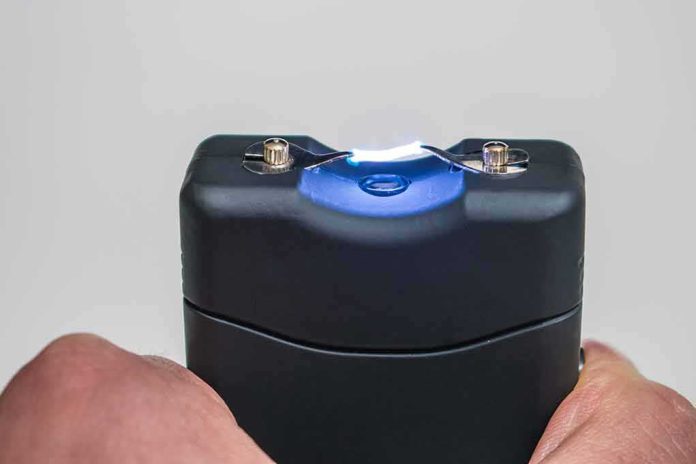
When agencies label a pain‑compliance weapon a “de‑escalation tool,” they are making a bet: that brief, targeted discomfort can head off the kinds of struggles that lead to broken bones, gunfire, and wrongful-death lawsuits. ICE’s planned adoption of electrified gloves squarely tests that bet — in mechanism, training, and oversight — because the device puts an electrical compliance tool literally in the officer’s hands rather than on a belt or at the end of a cartridge.
At a Glance
- DHS signaled up to $20 million to procure Generated Low Output Voltage Emitters (G.L.O.V.E.s) for ICE, describing them as “conductive distraction and de‑escalation” devices.
- The gloves deliver short, low‑output electrical shocks on direct skin contact to gain compliance from combative subjects; the manufacturer frames them as a less‑lethal alternative to higher‑risk force.
- ICE portrays the gloves as a way to reduce injuries and avoid deadly force during resistive arrests; early agency messaging emphasized training and policy limits.
- Critics argue pain‑compliance tools are ripe for misuse and lack an independent evidence base in field arrests; several outlets documented organized opposition from civil rights groups.
What ICE is buying and why it matters
The Department of Homeland Security issued a notice to purchase thousands of Generated Low Output Voltage Emitters for ICE operations, with a ceiling of roughly $20 million. The procurement language characterizes the gloves as “conductive distraction and de‑escalation” devices — an explicit signal that the agency views them as tools to end physical resistance without escalating to batons, sprays, or firearms. ICE’s logic tracks with standard force‑continuum doctrine: when a subject’s active resistance creates a hands‑on struggle, an officer needs a fast, controllable stimulus that breaks the cycle; done right, seconds of discomfort can avert minutes of violence and the cascade of risks that follow.
Unlike a conducted electrical weapon (CEW) that projects probes, the G.L.O.V.E. is tactile. Worn as ordinary patrol gloves until activated, the device delivers a low‑output electrical shock through direct skin contact — no prongs, no wires. The design aim is not incapacitation at distance but immediate pain‑compliance at the exact point of contact, typically to pry arms from beneath the torso or end a cling‑and‑thrash fight on the ground. The vendor positions the device for close‑quarters control and says it supplements, not replaces, other less‑lethal tools.
Mechanism of action: how an electrical “distraction” differs from a taser
Electrical compliance tools fall into two broad families. Projectile CEWs (the familiar taser form factor) can override neuromuscular signals across a span of muscle groups, disrupting coordinated movement. Contact devices, by contrast, deliver localized pain when electrodes meet skin. The G.L.O.V.E. is in the second family: the officer must physically touch the subject; the stimulus ends the moment contact ends. That immediacy is both the promise and the hazard. In a best‑case arrest, the glove turns a prolonged wrestling match into a three‑second reset window to apply handcuffs. In a worst‑case scenario, the same immediacy can tempt overuse — because the tool is already on the officer’s hands, activation is nearly frictionless. Manufacturer guidance attempts to bound that risk through limits on total application time, anatomical cautions, and categorical prohibitions for high‑risk populations (children, pregnant individuals, the elderly, and people with serious disabilities), but those constraints live or die in policy, training, and supervision.
A recurring claim from both agency and vendor communications is that the glove’s output is “low” relative to projectile CEWs and intended to end resistance quickly without lasting injury. Public demonstrations emphasize that the effect is transient and leaves no marks; several news outlets have carried those demos alongside the DHS procurement notice. The government’s own bid language — labeling the devices explicitly as “de‑escalation” tools — is the strongest on‑record statement of intended purpose.
Where this tool fits in the modern force continuum
Every force option competes on three axes: speed to effect, medical risk, and optics. Pepper spray contaminates bystanders and officers and can prolong medical monitoring; batons can break bones; projectiles require standoff distance and can fail at close quarters. A contact device worn as a glove is built for the ugliest slice of policing — entangled fights in doorways, vehicle extractions, ground scrums — where seconds matter and distance tools are moot. That is why the DHS notice and multiple briefings link the gloves to reducing injuries during hands‑on arrests and to curbing scenarios that might otherwise escalate to deadly force, including vehicle encounters where firearms present acute third‑party risks.
The flip side is accountability. Pain‑compliance tools are notoriously hard to audit because well‑trained applications can leave minimal visible injury. That makes after‑action documentation, body‑worn camera review, and clear activation thresholds non‑negotiable if an agency wants deterrence against misuse and defensible public reporting. Departments that integrated projectile CEWs effectively over the last two decades did so with policy bright lines, scenario‑based training, and mandatory reporting; the same disciplines will determine whether contact‑stimulus gloves perform as advertised or become another flashpoint.
The evidence gap and what to watch
Policing has a long history of adopting less‑lethal technologies on the strength of vendor claims and pragmatic appeal ahead of deep field research. Systematic reviews of electrical weapons have, at times, found modest reductions in officer injuries in specific contexts, coupled with persistent concerns about misuse, policy drift, and medical risk in vulnerable populations. The G.L.O.V.E. inherits that mixed lineage. DHS’s own notice anchors the program’s intent — distraction and de‑escalation — but intent is not outcome; outcomes turn on selection, training, and post‑deployment governance.
Three implementation choices will be determinative. First, placement in the force continuum: agencies must specify the resistance level that justifies activation (e.g., active physical resistance) and bar use for mere verbal noncompliance. Second, scenario training: officers need repetitions in precisely the circumstances the tool targets — pin‑and‑cuff grapples, crowded rooms, vehicle extractions — with strict time‑and‑target limits. Third, data discipline: mandatory reporting, supervisor review, and periodic public summaries with disaggregated metrics (use counts, injuries to officers and subjects, time‑to‑control, complaints sustained). Without those guardrails, any less‑lethal tool risks drifting into convenience force.
The policy case ICE is making — and the case against
ICE’s rationale is straightforward: in resistive arrests, an officer‑worn, contact‑only, short‑duration electrical stimulus can halt a struggle faster and with fewer injuries than strikes or sprays. Framed that way, the gloves are a harm‑reduction instrument aimed at the narrow band of encounters that most often spin into excessive force claims or lethal outcomes. DHS’s public characterization of the purchase underscores that institutional framing; the devices are being bought as de‑escalation tools, not as punitive implements.
Opposition coalesces around two points. First, pain‑compliance is easy to abuse, and ICE operates in settings — home raids, vehicle stops, cramped apartments — where documentation can lag and supervisory eyes may be scarce. Second, the field evidence specific to electrified gloves in arrest contexts remains thin in the federal space, even if local corrections and policing units report adoption. These concerns surfaced across major outlets covering the DHS notice and manufacturer claims; critics described the technology as unnecessary or cruel and questioned whether any promised reduction in deadly force would materialize. The dispute is therefore not about what DHS intends to buy, but whether the operational safeguards will match the rhetoric in practice.
What effective adoption would look like
A credible deployment program would move in stages. Pilot in a limited number of field offices with high‑fidelity training and enhanced supervisor presence. Pair distribution with clear prohibitions — no use for passive resistance or crowd‑control compliance; categorical bans for medically vulnerable populations mirrored in policy and reinforced in training. Require immediate post‑incident reporting tied to body‑worn camera timestamps and mandate medical screening after any activation. Most importantly, define success ex ante: fewer officer and subject injuries per arrest, shorter time‑to‑control in hands‑on encounters, and documented reductions in higher‑risk force categories on comparable operations. Publish those metrics quarterly. If the tool cannot meet those benchmarks, retire it.
There is also a design opportunity. Many modern less‑lethal systems incorporate activation logging — a simple event counter and duration recorder — to create an audit trail. A glove form factor heightens the need for that telemetry; frictionless activation must be balanced by transparent accountability. If DHS and ICE want the public to trust the “de‑escalation” label, data architecture should be part of the procurement and training package, not an afterthought.
ICE is reportedly planning to spend over $20 million on “shock gloves” from Kentucky-based Compliant Technologies. The gloves deliver an electric shock to help officers control resisting people without firearms, with the company claiming they cause no lasting harm. pic.twitter.com/jqMFc30GGH
— RIse World Intel (@Rise_world_Int) August 14, 2026
The bottom line
ICE is poised to put a close‑quarters electrical compliance tool into everyday enforcement, under a de‑escalation banner backed by DHS’s own procurement language. The technology’s value proposition — end dangerous grapples faster, with fewer injuries and less escalation — is plausible on mechanics and consistent with how force options evolve. Whether it delivers that value will hinge on disciplined policy placement, rigorous training, and auditable oversight. Less‑lethal tools succeed when agencies narrow their use to the specific, high‑risk problems they were built to solve — and prove, with data, that they did.
Sources:
abcnews.com, chosun.com, facebook.com