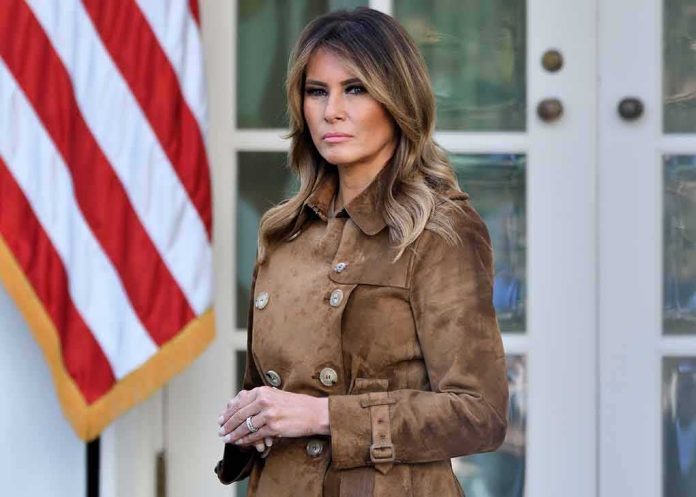
A White House-backed pause in fighting let nearly 800 people escape a hard-hit Ukrainian city as First Lady Melania Trump hosted Russian and Ukrainian envoys in Washington.
Story Highlights
- The White House says Melania Trump initiated talks that led to a local ceasefire in Oleshky.
- The pause allowed aid to enter and set up an evacuation route for civilians.
- Russian and Ukrainian human-rights officials met at the White House after the pause.
- The ceasefire was limited in time and location, focused on humanitarian goals.
White House Describes First Lady’s Role and Goals
The White House said First Lady Melania Trump independently opened channels with Russia and Ukraine and secured a localized ceasefire in Oleshky, a city in the Kherson region of southern Ukraine. Officials framed the effort as a humanitarian mission. They said the talks focused on stopping fire long enough to move aid and people out of danger. The statement also said she would host representatives from both countries at the White House to build on the pause and discuss next steps.
The administration also released terms for the pause when it was announced. The plan called for both sides to halt military action in and around Oleshky, allow humanitarian groups to reach civilians, and set up a marked route for safe passage out of the area. The White House said both sides agreed to those steps. The goal was narrow by design. It was not a broader peace deal. It was a time-limited pause to reduce harm to civilians in a single place.
Delegations Meet in Washington After Local Pause
Russian and Ukrainian human-rights officials were scheduled to meet at the White House following the pause. CNN reported that Ukraine’s ombudsman, Dmytro Lubinets, and Russia’s human-rights commissioner, Yana Lantratova, planned to attend, citing their offices and officials in both countries. That confirmation from both sides underlined that representatives were willing to talk in Washington, even as the wider war continued elsewhere in Ukraine.
News outlets described the ceasefire as short and focused on humanitarian needs. Reports said the pause ran from October 27 through November 1, local time, with a start at around 3 a.m. on the first day to allow aid convoys to move early and safely. The Hill said the pause area was widened to help vehicles reach people and bring them out. That kind of detail points to an operation set up around convoy timing and route security, not deep political terms.
Humanitarian Outcomes and Limits of the Agreement
The White House said the operation enabled the evacuation of nearly 800 people and allowed emergency aid to reach residents facing shortages of food and medicine. Local and national reporting repeated that figure and described shipments aimed at basic needs. These numbers offer a concrete way to judge the pause: people got out, and supplies went in. That is often the main test for a short ceasefire in an active war zone.
LIVE: First Lady Melania Trump Delivers Remarks on Russia-Ukraine Ceasefire… pic.twitter.com/Li2H8UFdnn
— CRAZY_BITCH_FROM_THA_MEGA_MAGA_SLAPAHOE_TRIBE 𖧶🪓 (@TRUMPGIRL_STL) November 6, 2026
Experts say narrow pauses like this are common in modern wars because they are easier to arrange than full peace deals. Research on ceasefires finds that time-limited, local deals can save lives but need clear rules and some way to handle disputes or violations. The Oleshky plan listed rules on halting fire and moving aid. It did not claim to end the broader conflict. That framing matches how many humanitarian pauses work and why they are often short.
Why This Matters for Americans
This story connects to a larger concern many Americans share: government should deliver real results, not just talk. A short pause that let families leave and aid enter is a measurable outcome. It also shows how soft power can work. A first lady is not a diplomat in the formal sense. Yet public roles can open doors when the goal is simple and urgent, like moving food and medicine or evacuating civilians under fire.
The fact that envoys from both sides came to the White House shows the United States still has leverage to help on practical steps, even when big politics are stuck. The ceasefire was small and local by design. But for the people who made it onto buses or got medical help, it was not small. That mix of limited scope and real human impact is common in conflict response and is one way institutions can still serve the public good.
What We Know and Do Not Know From Public Records
Public statements and reporting strongly support the ceasefire’s timing, terms, and the Washington meeting. They point to a six-day window, defined routes, and the presence of named officials from both countries. The record does not publish the full text of any signed agreement or list all signatories. That is typical in active conflicts, where access to documents and on-the-ground data can be limited, and where operational security can restrict what is shared.
For citizens watching from home, the bottom line is clear. A local pause in Oleshky stopped fire for several days, allowed convoys to move, and helped evacuate nearly 800 people, according to the White House and media reports. Representatives then met at the White House to discuss follow-on steps. The larger war goes on. But targeted actions like this can still reduce suffering and show that focused goals, clear rules, and face-to-face talks can make a difference.
Sources:
youtube.com, whitehouse.gov, cbc.ca, themoscowtimes.com