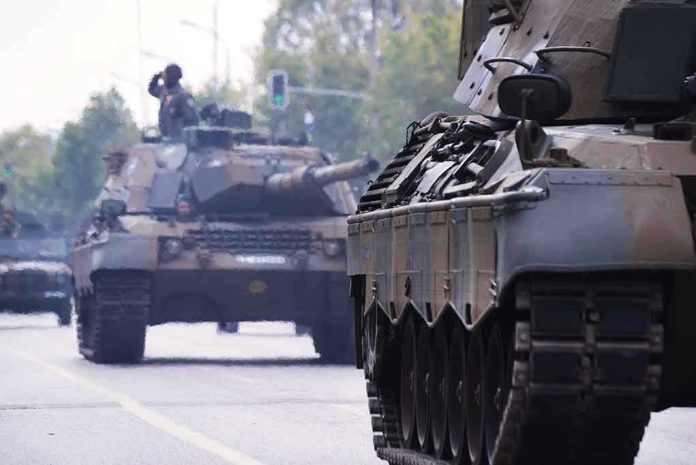
The U.S. Army’s next-generation battle tank sheds 10 tons and embraces hybrid power to survive the drone swarms that turned Ukraine into a graveyard for armored vehicles, marking a fundamental shift from brute-force armor to agility and electronic warfare.
Story Snapshot
- Army’s M1E3 Abrams prototype drops from 70+ tons to 60 tons with hybrid-electric propulsion for silent mobility and 50% better fuel efficiency
- AI-driven counter-drone systems including lasers, microwaves, and electronic warfare capabilities address vulnerabilities exposed in Ukraine conflict
- Reduced three-person crew with autoloader and modular architecture enables rapid tech upgrades without full redesigns
- Prototype unveiled at Detroit Auto Show enters testing phase in early 2026 under General Dynamics Land Systems development
Ukraine’s Lessons Drive Tank Revolution
The U.S. Army unveiled its M1E3 Abrams prototype at the Detroit Auto Show in late 2025, responding directly to battlefield realities from Ukraine where drones, loitering munitions, and top-attack missiles transformed tanks into easy targets. General Dynamics Land Systems built the demonstrator to weigh approximately 60 tons, shedding over 10 tons from current M1A2 variants that ballooned to 70-plus tons with add-on armor and active protection systems. This weight reduction addresses a core problem: heavy tanks struggle with global deployment, bridge crossings, and fuel logistics that drain combat effectiveness.
Army Chief of Staff General Randy George emphasized artificial intelligence as central to the M1E3’s design during the Detroit unveiling, highlighting AI-driven threat validation and automated countermeasures against unmanned aerial systems. The prototype incorporates hybrid-electric propulsion that enables silent movement, reduces thermal signatures, and generates substantial onboard power for energy-hungry sensors, electronic warfare systems, and potential directed-energy weapons. Testing commenced in early 2026 focusing on mobility, lethality validation, and software integration across the modular open systems architecture that allows rapid upgrades without redesigning the entire platform.
Drone-Killing Tech Takes Center Stage
The M1E3 integrates counter-UAS capabilities as a primary mission rather than an afterthought, reflecting observations from the Ukraine “drone graveyard” where even modern Western tanks proved vulnerable to cheap, proliferating aerial threats. The prototype features Common Remotely Operated Weapon Station systems optimized for engaging small drones and dismounted infantry, Javelin anti-tank missile integration for beyond-line-of-sight fires, and space reserved for directed-energy weapons including lasers and high-powered microwaves. Active protection systems are built into the design rather than bolted on, reducing weight while maintaining effectiveness against incoming projectiles that plague current tanks.
The shift to a three-person crew with an autoloader represents a departure from the Abrams tradition of four crew members and manual loading, prioritizing crew safety by reducing personnel exposed to combat while maintaining or improving rate of fire. The lower-profile turret and reorganized crew positions enhance survivability against the top-attack munitions that devastated armored formations in Ukraine. This redesign acknowledges that raw armor thickness cannot counter every threat; instead, networked sensors, AI-driven defensive systems, and electronic countermeasures provide layered protection that adapts to evolving battlefield conditions rather than relying solely on passive protection.
Defense Industrial Base and Strategic Implications
General Dynamics Land Systems continues M1A2 SEPv3 production at reduced rates while transitioning resources toward M1E3 development, balancing current operational needs with future capabilities under Army modernization directives. The modular open systems architecture enables commercial technology insertion without proprietary vendor lock-in, theoretically accelerating upgrades and reducing lifecycle costs that plague legacy defense programs. Improved fuel efficiency promises 50% gains over current turbine engines, cutting logistical burdens that consume combat power in extended operations. These economic factors matter as defense budgets face pressure from competing priorities and mounting national debt.
Army’s New M1A3: A Faster, Lighter, Drone-Killing Beasthttps://t.co/nzZnyd2Zl9
— RedState (@RedState) April 29, 2026
The M1E3 prototype stage indicates years remain before operational fielding, with early 2026 testing merely validating basic systems integration rather than proving combat readiness. Soldiers from armored brigade combat teams provide feedback loops that shaped the design, emphasizing mobility and reduced sustainment over the maximum protection philosophy that drove weight growth in previous variants. The Army’s gamble trades some armor thickness for speed, agility, power generation, and electronic survivability—a calculated risk based on peer threats from Russian and Chinese armored forces and the proliferation of precision strike capabilities that render heavy, slow platforms vulnerable regardless of armor thickness.
Sources:
The M1A3 Abrams and Its Western Competition – Sandboxx
The U.S. Army’s New 60-Ton M1E3 Abrams Super Tank Has Just 1 Mission – National Security Journal
US Army M1E3 Abrams Prototype First Look – MotorTrend
Our First Glimpse at the M1E3 Abrams Next-Gen Tank Demonstrator – The War Zone
Army Announces Plans for M1E3 Abrams Tank Modernization – Army.mil