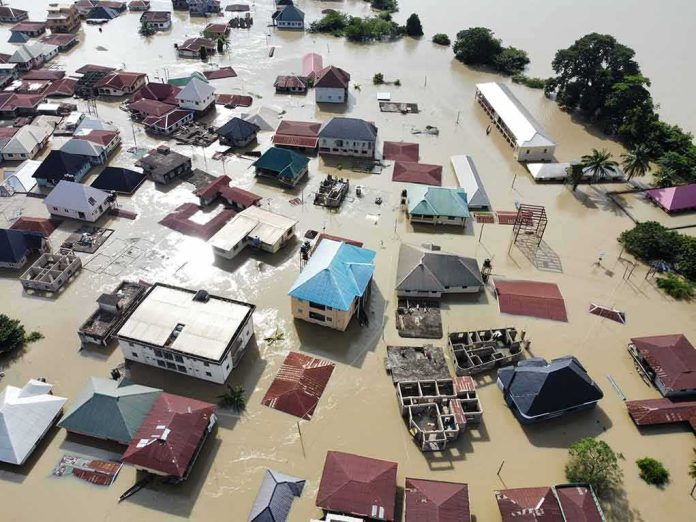
Floodwaters have swallowed farms, homes and city streets across Thailand, affecting more than 4 million people and leaving dozens dead since mid-September.
Story Snapshot
- Flooding hit 50 provinces across Thailand, damaging about 270,000 hectares of farmland since mid-September 2026.
- Government agencies reported the death toll climbing from 23 in early October to 44 by October 8.
- A strengthening low-pressure system combined with the southwest monsoon to dump heavy rain on the country.
- Bangkok briefly became a disaster zone before officials declared the capital’s crisis over on September 29.
- Farmers lost over 1.6 million rai of cropland, hitting rice production and rural livelihoods hard.
Flooding Spreads Across Dozens Of Provinces
Heavy rain has pounded Thailand since mid-September, and the damage keeps growing. The National Aeronautics and Space Administration (NASA) Earth Observatory reported flooding across 50 provinces, affecting more than 4 million people and damaging roughly 270,000 hectares of farmland. Thai government updates tracked the crisis as it expanded, moving from 27 provinces plus Bangkok on September 28 to 29 provinces the very next day.
Thailand’s Department of Disaster Prevention and Mitigation counted 2.6 million people affected across 167 districts by September 29, with more than 940,000 households hit. That number kept rising in the weeks that followed. By October 8, more than 3.1 million people remained affected and the death toll had grown to 44 across the country.
Weather System Triggers Nationwide Emergency
Thailand’s Meteorological Department warned on September 25 that heavy to very heavy rain would hit the country through September 27. The U.S. Embassy in Thailand backed up that forecast, telling Americans a strengthening low-pressure system combined with the southwest monsoon would bring heavy rain to many areas. That combination of weather forces pushed rivers over their banks and overwhelmed drainage systems built for lighter storms.
Bangkok felt the strain early. Flooding hit the capital alongside 27 other provinces in late September, forcing emergency measures before officials announced the city’s flood crisis had eased by September 29. Even as Bangkok recovered, floodwaters kept rising in other parts of the country, showing how fast the disaster’s footprint could shift from one region to another within days.
Farmland And Rural Communities Bear Heavy Losses
Thailand’s Ministry of Agriculture and Cooperatives reported flooding damaged 1,644,172 rai of cropland, equal to about 263,067 hectares, across 42 provinces. That figure closely matches NASA’s later estimate of 270,000 hectares, though the exact number shifted depending on when each agency counted it. Rice farmers took a major hit, since late September falls during a critical growing window for Thailand’s staple crop.
Rural losses often draw less attention than disruptions in Bangkok, where flooded streets and stalled flights at Suvarnabhumi Airport made international headlines. But the agriculture damage touches millions of farming families whose income depends on a single harvest. Crop losses compound slowly, through ruined fields and dead livestock, long after the floodwaters that caused them have receded from view.
Death Toll Climbs As Recovery Efforts Continue
The human cost of the flooding grew steadily through early October. ABC News reported 31 deaths across eight provinces by October 5, including four in Bangkok. Just three days later, Malay Mail reported the toll had reached 44 dead nationwide, with more than 3.1 million people still affected. The rising numbers reflect how the disaster kept evolving even as officials in some provinces shifted from emergency response to recovery.
GISTDA Records 4.21 Million Rai Flooded During October 3–9, 2026
GISTDA’s flood-monitoring dashboard recorded 4.2 million rai of flooded land during October 3–9, 2026. Nakhon Sawan had the largest flooded area among the provinces displayed, at 642,236 rai.
Ayutthaya followed… pic.twitter.com/bVuBlMM00W
— Thai Enquirer (@ThaiEnquirer) October 9, 2026
Thai officials have moved between emergency flood measures and recovery operations as conditions allowed, easing restrictions in provinces where rainfall slowed while maintaining relief efforts elsewhere. The shifting scale and location of the damage make this flood season one of the most geographically widespread in years, touching the capital, farming provinces and coastal communities within the same stretch of weeks.
Sources:
science.nasa.gov, thailand.go.th, reuters.com, abcnews.com