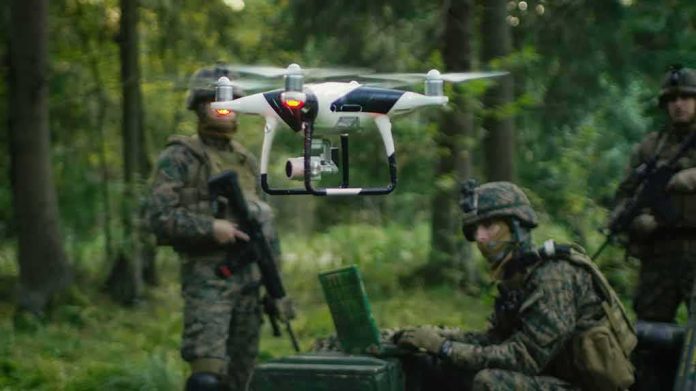
A wounded Ukrainian soldier spent two days trapped near the front line before a massive drone swooped down, lifted him off the ground, and carried him to safety.
Quick Take
- Ukraine’s military used a heavy-lift drone called StarGate to rescue two stranded soldiers near the Russian border after ground evacuation proved impossible
- Ukraine’s 92nd Assault Brigade says its hexacopter drone carried a 176-pound wounded infantryman 11 miles through a minefield
- Soldier Kostiantyn Vlasenko endured 491 days near the front and lost both feet before his own drone evacuation
- Military officials call drone rescues a “lifeline of last resort” as mines and enemy drones make ground evacuation more deadly
Trapped For Two Days, Then A Drone Arrived
Ukraine’s military says it carried out the first-ever aerial evacuations of wounded soldiers using a newly built rescue drone called StarGate. The aircraft pulled two stranded troops to safety near the Russian border, according to an elite military unit. One of those soldiers had waited two days for help after ground teams could not reach him safely.
Ground rescue had become too risky. Enemy drones patrolled the sky above the wounded men, and landmines littered the paths that medics would normally use to reach them. Commanders decided a flying machine was the only realistic option left. The soldiers were strapped in and lifted away from danger while still exposed to enemy fire below.
A Hexacopter Carries A Soldier 11 Miles To Safety
Ukraine’s 92nd Assault Brigade shared separate footage of what it called the first battlefield air evacuation by an unmanned aircraft in history. The brigade said a wounded infantryman, weighing about 176 pounds, was lifted by a heavy hexacopter built by Ukrainian company Gurzuf Defence and flown roughly 11 miles back to safer ground.
The video shows the injured soldier strapping himself to the drone before it climbs away from the contact line. A fleet of smaller drones reportedly flew escort, watching for Russian attack drones along the route. The brigade described the flight as proof that unmanned aircraft can now do a job once reserved for armored vehicles and helicopters.
491 Days Near The Front Line
Another soldier, who goes by the alias Magura and serves with the 30th Separate Mechanised Brigade, spent 491 days in what troops call the “grey zone,” the no-man’s-land between opposing lines. He eventually lost both feet before being airlifted out aboard a Heavy Shot Ayudag drone, according to Ukrainian reporting on his ordeal.
His case shows why these rescues matter beyond a single dramatic video. Soldiers wounded in contested territory often cannot be reached for days, sometimes weeks, because any ground movement draws immediate drone strikes. By the time help arrives, injuries that once were treatable have turned catastrophic, forcing amputations that might have been avoided with faster evacuation.
Why Ground Rescue Has Become A Death Trap
Military medicine experts describe the modern battlefield as “hyper-transparent,” meaning cameras, sensors, and drones can spot almost any movement near the front. That visibility has pushed safe evacuation routes much farther back from combat zones, delaying treatment for wounded troops by hours they may not have.
Ukraine has achieved many historic firsts in this war. Here is another one: the first-ever aerial medical evacuation of a wounded soldier using a heavy-lift drone.
On the Kupiansk front, Ukraine’s Defence Forces rescued Kostiantyn Vlasenko of the 30th Mechanized Brigade, who had… pic.twitter.com/lehLzHgfHM
— Andrii Sybiha 🇺🇦 (@andrii_sybiha) October 24, 2026
A recent medical comparison found that more than 60 percent of wounded patients arrived outside the safe window for tourniquet use in 2025, compared with just 15 percent in 2016. Ukrainian officials have called drone evacuation a “lifeline of last resort,” not a replacement for ground rescue, but a backup when no other option remains.
A Technology Still Finding Its Footing
Military researchers caution that fully unmanned casualty care remains years away. Current drone rescues still rely on human drone pilots steering the aircraft and monitoring the wounded soldier during flight, not autonomous machines making medical decisions. Even so, the United States military is watching closely, asking whether its own medical corps can adapt to a battlefield where the sky itself has become dangerous.
Sources:
military.com, pravda.com.ua, yahoo.com, apnews.com, tomshardware.com, militarytimes.com, academic.oup.com, ausa.org