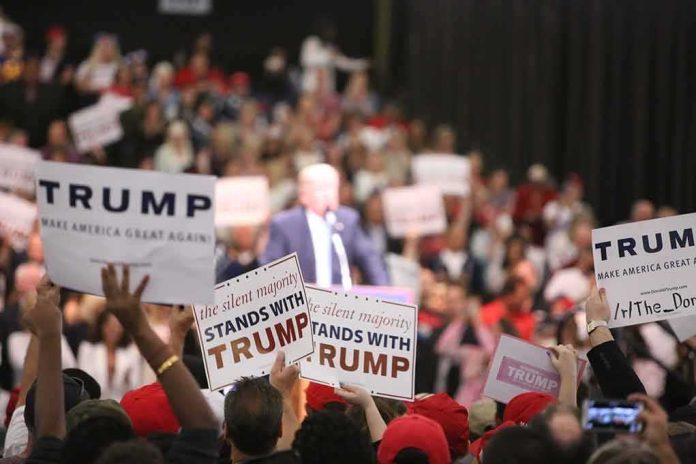
The Charlottesville fight over what Donald Trump did and didn’t say endures because two truths coexist: the transcript is unambiguous about excluding neo-Nazis, and yet the setting, organizers, and slogans of the event made any “both sides” framing combustible; understanding both levels—text and context—is the only way the controversy makes sense years later.
At a Glance
- Trump’s August 15, 2017 exchange contains an explicit exclusion: “I’m not talking about the neo-Nazis and the white nationalists, because they should be condemned totally.”
- The “very fine people” phrase appears while he’s arguing about the Confederate monument dispute, not to praise hate groups.
- Critics contend the distinction collapses in practice because the rally was organized by white supremacists and suffused with their slogans.
- The enduring dispute is less about what words appear in the transcript than about what group those words reasonably refer to in context.
What Trump Actually Said—and Where the Words Sit in the Exchange
The transcript of Trump’s impromptu Q&A on August 15, 2017, is the primary document for any serious assessment. In it, Trump makes three linked moves: he assigns “blame on both sides,” he argues some people were present to debate statues and park renamings, and he adds a categorical carve-out—“I’m not talking about the neo-Nazis and the white nationalists, because they should be condemned totally.” The “very fine people” phrasing appears inside that monuments-and-parks argument, not inside any defense of extremist groups. Multiple repositories have reproduced the exchange in full, and they each anchor that disclaimer in the record.
This is why literalists—across fact-checkers and transcript-based analyses—have long maintained that the popular shorthand (“Trump praised neo-Nazis”) is inaccurate. You can credibly object to the “both sides” formulation, the timing, or the rhetorical judgment; you cannot, by the text, make the carve-out disappear. In other words: the record contains the words that many people insist are absent.
Why the Dispute Persisted: Text Versus Pragmatics
If the transcript is clear, why does argument persist? Because political communication is received in context, not just in clauses. The Charlottesville weekend was defined by a white-power torch march and a rally convened by avowed extremists; several commentators therefore argue that invoking “very fine people on both sides” inevitably dignified, or at least normalized, a movement whose organizing core was explicitly racist. This view treats the pragmatic meaning of the remark—the audience, the moment, the power of a presidential utterance—as determinative, rendering the subsequent “not the neo-Nazis” carve-out insufficient to offset the broader signal.
Think of it as a reference problem. Grammatically, Trump’s limitation narrows the referent of “very fine people” to non-extremist statue protesters; pragmatically, critics hear any praise of “people in that group” during that news cycle as inseparable from the extremists who made and led the event. Both readings work as linguistics; they diverge as civic judgment. That divergence explains why the same transcript fuels opposing headlines years later.
The Specific Claims That Are Right—and the Ones That Are Not
Three claims can be weighed with confidence. First, Trump did say “very fine people on both sides” while discussing the statue dispute, not while defending neo-Nazis. The transcript is dispositive on that point. Second, in the same exchange, he explicitly excluded neo-Nazis and white nationalists and said they should be “condemned totally”. Third, critics who argue his overall framing still softened the moral asymmetry of the event have a defensible position rooted in who organized and animated the rally; that is an interpretive critique, not a transcript dispute.
What is not supported is the flat claim that Trump “called neo-Nazis very fine people.” That formulation erases a plainly stated carve-out and misidentifies the referent of “very fine people.” Major fact-checks that assess the full exchange have said as much, even as they also catalogue the legitimate objections to his both-sides rhetoric and tone across those days.
How Misquotes Harden into Dogma
Why did the inaccurate shorthand spread so widely? Speed, repetition, and moral urgency. In crisis moments, complex answers—and especially answers that separate text from context—lose out to punchy claims that confirm priors. Partial clips, elisions of surrounding sentences, and layered commentary created a simplified narrative that was easier to remember and to mobilize around than the messy transcript. Over time, repetition conferred the aura of fact. The opposite happened on the right: the carve-out became the entire story, and the contextual critique was dismissed as bad faith. Each side purified the narrative for rhetorical efficiency; neither told the whole story well.
The result is a durable binary that does not map onto the primary source. The literalists can be right about what the sentence meant grammatically and still be blind to why the utterance inflamed the country; the contextualists can be right about consequence and still wrong about the specific claim they place in Trump’s mouth. Mature civic discourse requires living with both truths at once.
Fox News' liberal co-host Jessica Tarlov is admitting she spent years repeating the Charlottesville "very fine people" story without ever listening to what President Trump actually said.
Appearing on The Bulwark, Tarlov said she hadn't spent much time engaging with arguments… pic.twitter.com/f8wLLklJx5
— TheMastiffMafia (@mafia_mastiff) November 23, 2026
Lessons for Consuming Political Speech Going Forward
There is a pragmatic checklist that reduces the odds of being misled by political sound bites. Start with the primary text or full video before you adopt a viral paraphrase, especially when the phrase becomes a totem in partisan identity battles. Identify whether a disputed word or clause has an explicit limitation in the surrounding sentences that narrows the referent, as happened here. Then shift lenses: ask what the context would have communicated to a reasonable listener, beyond literal grammar. Only after both passes—text first, pragmatics second—should you settle on a judgment about meaning and consequence. Fact checks that lay out both layers are useful precisely because they force this two-stage reading.
Sources:
pjmedia.com, politifact.com, npr.org, withreceipts.fyi, snopes.com, latimes.com, checkyourfact.com