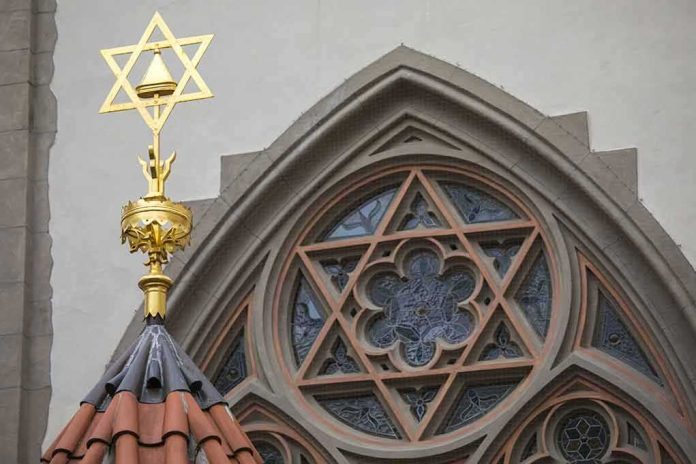
The core constitutional question here is not whether governments can declare some locations “sensitive,” but whether a county can extend that label so broadly that it disables congregants from exercising the right to armed self‑defense in their own sanctuaries—and, for some worshipers who walk on holy days, on the only practical paths to get there.
The Short Version
- A federal judge preliminarily enjoined Montgomery County’s worship‑place gun ban as applied to one synagogue and its rabbi, finding a likely Second Amendment violation inside the sanctuary.
- The county’s broader “public assembly” regime still bars carry within a defined perimeter outside, leaving observant pedestrians in legal limbo.
- The litigation exemplifies post‑Bruen “sensitive places” fights: courts now demand historical analogs, not policy balancing.
- County officials defend the law as a targeted public‑safety measure authorized by state statute and tailored with certain exceptions.
What the court has already decided—and what it hasn’t
In September 2026, the U.S. District Court for the District of Maryland issued a preliminary injunction allowing the Silver Spring Jewish Center (SSJC) and Rabbi Shapiro to possess and carry handguns inside their house of worship, concluding they are likely to succeed on their as‑applied Second Amendment claim. The order enjoined Montgomery County’s enforcement of its code provisions in that limited respect while the case proceeds. Injunctive relief at this stage is provisional by design, but it rests on a judicial forecast that the plaintiffs’ interior‑sanctuary claim will prevail on the merits.
Relief was not total. The same order left intact the county’s geographic “buffer”—a prohibition on possessing or transporting firearms within a fixed distance of places of public assembly—meaning congregants who walk to synagogue remain exposed to enforcement for the stretch outside the door. Subsequent docket activity shows the court later denied a separate motion from the plaintiffs, underscoring that this remains an active, contested case rather than a final win. The plaintiffs have also pursued appellate relief from the Fourth Circuit, placing the outdoor buffer and its interaction with both the Second Amendment and free exercise in front of a higher court.
The legal mechanism: “sensitive places” and post‑Bruen historical testing
Since the Supreme Court’s 2022 decision in Bruen, governments defending firearm restrictions must demonstrate consistency with the Nation’s historical tradition of firearm regulation. That test has pushed litigation toward archival evidence: were churches historically regulated like courthouses and polling places, or treated differently; and were perimeters around public venues part of that tradition, or a modern accretion? Different courts have answered differently, but the through‑line is clear—abstract appeals to public safety no longer carry the day absent historical kinship to known sensitive‑place limits.
In this case, the district court separated two questions. Inside the sanctuary, the synagogue’s volunteer security posture and the absence of a persuasive reason to treat it as more dangerous than licensed, exempted security counted heavily in the plaintiffs’ favor. Outside, the court left the pedestrian buffer in place for now, suggesting either a closer historical question or a record not yet developed enough to justify interim relief. That is precisely the kind of line‑drawing Bruen has made common: governments can designate some places as sensitive, but the scope and perimeter must be historically grounded to survive.
How Montgomery County’s law works
Montgomery County’s statute prohibits selling, transferring, possessing, or transporting firearms and ammunition “in or within 100 yards of a place of public assembly,” a definition that includes schools, parks, libraries, polling places, legislative assemblies, and houses of worship. The County narrowed some categories where statewide rules already govern and created a driving‑through exception for motorists on public roads within the buffer; pedestrians enjoy no comparable carve‑out. The architecture is categorical: the same perimeter applies whether the public assembly is a park at noon on a weekday or a sanctuary on the Sabbath.
County leaders defend the design as a lawful public‑safety measure expressly authorized by Maryland law for charter counties to regulate firearms in or within 100 yards of specified public‑assembly locations. They cite the state authorization and recent state‑court validation of county power within those bounds as confirmation that the county’s scheme sits on a proper legal foundation. State‑law authorization does not answer the federal Second Amendment question, but it explains why the county adopted a perimeter‑based frame and why officials remain confident in its basic structure.
Why the synagogue prevailed—inside—and why the walking buffer remains the live fight
Two features of the record moved the court toward interior relief. First, the plaintiffs tailored their claim: they sought carry rights within their own sanctuary for identified, trained volunteers, not a blanket dissolution of sensitive‑place doctrine. Second, the county exempted licensed security guards but barred the synagogue’s own volunteers; the court found the county had not shown that volunteer security was riskier than the licensed alternative it already permits. That mismatch weakened the county’s claim to necessity within the sanctuary itself.
The buffer is different. A fixed‑distance ban chokes off access routes as well as destinations, and for observant congregants who do not drive on the Sabbath or on certain holidays, “just drive around the zone” is not an option. The plaintiffs have argued that this transforms a location rule into a travel ban that uniquely burdens religious practice for walkers—precisely those who would need to carry for self‑defense en route. The district court kept that restriction in place while litigation continues; the Fourth Circuit appeal squarely tees up whether a perimeter with no pedestrian accommodation is consistent with both the Second Amendment and, as applied here, the Free Exercise Clause.
The real disagreements—and the evidence that matters
The county frames the ordinance as a measured response to gun violence risks in public spaces, backed by state authorization and limited exceptions. Plaintiffs insist Bruen requires more: a concrete historical pedigree for both the interior ban and the travel perimeter; parity between volunteer congregational security and licensed guards; and, for observant walkers, a path that does not criminalize the act of traveling to worship. The district court’s split ruling tracks these tensions. It indicates that, as applied to a congregation securing its own sanctuary, the county’s categorical ban likely overshot. It also indicates that the harder question is the zone outside, where public safety and pedestrian religious practice collide.
Two evidentiary gaps could decide the next phase. First, the historical record: governments arguing for sweeping perimeters must show enduring analogs, not sporadic outliers. Second, the practical record: mapping of actual walking routes, documented observance practices, and comparative incident data on volunteer versus licensed security. Those facts will either sustain the buffer as a historically cognate safety measure or collapse it as an overbroad modern innovation ill‑suited to the constitutional text and tradition.
What this means going forward
Houses of worship sit at the fault line of two constitutional commitments—free exercise and the right to armed self‑defense—while local officials shoulder responsibility for public safety in crowded civic spaces. Post‑Bruen, the law does not deny governments the ability to protect such places; it requires that protection to be historically rooted and sensibly drawn. The SSJC injunction shows that when a county prohibits even tailored, on‑site defensive carry inside a sanctuary, courts will demand a better answer than categorical labels. The unresolved pedestrian buffer will test whether a one‑size‑fits‑all perimeter can lawfully reach those who, because of their faith, walk through it to pray.
Sources:
reason.com, supreme.justia.com, courtlistener.com, storage.courtlistener.com, govinfo.gov, thebanner.com, apps.montgomerycountymd.gov, mocoshow.com