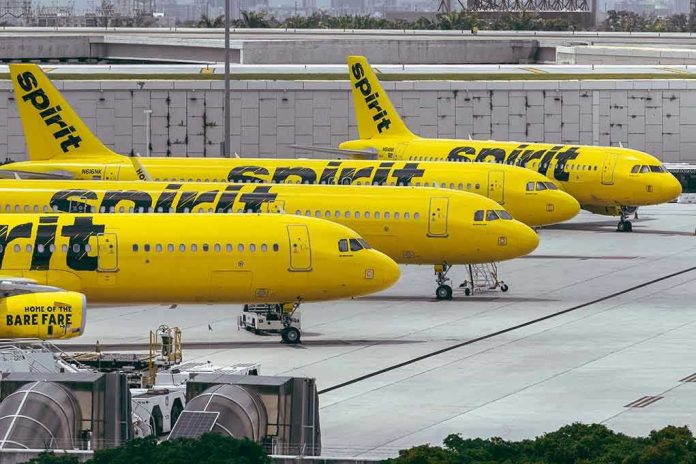
Spirit Airlines shut down overnight on May 2, 2026, after bailout talks with the Trump administration collapsed, leaving millions of budget travelers stranded and exposing how government failures and war-driven fuel costs destroyed a 34-year-old airline.
Story Snapshot
- Spirit Airlines ceased all operations at 3:00 a.m. EDT on May 2, 2026, after failed government bailout negotiations amid its second bankruptcy
- Soaring fuel costs from the 2026 Iran war crushed the ultra-low-cost carrier’s thin-margin business model, forcing immediate closure
- Over 10,000 employees face layoffs while millions of passengers scramble for alternative flights as competitors rush to fill the void
- Transportation Secretary Sean Duffy announced relief measures including price caps and job pathways, but critics question why the bailout failed
Government Bailout Collapse Triggers Immediate Shutdown
Spirit Airlines ended 34 years of service at 3:00 a.m. EDT on May 2, 2026, after bailout negotiations with the Trump administration broke down. The Florida-based ultra-low-cost carrier had entered its second Chapter 11 bankruptcy in August 2025, just five months after emerging from its first restructuring in March 2025. Transportation Secretary Sean Duffy’s Department of Transportation held leverage in rescue talks but ultimately walked away, leaving Spirit’s creditors with no choice but to liquidate operations immediately and strand passengers holding worthless tickets.
Iran War Fuel Costs Devastate Budget Airline Model
The 2026 Iran war sent fuel prices skyrocketing, delivering a fatal blow to Spirit’s business model built on razor-thin profit margins and bare-bones service. Founded in 1980 as Charter Airlines and rebranded in 1992, Spirit grew into a major carrier serving over 80 destinations across Latin America and the Caribbean with its fleet of yellow Airbus A320 and A321 aircraft. The airline’s point-to-point route network and no-frills approach—charging separately for carry-ons, seat selection, and refreshments—worked when fuel costs remained stable but collapsed under war-driven price spikes that larger hub-and-spoke carriers could better absorb through diversified revenue streams.
Millions of Travelers Left Without Options
Spirit’s sudden closure stranded millions of passengers who relied on the carrier’s rock-bottom fares for leisure travel to Mexico, the Caribbean, and domestic destinations. Budget-conscious travelers, including low-income families and retirees on fixed incomes, lost their most affordable airline option overnight. Frontier Airlines responded with “SAVENOW” promotional fares offering 50 percent discounts and $199 GoWild passes while adding nine routes and 15 flights in former Spirit markets. Delta offered reduced nonrefundable fares for five days in Spirit’s U.S.-Latin America routes, and American Airlines announced unspecified support programs. Secretary Duffy coordinated with major carriers to cap rebooking prices and create preferential hiring pathways for Spirit’s 10,000-plus displaced employees.
The airline industry now faces consolidation as competitors absorb Spirit’s routes and market share, likely ending the era of pure ultra-low-cost dominance in American skies. Frontier stands to gain the most, expanding into over 100 former Spirit routes, but analysts warn this consolidation could drive fares higher industry-wide. Spirit’s Airbus fleet will likely be sold or scrapped, shifting the market toward hybrid low-cost models. The carrier’s failed JetBlue merger in 2024, blocked on antitrust grounds, now appears prescient—a combination might have provided the financial cushion to survive the fuel crisis.
Deep State Failures Leave Working Americans Holding the Bag
Spirit’s collapse exposes familiar patterns of government incompetence that frustrate Americans across the political spectrum. The Trump administration held talks but failed to deliver a lifeline, leaving over 10,000 workers jobless and millions of customers scrambling for alternatives at higher prices. Budget travelers who depend on affordable fares to visit family or take vacations now face a consolidated industry where major carriers control pricing. This debacle mirrors broader concerns about an unresponsive federal government more focused on political maneuvering than solving real problems for ordinary citizens trying to get ahead through hard work and careful spending.
Spirit Airlines goes out of business after 34 years, ending operations immediately https://t.co/Ofr96Y5Z4y
— The Minnesota Star Tribune (@StarTribune) May 2, 2026
The geopolitical fuel crisis stemming from the Iran war shows how foreign entanglements drive up costs for everyday Americans, reinforcing frustrations with globalist policies that prioritize international conflicts over domestic stability. Meanwhile, the DOT’s orchestrated relief through major airlines raises questions about corporate favoritism—did the administration let Spirit fail to benefit politically connected legacy carriers? Whether liberal or conservative, working families paying the price for elite failures deserve answers about why their government couldn’t keep an affordable airline alive during an avoidable energy crisis.
Sources:
Frontier Airlines Announces Discounted Rescue Fares to Support Spirit Airlines Customers
Trump Transportation Sec. Duffy Announces Relief for Spirit Airlines Flyers, Employees
Delta Offers Rescue Fares to Support Travelers Following Spirit Airlines Suspension of Operations
American Airlines Takes Action to Support Spirit Airlines Customers and Team Members