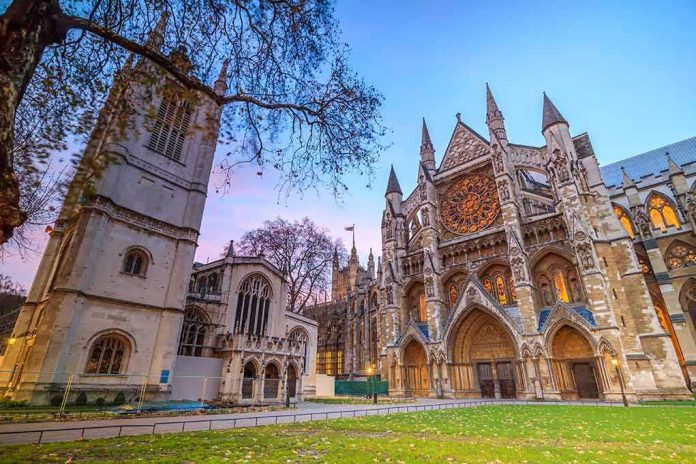
What made this theft different was not the loss of a valuable art object, but the deliberate destruction of a community’s most intimate point of contact with its patron saint—an attack on meaning more than money, carried out in a basilica built to guard that very connection.
At a Glance
- Police arrested a suspect after the theft of a reliquary at the Basilica of Saint-Nicolas-de-Port in Lorraine, France; the parish reported the disappearance to authorities.
- The man reportedly admitted breaking the display and taking a bone fragment attributed to Saint Nicholas, then burning and crushing it rather than attempting resale.
- The incident centers on a specific site and object: a public-facing reliquary inside a major regional shrine, distinct from the basilica’s most protected relics.
- The case aligns with a broader pattern of crimes targeting places of worship, even as motives here skew toward ideological desecration instead of profit.
What Happened: A Relic Targeted, A Suspect Arrested
The Basilica of Saint-Nicolas-de-Port—Lorraine’s centuries-old shrine to Saint Nicholas—reported the disappearance of a reliquary containing a bone fragment attributed to the saint. Local coverage and parish accounts describe a straightforward sequence: the parish priest filed a complaint, police identified a suspect, and officers arrested him at his residence following the investigation. In post-arrest reporting attributed to the parish, the suspect conceded he had smashed the protective case, taken the fragment, and then destroyed it by burning and crushing. Those admissions, relayed through multiple outlets, anchor the most consequential facts: the object taken, where it was taken from, and what was done with it afterward.
Several details give the story its particular texture. This was not a smash-and-grab aimed at a portable chalice or gilded statue; the reported victim was a small but symbolically charged relic, accessible enough to be stolen yet central enough to stir local outrage. The basilica retains other, more significant relics—most notably the “blessing hand,” two fingers attributed to Nicholas—kept under tighter security. The stolen fragment was displayed more publicly inside the church, and it was that vulnerability the thief exploited.
Stated Motive: Desecration Over Profit
According to published accounts, the suspect told investigators he viewed the veneration of relics as idolatry or fetishism and acted to destroy the fragment rather than traffic it. That is a qualitatively different motivation from the typical calculus behind thefts from churches, which—across countries and over time—tend to be opportunistic and resale-driven. Here, if the reported confession reflects the man’s purpose, the objective was symbolic harm to a practice he rejected, not illicit gain.
That distinction matters for prevention. When thieves target precious metals or marketable artifacts, risk-reducing steps emphasize deterrence and traceability: alarms, improved cases, registries, and distinct markings. When a perpetrator aims to desecrate, those measures still help, but the security model must assume a higher tolerance for risk and a willingness to destroy what cannot be fenced. The basilica’s experience—three profanations in roughly a year, according to local television—illustrates how religious sites must layer access control and monitoring even for items of modest material value if they carry high symbolic charge.
How This Fits a Wider Pattern of Crimes Against Sacred Heritage
Religious buildings are persistent targets for theft and damage worldwide. Law-enforcement guidance and international bodies have long warned that churches, synagogues, mosques, and temples present recurring vulnerabilities: predictable opening hours, dispersed stewardship, and objects that are valuable either for their marketability or their meaning. The FBI underscores that theft and vandalism affecting religious cultural property occurs more often than many realize, while also noting that cross-jurisdictional data are hard to aggregate consistently. INTERPOL similarly lists places of worship among common targets in cultural property crime, alongside private homes and museums.
Within that landscape, the Saint-Nicolas-de-Port case straddles two categories. On one hand, it is a theft from a house of worship—the classic scenario that heritage-crime units train for. On the other, the stated motive points toward iconoclastic harm: damage aimed at a community’s devotional anchor. Historic England’s analysis of heritage crimes shows most incidents follow material incentives—metal for scrap, saleable smalls—yet episodes like this one remind custodians that symbolic value can be the draw, changing both offender behavior and the likely fate of a stolen object.
MAN ARRESTED FOR SMASHING CASE, STEALING, BURNING & CRUSHING BONES OF ST. NICHOLAS AT BASILICA IN LORRAINE FRANCE
A Suspect Has Been Arrested (BUT NOT NAMED) After Breaking Into A Protective Display Case At The Basilica Of Saint-Nicolas-De-Port In Meurthe-Et-Moselle, France,… pic.twitter.com/lLb8a9tvv7
— John Basham (@JohnBasham) November 9, 2026
Relics, Provenance, and Why Authenticity Is Not the Point Here
Public reports identify the missing fragment as a relic of Saint Nicholas, the fourth-century bishop whose cult has deep roots in Lorraine and whose life helped shape the Santa Claus tradition. Whether every relic attributed to a major saint can bear modern scientific authentication is a separate scholarly debate; in church practice, what matters pastorally is the object’s recognized status within a community’s tradition and inventory. For law enforcement and courts, the controlling facts are more prosaic: a defined object, recorded as church property, was removed without authorization and, by the suspect’s own account, destroyed. The harm is cultural and communal as much as it is proprietary, and both are actionable under ordinary criminal codes.
In this case, the basilica’s own hierarchy of custody underscores that logic. The most revered relics remain secured and inventoried; more publicly accessible items serve devotional and educational purposes. The fragment that was taken sat in that second tier—available for the faithful to see and venerate, yet important enough that its loss resonates beyond monetary metrics, especially in the run-up to Saint Nicholas Day in early December.
Security and Stewardship: Practical Lessons for Parishes and Towns
Incidents like this generate understandable calls for “more security,” but the effective question is more specific: which countermeasures reduce risk for which objects, during which hours, at what cost to mission? A practical framework begins with stratification. Parish leaders, with diocesan or municipal heritage support where available, can map holdings into tiers by symbolic significance, replacement difficulty, and portability. High-symbolism items, even if they lack high material value, warrant museum-grade cases, limited hours of exposure, and surveillance coverage calibrated to blind spots and approach routes. Lower-risk devotional items can remain accessible, but mounted with tamper alerts and logged opening procedures.
Training matters as much as hardware. Staff and volunteers should know how to respond to a breach—whom to call, what to photograph, how to preserve a scene without contaminating prints or residues. Regional police can help design these playbooks. The FBI’s law-enforcement bulletin on religious-heritage theft emphasizes both community partnership and methodical documentation; that same posture has proven effective in Europe, where local units coordinate with national cultural-property teams and INTERPOL’s stolen-works databases to harden targets and recover items when prevention fails.
What Comes Next in the Saint-Nicolas-de-Port Case
Based on the parish’s account and regional reporting, the immediate law-enforcement milestones—complaint, identification, arrest, and a reported confession—have occurred. Some coverage mentions subsequent judicial steps, including psychiatric evaluation, which would be routine in a case featuring religiously framed desecration and alleged destruction of remains. As with any arrest, the presumption of innocence applies until adjudication; that legal caveat coexists here with a practical reality for the basilica and town: the fragment, by the suspect’s account, cannot be restored.
Communities often respond to such losses by doubling down on stewardship and remembrance—tighter protection for what remains, renewed teaching about what these objects mean, and, sometimes, commissioning contemporary art or reliquary casings that make violation harder without turning a church into a fortress. That balance is never perfect. But it is the work: guarding access to the sacred while refusing to let those who would harm it define the terms of devotion.
Sources:
nashaniva.com, dailycaller.com, thecatholicherald.com, dailymail.com