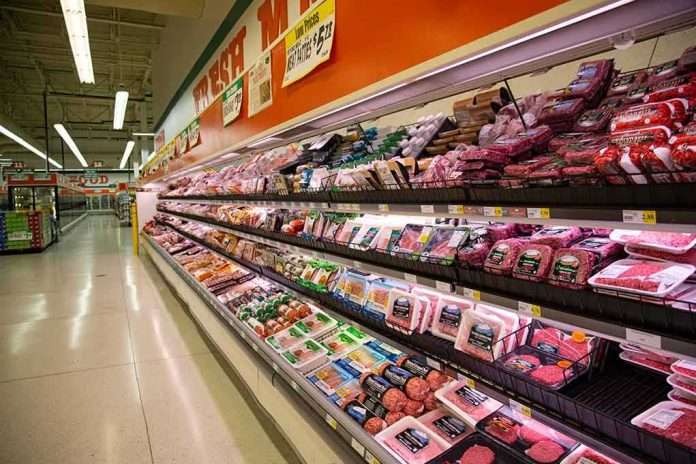
When software reaches into the cold chain, cybersecurity failures don’t just steal data—they melt inventory, torch margins, and threaten consumer trust. France’s supermarket incident made that concrete: a coordinated cyberattack remotely manipulated connected refrigeration controls across multiple chains, driving case temperatures far above safe ranges and forcing mass product disposal while authorities opened a criminal probe and mobilized the national cyber agency.
At a Glance
- Paris prosecutors opened a criminal investigation into a large-scale cyberattack that disrupted supermarket refrigeration across several French retailers.
- France’s prime minister tasked the national cyber agency ANSSI to investigate and coordinate with European counterparts, elevating the response beyond private incident claims.
- Early reporting points to targeted Danfoss refrigeration management systems—particularly legacy AK-SM800/AK-SC355 units running outdated firmware—consistent with remote manipulation of controls.
- Danfoss acknowledged incidents in France affecting a limited number of systems and linked affected units to outdated firmware; retailers reported widespread food spoilage and operational disruptions.
What happened: coordinated manipulation of connected cold-chain controls
Authorities and multiple outlets reported that connected refrigeration systems at several major French supermarket groups were maliciously driven to abnormal temperatures, in some cases above 40°C, resulting in food spoilage and emergency responses overnight. The Paris prosecutor’s office characterized the event as a “large-scale cyberattack” and opened a formal criminal investigation—an important signal that the state treats the disruption as deliberate intrusion into operational technology (OT), not a coincidental wave of equipment failures. The attack profile—simultaneous overrides across dispersed sites, out-of-band temperature setpoints, and rapid spoilage—aligns with remote manipulation of centralized or networked controllers rather than localized mechanical faults.
France escalated its response accordingly. A source close to Prime Minister Sébastien Lecornu said ANSSI, the national information systems security agency, was tasked to investigate and liaise with European peers, reflecting concerns about supplier commonality and cross-border exposure in retail cold chains. That institutional posture matters: supermarket refrigeration may not be “critical infrastructure” by statute, but it is critical to public health and food security in practice.
The technical spine: shared controllers, legacy firmware, and remote access
Preliminary reporting identified Danfoss supervisory controllers as a nexus—specifically the AK-SM800 and AK-SC355 lines—with at least one AK-SM800 variant flagged for “outdated firmware”. Danfoss, for its part, confirmed it was aware of incidents in France affecting a limited number of refrigeration management systems and noted that the impacted units were running outdated firmware; the company said it had advised operators to update supported systems and migrate legacy ones that are beyond support. That combination—shared vendor, legacy models, and remote connectivity—tracks with established OT risk patterns: once attackers find an exposed fleet of identical devices, compromised authentication or unpatched weaknesses can scale quickly across sites.
It is common in supermarket estates to centralize case controllers under a store or enterprise supervisory system to automate defrost cycles, alarms, and energy optimization. Those functions are valuable—but they also create a single command surface. If reachable from the internet or through a vendor remote-maintenance path, and if credentials, segmentation, or firmware hygiene are weak, an adversary can forcibly set case temperatures, disable alerts, or schedule repeated defrosts, all without stepping onto the shop floor. The observed France-wide pattern is consistent with exactly that kind of abuse of legitimate control pathways.
Why this fits a broader OT security pattern
Industrial and commercial control systems were engineered for reliability and availability; security hardening often arrived later, and unevenly. The supermarket episode echoes a decade of lessons: digital access to physical processes creates real-world impact. From energy-sector incidents to safety-system compromises, the through-line is not that every controller is fragile, but that connectivity without rigorous governance turns convenience into a liability. Food-sector analysts have specifically warned that attacks on refrigeration—whether in stores, warehouses, or logistics—carry high probability and high impact because perishables have minimal temperature tolerance and short rescue windows.
The retail cold chain also faces a practical asymmetry. Phones and laptops receive monthly patches; case controllers and supervisory systems can run for years without updates because planned downtime risks product loss, and legacy units may be end-of-support, turning even known fixes into capital projects. That maintenance reality—coupled with remote vendor access for diagnostics—explains why an attacker who finds one exposed entry point can affect many stores in one move.
What investigators and operators know—and what operational decisions follow
Three anchors are firm. First, French prosecutors and specialized cybercrime investigators have a live case examining large-scale malicious manipulation of supermarket refrigeration. Second, the prime minister’s office put ANSSI on point to determine scope, mechanism, and coordination, including with European partners. Third, Danfoss acknowledged incidents involving French refrigeration management systems where affected units ran outdated firmware, and it urged updates or migrations off unsupported lines. Together, those facts justify decisive operational mitigations even as technical attribution unfolds.
For operators, the immediate playbook is straightforward: sever unnecessary remote access; rotate and vault credentials; enforce network segmentation that isolates controllers from the public internet and from IT user domains; verify alarm integrity; and patch or replace legacy supervisory devices. Where end-of-support hardware persists, compensating controls—application-layer gateways, strict allowlist firewalls, and out-of-band temperature monitoring—buy down risk until upgrades land. These are not abstract best practices; they are the difference between alarms that staff can trust and cases that quietly step into a forced-defrost schedule at 2 a.m.
Scale, consequence, and the food-safety lens
Reports described effects across several major chains and “hundreds” of sites, with notable product spoilage and some fire responses; retailers cut power or disconnected systems to halt further tampering. Even without a precise national loss tally, the cold-chain arithmetic is unforgiving: when perishable goods rise above safe temperatures for hours, disposal is the only defensible choice. That drives not just direct shrink but cascading costs—sanitation, restocking, insurance queries, and reputational repair. The public-health frame is equally important: maintaining consumer confidence after visible case outages requires transparent remediation and verifiable temperature integrity.
The episode should also reset executive assumptions about cyber risk in retail. The most damaging attack on a given week may not touch point-of-sale or loyalty databases; it may target the quiet control systems that keep lettuce crisp and vaccines viable. Boards should insist on asset inventories of OT devices, patch-level visibility, remote-access governance, and tabletop exercises where the scenario is physical loss, not data exfiltration. Insurers, for their part, will scrutinize firmware age, support status, and segmentation—exactly the risk factors implicated here.
Hackers turn French supermarket fridges into fire hazards in major cyberattack
Sakshi Mehra @sakshiiimehra reports#ThePrintFeaturehttps://t.co/pwa0xjS7v7
— ThePrintIndia (@ThePrintIndia) October 14, 2026
What this means going forward
France’s coordinated law-enforcement and national-cyber response sets the right precedent: when attackers pivot from screens to compressors, it is a public matter. Expect ANSSI’s findings to inform advisories across Europe, with emphasis on unsupported supervisory lines, exposed remote interfaces, and credential hygiene. For global retailers and facility managers, the practical takeaway is blunt. Treat refrigeration controls as safety-critical systems: maintain supportable hardware, apply security updates on a disciplined cadence, eliminate direct internet exposure, and implement layered monitoring that can’t be silenced from the same console that drives the setpoint.
Sources:
townhall.com, dw.com, afp.com, france24.com, insurancebusinessmag.com