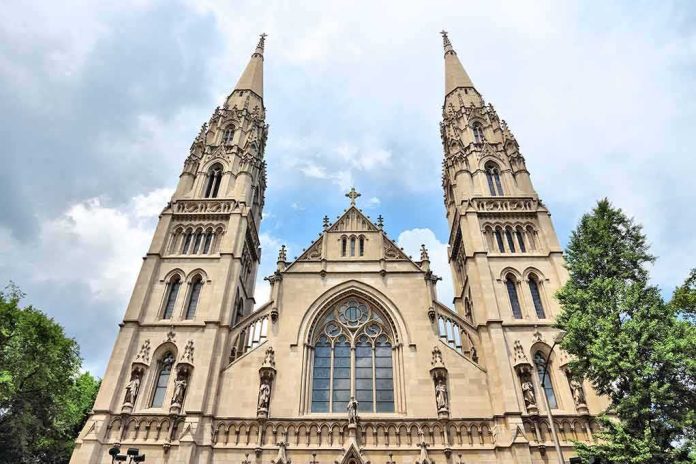
French church leaders say a thief smashed a display, stole a Saint Nicholas bone fragment, and confessed to burning and crushing it.
Story Highlights
- Parish condemned the act as an attack on faith and history.
- Police identified a suspect on security video; reports say he admitted destroying the relic.
- The glass case at the Basilica of Saint-Nicolas-de-Port was broken during the theft.
- The diocese held a Mass of reparation on November 20, 2026.
What Happened at the Basilica
Parish officials in Lorraine, France reported that a man broke a glass case at the Basilica of Saint-Nicolas-de-Port and stole a small bone fragment attributed to Saint Nicholas. The parish called it a deep attack on history, faith, and generations of pilgrims. The basilica is long linked to public veneration of Saint Nicholas, drawing visitors who honor the fourth-century bishop best known as the model for Santa Claus.
Reports state that police used security footage to identify a suspect. Those accounts say he told investigators that he broke the glass, took the piece, and then burned and crushed it. Police have not publicly released his name. Media outlets describe him as an unidentified man who faces legal proceedings in the region.
How Church Leaders Responded
The Diocese of Nancy and Toul condemned the theft and destruction. Church leaders offered a Mass of reparation at the basilica on November 20, 2026, a traditional response after a desecration. The parish’s public statement stressed that the loss went beyond a heritage item. It framed the act as a wound to local identity and to the devotion of people who have prayed at the site for years.
Coverage cites the suspect’s stated motive as rejecting relics as “fetishism.” That claim tracks with the parish view that the act was intentional and aimed at belief, not just property. While the basilica holds a principal arm-shaped reliquary in its treasury, reports say the stolen fragment was a separate piece that had been accessible for public veneration in a small case.
Why This Matters Beyond One Church
Attacks on sacred objects often carry three layers: a crime scene, debates over authenticity, and a strike at cultural identity. Scholars note that science can test and date remains, but it cannot decide their spiritual meaning for believers. That split helps explain why both police work and religious rites followed this incident. The diocese addressed the spiritual wound while investigators handled the alleged offense.
The facts reported so far are clear on the break-in, the removal, and the church response. Some details remain loose, like the exact date across outlets and the lack of a public name for the suspect. Reports also note there is no lab proof about the fragment’s origin in the coverage. Still, the parish and diocese treated the case as a serious desecration of a revered object and place.
The Broader Civic Angle
People across the political spectrum see a pattern when institutions fail to protect core community symbols. Many feel leaders talk tough but struggle to guard everyday places like churches, schools, and civic halls. This theft speaks to that fear. A small relic in a local basilica mattered to real people. When it was taken and reportedly destroyed, it signaled that basic order and respect can feel out of reach for ordinary citizens.
A man stole and destroyed one of the relics of St. Nicholas of Bari (or Myra), which are kept in the Basilica of Saint Nicolas-de-Port in the Lorraine region of France.
The alleged perpetrator, who was identified through security footage, stated that he stole a bone fragment of… pic.twitter.com/xq010DKabh
— EWTN News (@EWTNews) November 25, 2026
For readers in the United States, the lesson is simple. Protecting cultural and religious heritage is not a left or right issue. It ties to safety, local pride, and the freedom to live out one’s beliefs in peace. Whether you worship in a church, gather in a synagogue, attend a mosque, or visit a veterans’ memorial, the same principle applies: communities need clear security, swift justice, and steady respect for what people hold dear.
Sources:
nypost.com, dnyuz.com, ewtnvatican.com, zenit.org, catholicconnect.in, infovaticana.com, ibtimes.co.uk