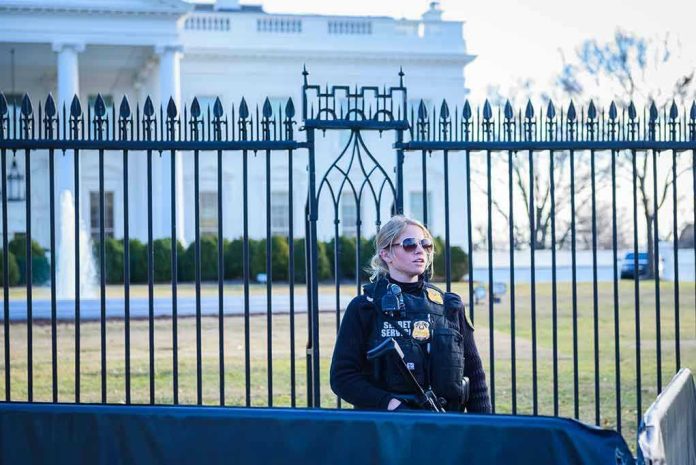
A would-be attacker armed with multiple weapons was stopped outside a White House event, raising fresh questions about perimeter security and the media’s rush to certainty.
Story Highlights
- The United States Secret Service confirmed a shooting near a main screening area; all protectees were safe [1]
- Reports say the suspect ran past barricades before being tackled and taken into custody [2]
- Accounts describe the suspect carrying a shotgun, handgun, and knives, signaling a serious threat [1]
- Conflicting early reports on shots fired and injuries show key facts remain unsettled [3]
Secret Service Confirms Incident And Protectee Safety
The United States Secret Service stated it was investigating a shooting near the main magnetometer screening area tied to the White House Correspondents’ Dinner and confirmed the president, first lady, and all protectees were safe [1]. Officials initiated lockdown procedures while coordinating with the Metropolitan Police Department. The statement emphasized safety over specifics, leaving open questions on sequence, shot count, and intent pending the full investigation. The limited release reflects standard practice during fast-moving protective operations and early evidence gathering [1].
Witness accounts and live coverage described an active security response, with agents ordering people to shelter and locking down parts of the complex while patrolling the grounds [4]. Early on-the-ground reporting conveyed uncertainty about the number of shots and the precise origin of gunfire, underscoring the fluid nature of the event. Estimates ranged widely, illustrating how live audio cues and stress can distort perception before forensic confirmation arrives and incident timelines are finalized [3][4][5].
Suspect’s Movement And Arsenal Indicate Elevated Danger
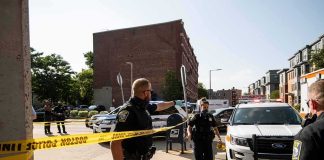
Local reporting said the suspect ran past security barricades as agents moved to intercept, and that he was ultimately tackled and taken into custody before reaching the protected space [2]. Outlets cited law enforcement descriptions of a multi-weapon loadout, including a shotgun, a handgun, and multiple knives, the kind of mix that elevates risk for responders and civilians in a crowded checkpoint environment [1][2]. Those specifics, while still subject to official corroboration, align with protective doctrine that treats multi-weapon threats as high priority interdictions [1][2].
Public summaries identified the suspect as Cole Tomas Allen and reported that authorities believed he intended to target multiple Trump administration officials, though the materials provided do not include a charging document or affidavit substantiating that claim with direct evidence [1]. Without a sworn complaint, manifesto, or device forensics, motive remains unconfirmed. That gap matters because prosecutorial filings and forensic reconstructions typically establish trajectory, target selection, and premeditation, which convert speculation into an evidentiary record [1].
Evacuations, Lockdowns, And Conflicting Early Reports
Reports said President Donald Trump, First Lady Melania Trump, Vice President J. D. Vance, and Cabinet members were evacuated from the venue, a decisive step that indicates an immediate threat assessment by the protective detail [1]. Separate live reporting described a lockdown and orders for personnel to shelter inside, consistent with protocol while agents cleared potential secondary threats [3][4][5]. These actions, while disruptive, reflect conservative first principles of strong security, rapid response, and prioritizing life over optics during unfolding danger [1][3].
Key facts remain unsettled. Accounts vary on how many shots were fired and who was struck, with some reports describing a bystander injury but not confirming whether the round came from the suspect or from return fire [3]. Other reports suggest the suspect fired at least three times toward the White House area, but do not present trajectory analysis or shell-casing matching to verify directionality [3]. Until the after-action review, ballistic reconstruction, and charging language are public, details like first shot, round count, and intent are provisional [1][3].
What Conservatives Should Watch For Next
Transparency now matters as much as speed. The public deserves the Secret Service timeline, radio traffic logs, and use-of-force review, plus the criminal complaint and affidavit that clarify motive, path of travel, and weapon use [1]. Forensic outputs—surveillance video, casing analysis, and wound-path findings—should resolve contested issues that early coverage muddled. Conservatives should insist on facts over narrative, supporting law enforcement’s rapid protection while demanding evidence-based accountability from agencies and media alike [1][2][3][4][5].
Secret Service statement regarding the shooting near the White House: Suspect pulled a weapon and began firing, Secret Service returned fire, suspect later died at the hospital, a bystander was struck by gunfire, no officers were injured. President was at the White House at the… https://t.co/kLpNpnKueW
— Catherine Wen (@CatherineWenNTD) May 24, 2026
Security near the People’s House is nonnegotiable, especially when leaders and families gather. The quick interdiction suggests training worked; the confusion in coverage suggests patience is prudent. Readers should separate confirmed statements from speculation, recognize conflicting early audio estimates, and wait for documents that settle motive and shot direction. That approach protects constitutional order, backs the professionals who stand the watch, and resists media-driven event inflation until the full record is released [1][2][3][4][5].
Sources:
[1] Web – 2026 White House Correspondents’ Dinner shooting – Wikipedia
[2] Web – White House Correspondents’ Association dinner shooting – WHYY
[3] YouTube – Suspect identified in White House Correspondents’ Dinner shooting …
[4] YouTube – White House placed in lockdown after reported gunfire near complex
[5] YouTube – Gunshots heard near White House | 9 News Australia