A federal judge with four decades of experience called President Trump’s attempt to end birthright citizenship the most constitutionally egregious action he’d witnessed in his entire judicial career.
Story Snapshot
- Reagan-appointed Judge John Coughenour blocked Trump’s birthright citizenship executive order in January
- The veteran judge described it as the most unconstitutional action he’d seen in 40+ years on the bench
- The case has reached the Supreme Court for final constitutional determination
- Birthright citizenship stems from the 14th Amendment’s clear constitutional language
A Constitutional Showdown Decades in the Making
Judge John Coughenour has presided over countless constitutional challenges during his tenure on the federal bench since the Reagan era. His judicial experience spans multiple presidential administrations, landmark civil rights cases, and constitutional crises that have tested America’s founding principles. When a judge of his caliber and conservative pedigree issues such a stark constitutional warning, the legal community takes notice.
The executive order in question attempted to redefine who qualifies for automatic citizenship at birth on American soil. This fundamental principle, enshrined in the 14th Amendment since 1868, has anchored American immigration law for over 150 years. The amendment’s language appears deliberately unambiguous: “All persons born or naturalized in the United States, and subject to the jurisdiction thereof, are citizens of the United States.”
The Supreme Court takes up the most unconstitutional thing Trump has done – Vox https://t.co/uFOcT3RtWE
— Susan (@RKGrammy) December 7, 2025
The Constitutional Foundation Under Attack
Birthright citizenship emerged from the Reconstruction era’s determination to ensure that freed slaves and their children could never be denied American citizenship again. The framers of the 14th Amendment crafted language designed to be nearly bulletproof against future political manipulation. They had witnessed how the Dred Scott decision had stripped citizenship from entire populations, and they intended to prevent such constitutional travesties forever.
The Supreme Court has consistently upheld this interpretation across multiple decisions spanning more than a century. In United States v. Wong Kim Ark (1898), the Court definitively established that children born on American soil to non-citizen parents automatically receive citizenship. This precedent has withstood numerous legal challenges and remains one of the most settled areas of constitutional law.
Why This Case Matters Beyond Immigration
Judge Coughenour’s assessment reflects broader concerns about executive overreach and constitutional boundaries. If a president can unilaterally reinterpret clear constitutional text through executive action, the separation of powers framework that protects American democracy faces existential threat. Constitutional amendments require a deliberately difficult process involving congressional supermajorities and state ratification specifically to prevent such arbitrary changes.
The case also highlights fundamental questions about American identity and values. Birthright citizenship has created pathways for millions of Americans whose families built businesses, served in the military, and contributed to their communities for generations. Eliminating this principle would create a complex legal maze determining who qualifies as a “real” American, potentially destabilizing the citizenship status of millions.
The Supreme Court’s Constitutional Responsibility
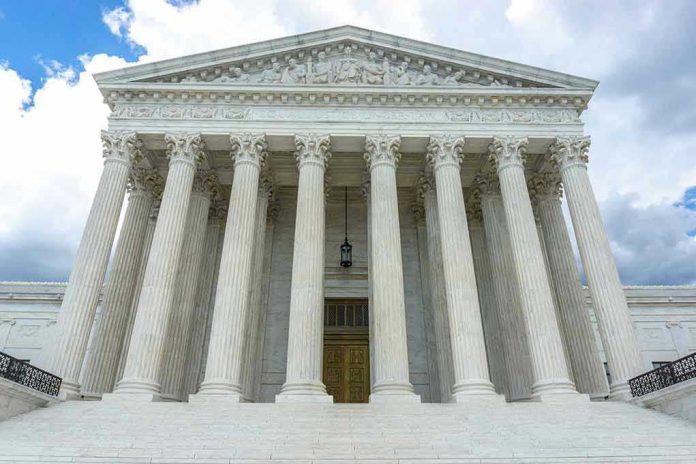
The Supreme Court now faces the responsibility of definitively resolving this constitutional question. The justices must determine whether executive power extends to redefining fundamental constitutional provisions through administrative action. Their decision will establish precedent affecting not only immigration law but the broader relationship between executive authority and constitutional limits.
Conservative constitutional principles traditionally emphasize strict adherence to textual interpretation and originalist methodology. The 14th Amendment’s framers intended birthright citizenship as a permanent constitutional feature, not subject to presidential modification. A Supreme Court decision upholding constitutional text over executive preference would reinforce the rule of law that conservatives have long championed as essential to American governance.
Sources:
U.S. Supreme Court Significantly Limits Restraints on Unconstitutional Presidential Actions