Iran’s foreign minister didn’t just threaten retaliation—he widened the target list to include American troops “hiding” in ordinary places, turning hotels and bases into front-line concepts.
Story Snapshot
- Iranian Foreign Minister Abbas Araghchi signaled Iran is “waiting” for possible US ground troops while warning US personnel in the region remain targetable.
- US strikes under Operation Epic Fury hit missile sites, air defenses, and command-and-control nodes, with US officials describing the campaign as large and ongoing.
- The White House said ground troops are not the current plan, but it refused to rule them out—an ambiguity Iran exploits for psychological leverage.
- US officials justified preemptive action by citing an “imminent” Iranian threat; Iran countered that the US chose a war on Israel’s behalf.
Araghchi’s “Waiting” Line Is a Trap Built From Words
Abbas Araghchi’s message works because it compresses two goals into one sentence: dare Washington to escalate, and warn Americans across the region that nowhere feels fully civilian. His hotel remark aims at the seam between uniformed war and everyday life—exactly where Iran’s playbook thrives. Tehran understands it cannot out-fly the US; it can, however, make every deployment rumor feel like a countdown clock.
That is psychological warfare with a practical edge. If US personnel must treat lobbies, shuttle routes, and temporary quarters as potential target zones, commanders spend energy on force protection instead of operations. Iran also gains propaganda value by portraying US troops as “hiding” rather than staging—language designed to frame America as an occupier-in-waiting, not a retaliatory actor. The purpose isn’t accuracy; it’s to shape what regional audiences believe first.
Operation Epic Fury Signals Deterrence, Not Occupation—So Far
The Trump administration framed the strikes as precision action against capabilities: ballistic missiles, maritime mining capacity, air defenses, and command-and-control. US messaging emphasized protecting American forces, securing commerce near the Strait of Hormuz, and limiting Iran’s pathways to greater regional coercion. The reported scale—nearly 2,000 targets—telegraphs a doctrine of overwhelming pressure without committing to the burdens and risks of marching on Tehran.
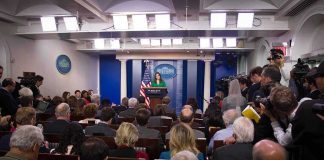
White House Press Secretary Karoline Leavitt’s formulation—ground troops not currently planned but not ruled out—keeps options open, yet it also keeps anxiety open. That ambiguity can deter Iran’s planners, but it can also invite miscalculation if Tehran decides to “preempt the preemption” by hitting US bases or regional assets. Americans over 40 remember how quickly limited missions can grow legs; this is the kind of language that makes voters scan history books.
Two Narratives Collide: “Imminent Threat” Versus “War of Choice”
Secretary of State Marco Rubio justified the strikes by describing an imminent Iranian retaliation threat—an argument built for a world where waiting can cost lives. Araghchi’s rebuttal insisted the US chose conflict for Israel, a line meant to delegitimize American intent and rally sympathetic audiences. The factual dispute matters, but the strategic effect matters more: both sides now claim “self-defense,” which narrows diplomatic space and widens the menu of justifications.
Common sense and conservative values put a premium on protecting American lives and interests, especially when adversaries sponsor proxies and threaten shipping lanes. At the same time, prudence demands clarity about objectives. “Preemptive” can be responsible if evidence is solid and goals stay limited; it becomes reckless when definitions stretch to fit politics. The public should demand a tight chain between threat, target selection, and end state—because vague missions invite endless bills.
Why Iran Talks About Hotels: Asymmetric War Loves Soft Geography
Iran’s conventional forces can suffer badly under US air and naval dominance, so Tehran leans into asymmetric leverage: proxy networks, missile salvos, drones, cyber, and intimidation that forces expensive defensive posture. Targeting rhetoric around hotels, housing, and regional transit corridors widens “soft geography,” the spaces where militaries must still live and move. The goal is to make deterrence feel personal to servicemembers and political to their families.
The United States has seen this movie in different theaters. When adversaries can’t win outright, they try to make the cost of being present feel unpredictable—one attack can produce strategic headlines even if it changes nothing on the battlefield. That is why evacuations and force posture shifts matter as much as strikes: moving 17,500 Americans signals seriousness, but it also signals vulnerability if protection measures lag behind threat messaging.
The Ground-Troops Question: Iran Wants the US to Own the Biggest Risk
Iran’s “waiting” posture works like a rhetorical judo throw. If the US never deploys ground troops, Tehran claims it deterred America. If the US does deploy, Tehran claims it predicted “occupation” and gains a narrative to fuel resistance. Meanwhile, reported leadership losses—most dramatically the claim that Supreme Leader Ayatollah Ali Khamenei was killed—create a volatile environment where succession politics and revenge incentives can overpower restraint.
Americans should watch for one practical indicator: whether Iran shifts from messaging to sustained, coordinated attacks on US bases and logistics hubs. A single strike is theater; a campaign is strategy. The administration’s challenge is to keep military success from turning into strategic sprawl. Conservatives typically support decisive action, but they also expect measurable results and an exit ramp that doesn’t depend on wishful thinking about regime behavior.
What Happens Next Depends on Discipline, Not Rhetoric
US officials described ongoing operations and warned the fight will take time. Iran signaled openness to talks after strikes cease, while simultaneously asserting self-defense against regional US targets. That combination—talks later, pressure now—often means a search for leverage before negotiations. The risk is that both sides chase “one more” advantage, and the advantage becomes a wider war no one scheduled.
https://twitter.com/HumanEvents/status/2029613453623591064
Iran’s hotel talk and America’s ground-troops ambiguity both aim at the same nervous system: public tolerance. The smart play for Washington is to keep objectives narrow, protect US personnel aggressively, and communicate clearly enough to deter without bluffing. The smart play for citizens is to insist on accountability—because once leaders normalize the language of open-ended options, the next “option” has a way of becoming your family’s reality.
Sources:
ABC News – Iran Live Updates: Trump Says Major Combat Operations Have Begun
Fox News – Leavitt Says Ground Troops in Iran Not Currently Being Considered, Doesn’t Rule Out
CBS News – Iran Reaction to Trump 2026 State of the Union Claims About Nuclear Program
Iran International – Iranian Foreign Minister Warns US Soldiers in Regional Hotels Are Targets