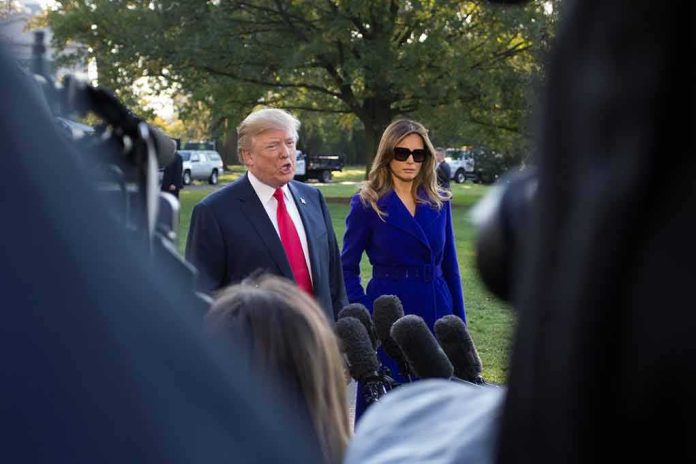
President Trump is warning Iran that any new betrayal or attack could trigger the kind of military response that reminds Americans how easily far‑off decisions can put their lives, and their country’s stability, at risk.
Story Snapshot
- The Justice Department says Iranian-linked operatives plotted political assassinations, including against Trump.
- New Israeli intelligence shared with Washington points to a fresh scheme to kill President Trump.
- Iran’s leaders flatly deny any plan to assassinate Trump, calling U.S. claims malicious and false.
- Trump is tying alleged plots to a “real agreement” with Iran, warning massive force if it is broken.
Justice Department Alleges Iran-Linked Plots Against Trump
The United States Department of Justice has laid out some of the most serious claims yet about Iranian activity targeting American leaders. Prosecutors say Iranian-linked operatives were directed to plan political assassinations on U.S. soil, including against Donald Trump. In one case, federal officials charged Farhad Shakeri, describing him as an asset of Iran’s Islamic Revolutionary Guard Corps. They accuse him of being told to surveil and kill Trump and to present a plan within days or wait until after Election Day if he could not.
A separate case involves Asif Merchant, a Pakistani man who a federal jury convicted of murder for hire and terrorism tied to a foiled assassination plot. The Justice Department said Merchant admitted in court that Iranian Revolutionary Guard contacts sent him to the United States to set up political killings and steal sensitive documents. Reporting from major outlets describes how Merchant met in cheap motels, sketched plans on napkins, and discussed possible targets that included Trump among others. These two cases give American officials criminal-court backing for claims that Tehran’s network reached inside the United States.
Fresh Israeli Intelligence and Trump’s Public Warnings
While those criminal complaints cover earlier plots, U.S. officials now say they are seeing new danger signs. Israel shared updated intelligence with Washington that Iran had recently built a new plan to assassinate President Trump. According to reporting, this information came as a ceasefire in the Iran war was under strain, and it pushed the United States Secret Service and other agencies to reevaluate Trump’s security. Some sources described a steady stream of signals about possible assassination efforts, even before the Israeli warning arrived.
President Trump has not kept his feelings about these reports hidden. In public comments, he said he has “been on their list for a long time” and claimed he left instructions to strike Iran hard if he is ever assassinated. He has also used the alleged plots to frame his demands in the ongoing Iran conflict. Trump says U.S. military forces will stay near Iran until a “real agreement” is fully honored and warns that any violation would lead to a response “bigger, better, stronger than anyone has ever seen.” To many citizens, that sounds like yet another high-risk showdown managed by leaders they no longer trust.
Iran’s Flat Denials and the Fog Around the “Broken Agreement”
Iran’s government rejects all of this. Iranian President Masoud Pezeshkian told NBC News his country has “never” plotted to kill Donald Trump and said the claims are just another tactic to stir up fear of Iran. The Iranian foreign ministry’s spokesperson also called the assassination accusations “malicious” and denied any role in armed attacks on Trump. Iranian officials insist there is no secret kill order and argue Washington is using scary stories to justify pressure, sanctions, and military threats that harm ordinary people on both sides.
The public record still leaves big gaps, especially in Trump’s talk of a “broken military agreement.” He has warned that Iran will face massive strikes if it breaks what he calls the real deal, and he has tied that warning to the alleged assassination threats. Yet no public document clearly shows the exact terms of this agreement or how Iran is said to have violated it. Much of the evidence behind both the alleged plots and the war decisions remains locked inside classified files, secret court exhibits, and internal orders. That makes it hard for regular Americans to judge who is telling the fuller truth and who is gaming the crisis.
Shared Public Frustration With Power, Secrecy, and Risk
These events feed a broader anger that now runs through both right and left. Many conservatives see another example of a hostile regime testing American weakness after years of globalist deals and failed deterrence. Many liberals see yet another cycle where shadowy intelligence claims and hard-line threats risk dragging the country into endless war while the gap between rich and poor grows wider. Both sides notice that the people making life-and-death choices are insulated elites who never seem to pay the price for failure.
Here, the pattern is familiar. Secret services receive warnings from unnamed sources. Prosecutors file limited public complaints. Presidents issue social media threats about wiping out a civilization or taking a country back to the “Stone Ages.” Iran answers with flat denials. Meanwhile, families at home worry about inflation, debt, and whether their kids will ever own a home. When leaders talk about bombing nations “in one night” or “finishing the job” if talks fail, it can sound less like sober defense and more like a dangerous game played above the heads of citizens who just want a fair shot at the American Dream.
Sources:
nytimes.com, politico.com, justice.gov, youtube.com, aljazeera.com, cbsnews.com, wsj.com, iranintl.com, fox32chicago.com