Debates over “inculturation” almost always turn on the same hinge: when do cultural symbols enrich Christian worship, and when do they cross into religious double-speak that confuses the object of adoration? The Pucallpa episode in Peru—where a welcome hymn invoking “mothers of the forest and the water” reportedly opened a papal Mass—lands squarely on that hinge, not because the Church lacks teaching on inculturation, but because the facts that would decisively classify the song as cultural metaphor or religious invocation remain fragmentary.
At a Glance
- The event intertwined Amazonian cultural elements with a papal Eucharistic celebration in Pucallpa, Peru.
- Organizers described the goal as evangelization through local symbols, not equivalence with indigenous religion.
- Critics cite lyrics referencing “mothers of the forest and water” and the composer’s reported ayahuasca experiences as evidence of syncretism.
- Key uncertainties remain: full official lyrics, an authenticated recording, and competent approvals for the hymn are not in evidence.
What’s established and what is not
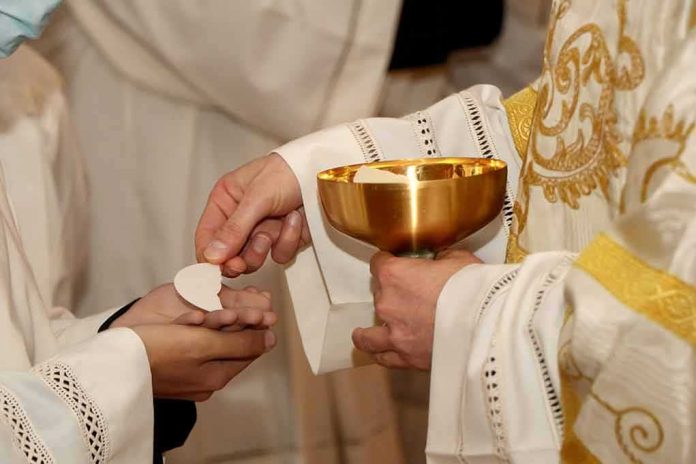
Two clusters of facts are well supported. First, the Pucallpa papal liturgy intentionally integrated regional motifs. Organizers anticipated a chalice shaped like a traditional Amazonian vessel, a river-evoking paten, and vestments inspired by Shipibo art—choices presented as signs that allow local identity to converse with the Gospel, not supplant it. Local and Vatican-linked coverage also documented traditional dances and songs accompanying the papal encounter. Second, the Pope himself framed the Amazon visit around respect for ancestral knowledge integrated with a life shaped by the Gospel, underscoring education in indigenous languages and an evangelizing model that is culturally attentive yet Christocentric.
The contested point is narrower and rests heavily on an adversarial account. LifeSiteNews published a translation of a welcome hymn—reportedly sung as the Pope entered for the November 15 Mass in Pucallpa—containing the line, “Mothers of the forest and the water, care for the young and the old, so that our face may not be forgotten,” and identified the composer as a priest who has described participating in ayahuasca sessions. What the record does not yet supply is the complete official text, authenticated audio or score, or an independent translation vetted by organizers or diocesan authorities; nor does it show a direct organizer explanation of the disputed terms within the hymn itself.
How Catholic inculturation is supposed to work
Inculturation is not a mood or a license; it is a disciplined theological project in which the Gospel takes flesh within a culture by purifying, elevating, and fulfilling its meanings. That framework is explicit in modern magisterial documents and in missionary practice in the Amazon. In Pucallpa, the general coordinator spoke in just those categories: Shipibo kené patterns can “enter into dialogue” with the Christian cross without being assigned the same meaning, and the point of the signs was to manifest history, culture, and spirituality, not to decorate an otherwise imported rite. The stated aim—“that the Gospel bear fruit within their culture, not outside it”—echoes decades of teaching that Christian liturgy may adopt local forms provided those forms are reinterpreted within the Church’s faith and do not imply worship of another power.
Practically, this is why the same material object can function differently in two settings: a river motif on a paten can signify baptismal life and the local watershed rather than an indigenous water deity; a textile pattern can symbolize communal memory, not a pantheon. The theological test is not the artifact’s pre-Christian origin but its liturgical signification here and now, governed by the Church’s prayer and the celebrant’s intention.
Where the real dispute lies: the hymn’s language and authorship
The strongest specific criticism zeroes in on words. If a text within the liturgical action appears to ascribe maternal guardianship to spirits of forest and water, that invites a responsible question: were these terms deployed as poetic personifications of creation under God—or as invocations of autonomous spiritual beings? On this point, we lack the primary sources that would resolve ambiguity: a complete approved text, a definitive translation that preserves local nuance, and an organizer’s gloss on contested terms. Without those, the argument risks being adjudicated by inference from the composer’s reported personal experiments with ayahuasca—a biographical datum relevant to prudence, not a substitute for textual evidence of the hymn’s meaning.
By contrast, the organizers’ on-record rationale for Amazonian elements is consistent: cultural forms in service of the Gospel, not parallel worship; dialogue, not syncretism; and sacramental signs shaped to local identity without altering the Eucharistic substance. That rationale aligns with how the gathering was presented in mainstream and Vatican coverage: as a papal encounter where indigenous dances and songs formed part of the welcome and context.
Liturgical boundaries that actually protect clarity
Several bright lines guard against confusion. The Church’s liturgical law fixes the structure and essential texts of the Mass—readings, Eucharistic Prayer, consecratory formula, and sacramental matter—while allowing inculturated options at prescribed points. The material record supplied here does not allege any alteration to those essentials; rather, it concerns a processional welcome and the symbolic design of vessels and vestments. That distinction matters: a problematic welcome song, if such it proved to be, would not by itself invalidate the Eucharist. It could, however, sow symbolic noise that pastors rightly seek to avoid.
The Amazon is not the first arena where that line has been hard to police in real time. The 2019 “Pachamama” dispute taught a durable lesson: when a symbol carries contested meanings across audiences, failing to explain it promptly cedes the interpretive field to those most motivated to define it.
What would settle the question—and how to reason in the meantime
Three items would move discussion from conjecture to conclusion. First, the official lyric, score, and broadcast audio from the Pucallpa entrance, with a certified translation by a linguist in the relevant Amazonian language families. Second, documented review and approval by competent liturgical authority—who signed off, on what basis, and with what theological reading of the contested terms. Third, an organizer’s or composer’s explanatory note that makes explicit whether the “mothers” language is metaphorical, catechetically reframed, or devotional in a sense incompatible with the Mass. Those documents exist or can be requested; until they surface, claims of either outright pagan invocation or pristine inculturation overrun the evidence.
Reasoned judgment, then, looks like this. The Church’s stated aim in Pucallpa was orthodox inculturation in continuity with magisterial teaching; public coverage and the Pope’s own words support that frame. The most pointed allegation—a text invoking forest and water “mothers”—remains insufficiently documented to anchor a verdict; its plausibility turns on unresolved questions of language, context, and approval. The right instinct is neither to baptize every indigenous term by fiat nor to anathematize every local metaphor; it is to demand the primary sources and apply the Church’s criteria for symbols inside the liturgy.
The enduring lesson for pastors and planners
Inculturation succeeds when sign and meaning travel together. In a global, hyper-mediated Church, any ambiguous sign will be interpreted at scale, often by audiences far from its original context. The pastoral task is not to retreat from local expression but to front-load catechesis: tell people what a sign now means in Christ; tell them what it does not mean; and choose texts and symbols whose theological valence can bear that weight. Where Pucallpa did that with vessels, vestments, and setting, the record is coherent; where it did not do so explicitly with a contested hymn text, the vacuum created the controversy. That, at least, is clear—and fixable.
Sources:
lifesitenews.com, fides.org, thelettersfromleo.com, vatican.va