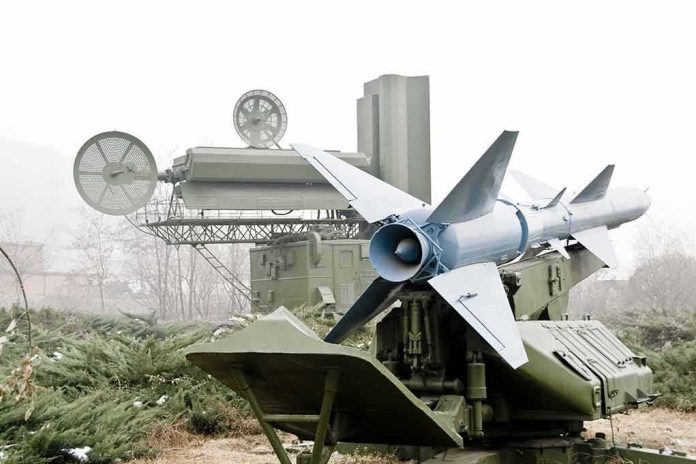
Arms control collapses the way bridges do: slowly, then all at once. The Intermediate-Range Nuclear Forces (INF) Treaty held back an entire class of ground-launched missiles for three decades; Russia’s deployment of the 9M729 broke that dam, Washington exited the pact under its own legal terms, and the U.S. Army moved quickly to field Typhon — a road-mobile launcher restoring ranges the treaty had prohibited. The result is not a return to the 1980s but a new competition shaped by precision, mobility, and politics.
At a Glance
- U.S. and NATO judged Russia in material breach of the INF Treaty over the 9M729, prompting U.S. suspension and withdrawal under Article XV in 2019.
- With the ban gone, the U.S. Army fielded Typhon (Mid-Range Capability), a mobile launcher firing Tomahawk and SM-6 to restore the 500–1,600+ km envelope.
- Moscow denied any INF violation, claiming the 9M729 stayed within 500 km and was tested/configured accordingly — a stance allies found not credible.
- Typhon anchors a broader shift: allied basing and European/Indo-Pacific integration of land-based long-range fires after the INF regime’s demise.
How the INF unraveled — and why that matters
The INF Treaty, signed in 1987, eliminated all U.S. and Soviet ground-launched ballistic and cruise missiles with ranges between 500 and 5,500 kilometers. It worked — thousands of missiles were destroyed and Europe’s most destabilizing flight times disappeared. Starting in 2014, the United States publicly assessed that Russia had violated the treaty by developing and fielding a ground-launched cruise missile of prohibited range, known in NATO nomenclature as the SSC-8 and by Russia as the 9M729. After several rounds of allied diplomacy and a final compliance window failed, Washington suspended its obligations in February 2019 and, following the treaty’s terms, withdrew six months later citing Russia’s continuing noncompliance. NATO aligned with that judgment, stating Moscow had not provided credible answers nor taken steps toward compliance.
Russia countered that the 9M729 never exceeded the 500-kilometer ceiling and had not been tested at banned ranges; officials publicly displayed the missile and framed it as an upgrade to a permitted system rather than a prohibited new one. Western allies were unpersuaded. U.S. intelligence leaders detailed a years-long pattern: denial, requests for more information, and counter-accusations — particularly over U.S. missile defense — without verifiable steps to cure the breach. In arms control, disputes rarely end with a smoking-gun blueprint on the public record; they end politically after allies weigh the totality of behavior. That happened here.
From treaty vacuum to fielded capability: Typhon’s design logic
Once Washington left the INF regime, the Army moved to close a hard operational gap: ranges between the evolving Precision Strike Missile and the developmental hypersonic weapon. The answer was not to invent new munitions but to mobilize existing naval weapons on land. Typhon — the Mid-Range Capability — adapts the Navy’s combat-proven Mk 41 vertical launch system and Aegis fire control into a road-mobile package with an operations center and multiple four-cell launchers. The missile menu is deliberate. Tomahawk provides long-range, precise land-attack strike into the low thousands of kilometers depending on variant, while SM-6 adds a versatile, fast missile that can prosecute high-end air threats and, in specific modes, surface ships at theater distances — turning Army units into consequential maritime actors from shore.
This is not nostalgia for Pershing-era hair-trigger postures. It is a multi-domain design shaped by modern sensors, distributed kill chains, and allied geography. Mobility raises survivability; conventional payloads and precision narrow effects to the target set that matters — air bases, integrated air defense nodes, command-and-control, and key maritime assets. In the Indo-Pacific, a mobile, land-based launcher sited with willing partners can complicate an adversary’s anti-access/area denial architecture. In Europe, it reintroduces a ground-based strike option that does not depend on scarce aircraft or risk pilots in contested skies. Conceptually, Typhon is a logistics problem for adversaries and an options generator for commanders.
The dispute over 9M729: what was claimed and what held up
Moscow’s core claim was simple: the 9M729 complied — range under 500 km; test history configured to stay within INF limits; missile-defense basing by the United States was the real violation. Russian officials even argued fueling procedures bounded performance. Washington and allies saw a different pattern: a ground-launched cruise missile with INF-range capability fielded to operational units, with allied consultations across several years and a public intelligence case to partners; Russia denied, obfuscated, and then acknowledged the system while maintaining compliance rhetoric. On balance of evidence — and this is the standard that matters in alliance politics — the Russian position did not carry the burden of proof it claimed.
Two lessons endure. First, verification frays when transparency and inspections atrophy; by the time disputes emerge, parties revert to political judgments backed by classified data their publics cannot see. Second, even a successful treaty cannot withstand sustained noncompliance claims without a viable pathway back to confidence. The United States followed the withdrawal clause rather than detonating the pact extralegally; Russia matched the exit rhetorically and moved on. The category was unbanned; strategy filled the vacuum.
Where Typhon fits in the U.S. and allied order of battle
Typhon is one strand of a broader Long-Range Precision Fires modernization weaving together PrSM at one end and hypersonic strike at the other, with Typhon bridging the theater mid-range band. The architecture is not America-only. Partners are moving: some in Europe are procuring Tomahawk and considering or acquiring ground-based launchers; in the Indo-Pacific, rotational presence and exercises have already demonstrated how land-based fires plug into maritime operations. An Army system that can hold coastal infrastructure, airfields, and naval units at risk from dispersed land positions gives joint force commanders a lever that is hard to counter economically: it forces an adversary to defend more coastline, disperse air power, and allocate limited ISR and strike assets to hunt mobile launchers that can shoot-and-scoot.
The political economy is equally important. Land basing spreads costs and sovereignty: host nations control where systems go and what they do, while still deterring by presence. That was one of INF’s lasting effects — it removed the class of weapons that created acute basing politics; its demise reopens those debates, but with more nuance. Today’s systems are conventionally armed, more precise, and integrated into alliance command structures. The escalatory ladder is still there; the rungs are narrower.
What this means for deterrence — and for the next treaty
Deterrence is always a conversation about capability, credibility, and cost. Russia’s 9M729 decision signaled it would accept the risks of undermining a signature Cold War accord to gain an operational advantage. The U.S. response — legally exit, rapidly field an answer, align allies — restored a balance of capability in the mid-range band. Whether that ends the conversation or merely resets it depends on two things. First, whether adversaries conclude that ground-based conventional strike from allied soil is here to stay and must be factored into their planning. Second, whether policymakers can craft a successor framework that acknowledges new realities: multi-domain systems, dual-capable missiles, ambiguous launchers, and the verification challenges of mobile platforms.
The next durable agreement, if one emerges, will not look like INF. It will have to grapple with sea- and air-launched systems, with dual-use technologies that blur nuclear and conventional lines, and with regional dynamics that were peripheral in 1987 but central now. Until then, strategy abhors a vacuum. Typhon is the material expression of that truth — a system born from a treaty’s failure, optimized for the geometry of today’s theaters, and calibrated to restore a deterrent gap that politics had reopened.
Sources:
19fortyfive.com, 2017-2021.state.gov, armscontrol.org, war.gov, commonslibrary.parliament.uk, congress.gov, voanews.com, nato.int, dni.gov, battlepolicy.com