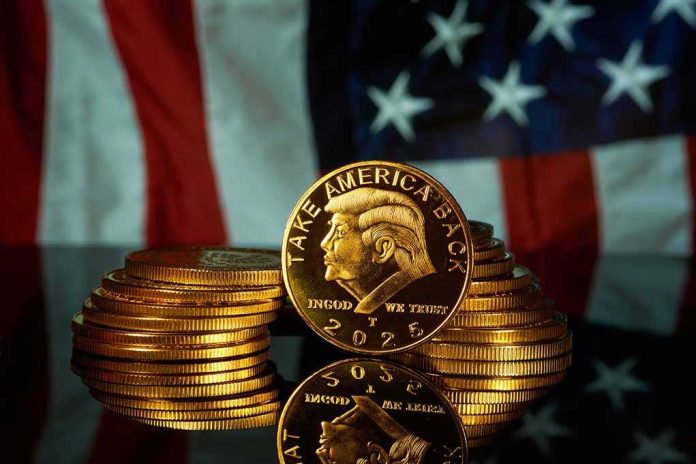
For the first time in a century, a sitting U.S. president’s face is on American money that people can spend.
Quick Take
- The U.S. Mint began selling gold-colored $1 coins featuring President Trump’s face at noon, tied to America’s 250th birthday.
- Treasury Secretary Scott Bessent announced the coin in July, and it went into production soon after.
- Trump is the first sitting president shown on U.S. coinage in about 100 years, since a 1926 coin featured President Calvin Coolidge.
- A 2020 law created special rules for this anniversary coin that legal experts say allowed Trump’s portrait on the front, even though older laws ban living people on money.
Coin Goes On Sale For America’s 250th Birthday
The U.S. Mint released 250,000 of the $1 coins, calling them a way to honor “250 years of great American heritage”. The coins carry a gold finish and show a portrait of Trump designed by U.S. Mint Chief Engraver Joseph Menna. The design also includes the words “Liberty,” “In God We Trust” and the years “1776” and “2026” marking the anniversary.
Treasury Secretary Scott Bessent unveiled the coin’s design in mid-July and said the Mint would begin striking it right away. He called it “a tribute to the nation’s 250th anniversary”. The coin is not going into everyday circulation. The Mint says people can still spend it like normal money if they choose to, even though it’s mainly sold as a collectible.
First Sitting President On U.S. Money In A Century
Putting a sitting president’s face on money breaks a long tradition. The last time a sitting president appeared on U.S. coinage was 1926, when a half-dollar coin marking the country’s 150th birthday featured Calvin Coolidge. Before that, Alabama Governor Thomas Kilby appeared on a 1921 coin, making him the first living person ever pictured on U.S. money. Both cases involved special anniversary coins, not everyday currency.
An 1866 federal law bans images of living people on U.S. currency. But that law applies specifically to paper money made by the Bureau of Engraving and Printing, not to coins. A separate 2005 law about presidential dollar coins does ban living presidents from appearing on that specific coin series. Congress passed a different law in 2020 that made room for this year’s anniversary coins under their own set of rules.
Legal Debate Over Rules For The Coin
That 2020 law says a living person’s portrait cannot appear on the back of the 250th anniversary coin, but it does not say the same thing about the front, where Trump’s face appears. Some legal experts argue this is a loophole that lets the coin follow the letter of the law while breaking from long-standing tradition. Public radio reporting on the coin noted that experts see it as both breaking from custom and testing the edges of what current law actually allows.
A separate bill in Congress, introduced after the coin’s announcement, would ban any living president’s image from appearing on future coins or currency. That bill has not become law. Meanwhile, a federal commission made up entirely of Trump-appointed members voted to approve a related 24-karat gold coin also featuring Trump’s image for the anniversary.
The Trump administration’s new $1 coin is officially here as part of America’s 250th-anniversary celebrations. The Mint says the coin is authorized under the 2020 legislation governing the Semiquincentennial program, with Trump’s portrait on the front and the Presidential Seal on… pic.twitter.com/qHghgJl3JT
— OGM News (@OGM_News) September 3, 2026
Collectors moved fast once sales opened. Reports describe the coin selling out quickly online as buyers rushed to add it to collections tied to the anniversary. A 25-coin roll sells for $61 through the Mint’s official channels. The Mint has said the coin is scheduled to keep shipping into the fall as part of its broader lineup of 250th anniversary coins and medals.
Sources:
youtube.com, thehill.com, npr.org, apnews.com, investor.wedbush.com, reuters.com, govinfo.gov, washingtonpost.com, msn.com, nbcnews.com, usmint.gov