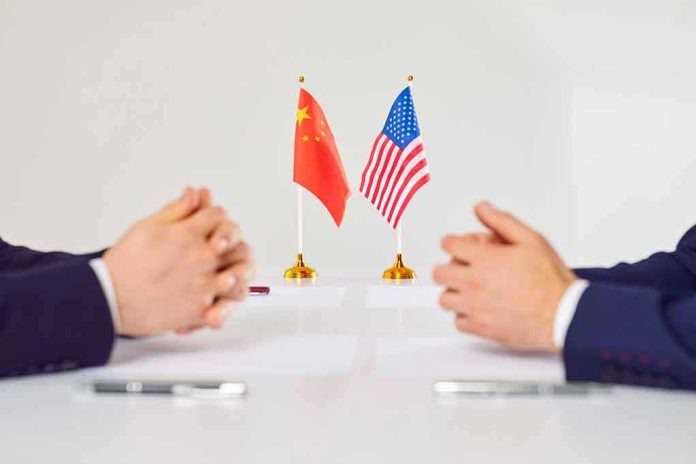
Washington and Beijing quietly moved the trade cliff two months down the road, extending the “Busan Agreement” ceasefire to January 10.
Story Highlights
- Treasury Secretary Scott Bessent said the United States and China agreed to extend the Busan Agreement through January 10.
- The extension preserves a tariff and critical-minerals truce set to lapse in November.
- Officials say the extra time aims at talks on a broader economic package.
- The move fits a pattern of short truces that calm markets but leave core disputes unresolved.
What Was Extended And Why It Matters
U.S. Treasury Secretary Scott Bessent said the United States and China agreed to extend the “Busan Agreement” until January 10. He described it as an economic détente that pauses new tariffs and certain critical-minerals steps while talks continue. The truce had been set to expire November 10, which risked a snap-back in trade pressure near year end. Bessent said the added time could support a “bigger deal” effort, but he did not outline specific concessions or deadlines.
The extension lands as President Trump hosts China’s leader for high-stakes talks in Washington. The schedule gives both sides breathing room through the holidays. Markets often react to these pauses because they lower near-term risk for shippers, manufacturers, and retailers. The trade channel shapes prices that families pay for many goods. A short extension does not end the rivalry, but it reduces the chance of sudden cost spikes that can hit paychecks and small businesses.
What The Busan Agreement Covers And What It Does Not
The détente has centered on tariffs and sensitive sectors like rare earths, where new limits could disrupt tech, autos, and defense supplies. The pause also lowers the temperature around export controls and licensing, which have snarled chip and software flows. But the truce does not settle long-running disputes over subsidies, data rules, and market access. Those issues remain hard. They would likely require detailed talks across many agencies and industries before any lasting change.
Bessent’s remarks echo recent cycles where Washington and Beijing used short extensions to steady nerves while talks continued. Analysts say these moves are tactical. They keep leverage on both sides and avoid a sudden shock to trade. That pattern showed up in earlier ninety-day pauses and rollovers in 2025 and 2026. Each time, the near-term threat eased, but the core arguments carried forward to the next deadline.
What To Watch Before January 10
Officials framed this as time to test a broader package, not a guarantee of one. Watch for signs of working groups on tariffs, rare earth supplies, and export rules. Any joint statements that name sectors, timelines, or verification steps would be meaningful. If none appear, the extension may serve mainly as a market pressure valve. Business groups will seek clarity on planning windows, because production and shipping plans for early 2026 are already in motion.
🔴 Trump, Xi extend US-China trade truce to January 2; Lai release pressed
US Treasury Secretary Scott Bessent announced the US and China agreed to extend their trade truce by two months, pushing the deadline from November 10 to January 2. "We have agreed today that we will… pic.twitter.com/APcAiqjuT6
— NewsTongue (@NewsTongueX) September 24, 2026
For everyday Americans, the stakes are simple. A calm trade channel helps keep shelves stocked and prices steadier. A breakdown risks higher costs and fresh strain on supply chains. Many on the right and left worry that elites play brinkmanship while families absorb the fallout. This move buys time to avoid self-inflicted shocks. It also reminds us that short deals are no substitute for hard fixes. Voters will judge whether leaders use these weeks to deliver practical gains, not just headlines.
Sources:
foxnews.com, newsbreak.com, firstpost.com, reuters.com, commbank.com.au, bloomberg.com