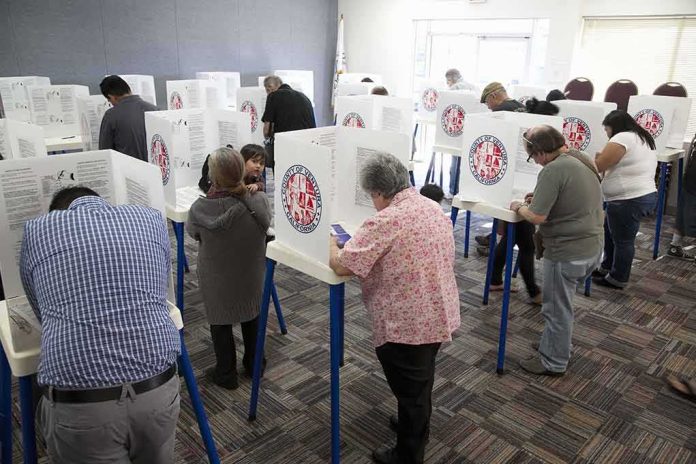
The heart of this case is not a mystery about “stolen elections” but a straightforward question the law answers with precision: where you live determines where you may register, run, and vote. A San Luis Obispo County jury found that Gaea Edde Powell answered that question falsely—repeatedly—and convicted her on nine counts of election fraud spanning two election cycles.
At a Glance
- A San Luis Obispo County jury convicted Gaea Edde Powell on nine counts tied to the 2022 and 2024 Arroyo Grande mayoral cycles, including voter registration fraud, perjury by declaration, false nomination papers, Political Reform Act violations, and fraudulent voting.
- Prosecutors established a pattern: multiple filings and three separate elections in which Powell voted while asserting an ineligible residence inside city limits.
- The trial ran ten days and ended with guilty verdicts on all counts; local outlets report Powell represented herself at trial.
- Residency-based election cases are rare but consequential; they turn on whether a claimed address is a bona fide domicile, not on broad national narratives about voter fraud.
What the jury decided and why it matters
After a ten-day trial, jurors convicted Powell on nine charges that collectively describe a single through-line: she anchored her candidacy and her voting eligibility to an Arroyo Grande condominium address while, according to the prosecution’s evidence and the jury’s verdict, she actually lived outside the city. The district attorney’s office identifies the counts as including voter registration fraud, perjury by declaration, filing false nomination or declaration papers, failure to provide written notification required by the Political Reform Act, and fraudulent voting in three elections across 2022 and 2024. The verdict covers discrete acts on specific dates—July and August filings in 2022 and 2024, and voting on November 8, 2022; March 5, 2024; and November 5, 2024—underscoring repeated conduct rather than a single paperwork mistake.
The case significance is twofold. Locally, it vindicates the simple principle that officeholders and voters must share a real civic community with those they seek to represent; residency is not a box to be gamed. More broadly, it illustrates how “election fraud” prosecutions, when they occur, commonly involve residency, registration, and filing misstatements—not the cinematic impersonation scenarios that crowd the imagination. Labeling matters; the counts here were technical but not trivial. Jurors confronted a documentary record of addresses, filings, and ballots, and concluded—beyond a reasonable doubt—that the rules were knowingly broken.
https://www.youtube.com/watch?v=NZ_vKoJmapc
How residency rules function in candidacy and voting
California election administration, like most states, grounds eligibility in domicile: your true, fixed, and permanent home—the place you intend to return to when you’re away. That definition carries into three gates that must align: where you register to vote, where you may run for office with geographic residency requirements, and where you cast your ballot. When a candidate claims an in-city address that is not their domicile and signs filings under penalty of perjury, two things happen. First, the candidacy becomes ineligible. Second, if the person also registers and votes using that address, they convert a misrepresentation into unlawful ballots cast in the wrong jurisdiction. Prosecutors in this case alleged exactly that pattern; the jury agreed, count by count.
These cases typically rise or fall on prosaic proof: lease terms, utility records, driver’s license and tax addresses, occupancy testimony, and the physical realities of daily living. Courts are sensitive to edge cases—students, military families, people in transition—but they expect coherence: evidence of actual habitation, not occasional stays or mail drops. The prosecution’s theory here focused on a condominium on James Way in Arroyo Grande; reporting indicates the jury accepted that Powell did not in fact live there as her domicile during the relevant periods.
The conduct the verdict covers: repeated acts across two cycles
The count structure itself tells the story. Jurors convicted Powell of false statements on nomination papers and declarations, which are sworn filings that anchor a candidacy to a jurisdiction; of voter registration fraud, which keys on knowingly listing a false residence; of a Political Reform Act notification failure, a compliance obligation that tracks campaign activity; and of fraudulent voting in three separate elections—a general election in 2022 and two elections in 2024. The dates captured by the verdict map to filings and balloting windows, corroborating the pattern rather than a one-off irregularity. Local coverage described the prosecution’s through-line in just those terms, and the district attorney’s announcement confirms the specific counts and dates.
One detail that will interest court-watchers: Powell reportedly represented herself at trial. Pro se defenses can be challenging in complex documentary cases; the record nevertheless shows the state met its burden, securing unanimous guilty verdicts on all nine counts after ten days of testimony and deliberations concluding September 21, 2026.
What this case is—and is not—in the larger fraud debate
Election fraud prosecutions attract outsized attention because they are uncommon and politically charged. The temptation is to generalize from a single local case to sweeping claims about systemic integrity. The empirical record argues against that inference. Across decades of study and nationwide data, documented instances of illegal voting are consistently found to be exceedingly rare—measured in fractions of a percent—while the subset that proceeds to prosecution is smaller still. In other words, the Powell case is notable precisely because it is unusual; rarity does not minimize culpability in a specific case, but it does set the right scale for public conclusions.
Residency controversies also differ from fraud tropes about impersonation at the polls. They pivot on domicile—a legal concept that can be fact-intensive but is not amorphous. Courts, including in recent high-profile ballot-access decisions, have emphasized that “using a friend’s address” or maintaining only a paper presence does not establish residency for election law purposes. Where a person actually lives and intends to remain is the touchstone, and sworn filings that diverge from that reality carry legal risk. The jury’s verdict signals that the state carried that burden here.
🚨🚨 BREAKING NEWS 🚨🚨
ANOTHER ELECTION FRAUD CONVICTION IN CALIFORNIA.
Former Arroyo Grande mayoral candidate Gaea Powell has been convicted on NINE election-related counts — eight felonies and one misdemeanor — including fraudulent voting in three separate elections.
And… pic.twitter.com/wMTcSn5bnE
— Mike Netter (@nettermike) September 23, 2026
Sentencing, appeals, and what to watch next
With convictions on nine counts—described by authorities as eight felonies and one misdemeanor—the case now moves to sentencing. Local reporting has referenced potential exposure measured in years, typical for felony perjury and registration-fraud counts compounded across multiple acts. Post-verdict, defendants commonly pursue appellate relief challenging evidentiary rulings or jury instructions; if Powell appeals, the briefs will sharpen which facts the parties view as dispositive and whether any procedural issues are preserved for review. Those filings, along with the jury’s verdict form and the court’s minute orders, will fix in the public record the exact elements satisfied for each count.
Bottom line
Elections run on residency, not vibes. Over two cycles, Powell signed the forms and cast the ballots that tied her political ambitions to an address the jury concluded was not her domicile. The law treats that as fraud because representation depends on real community membership. The verdict affirms that principle—and reminds the rest of us that while election fraud is rare, the rules that prevent it are specific, enforceable, and taken seriously.
Sources:
feedpress.me, calcoastnews.com, ksby.com, sanluisobispo.com, yahoo.com, slocounty.ca.gov, ground.news