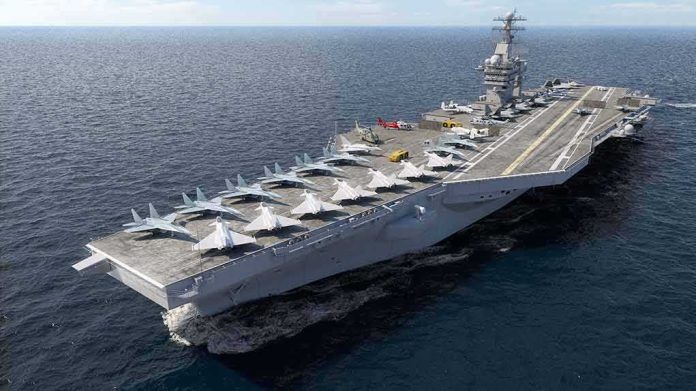
The modern U.S. carrier force is built to surge, not to live at surge—and when it does, the human bill comes due first for the sailors and families who keep those ships fighting.
The Short Version
- The USS Abraham Lincoln’s cruise stretched into a tenth month, with the Navy acknowledging an extension driven by mission demand.
- Official figures point to an exceptionally heavy combat tempo: 266 days deployed, roughly 200 in a combat zone, 10,000-plus sorties, and 1.5 million pounds of ordnance.
- Multiple overboard attempts and suicide attempts in the strike group were confirmed by the Navy, even as leaders disputed a spike linked to shipboard conditions.
- This case fits a long-running pattern: carriers repeatedly exceed the service’s preferred seven-month model as operational demand outruns the maintenance-and-training cycle.
What an extended carrier deployment actually means on the deck plates
Long deployments are not abstractions; they are schedules, watch bills, and maintenance cards stretched past their design points. The Navy publicly celebrated the Lincoln’s combat output—266 days deployed, about 200 in a combat zone, 10,000-plus sorties, and 1.5 million pounds of ordnance—while emphasizing the deployment was part of a planned rotation and that safety remained paramount. Leaders later conceded the obvious operational truth: the cruise was extended because the mission demanded it. That combination—mission-driven necessity paired with prolonged tempo—captures the operational reality of a carrier at sustained surge. Air wings consume parts and crew hours faster; engineering plants and catapults need more care, not less; and sailors’ margin for rest, medical appointments, and family contact narrows just when stress runs hottest.
These pressures do not make a ship unsafe by definition; a well-led carrier can execute hard missions for a long time. But the risks compound. A strike group is a system of systems, and fatigue is a system-wide input. The Navy’s own doctrinal descriptions of carrier strike groups—forward presence, deterrence, sea control, power projection—presume periodic reset in maintenance and training phases; the model is not intended to be run continuously at peak load. When it is, readiness can stay high for a period, but the human and material accounts draw down in tandem.
The lived experience: distress signals and the limits of reassurance
Across months seven through ten, reporting captured the strain on the Lincoln’s crew and families: accounts of overboard attempts, worries about mental health, and allegations of degraded shipboard conditions such as intermittent water and plumbing issues. Some claims relied on relatives and unnamed officials, which makes causal diagnosis difficult. But not everything is anecdotal. The Navy itself later confirmed eight suicide attempts within the strike group during the deployment period—one sailor went overboard in early August and another was stopped in March—while maintaining that command data did not show an increase in suicidal ideation aboard the carrier itself. Both things can be true: a commander can report no statistically significant spike on one hull while the wider formation experiences multiple acute incidents. Either way, the signal for leaders is the same—tempo and exposure in a combat zone are stressing the force.
The Navy’s messaging struck a careful balance: acknowledge strain on sailors and families; insist that health and wellbeing remain priorities; and defend the deployment as mission-driven with onboard counseling and medical support available. That is institutionally coherent. It is not, however, the same as saying the tempo is sustainable. In the absence of released command investigations or comprehensive medical data, the cleanest, uncontested facts remain the deployment’s length and intensity—and the Navy’s own admission that the mission required the extension.
How we got here: a pattern of demand outpacing the reset cycle
To understand why carriers “never come home,” start with the Navy’s modern readiness architecture. Over the last decade, the service has tried to discipline rotations through the Optimized Fleet Response Plan (a roughly 36‑month maintenance–training–deployment cycle) built around about seven months on deployment. In practice, global events repeatedly punch holes in that design. GAO and naval analysts have documented that extended deployments compress training and maintenance phases, shifting risk forward and eroding the buffer that keeps ships and crews healthy over time. Even before the Lincoln’s extension, average carrier deployments had drifted beyond the six-to-seven-month ideal during prior surge periods, straining both people and platforms.
This is not mere bureaucratic drift. Carrier strike groups exist to give the President and combatant commanders rapid, flexible options, and the Navy is candid that CSGs are the fastest way to project decisive force at sea and ashore. When crises stack, presidents spend carrier readiness, often faster than the system can regenerate it. The inevitable consequence is that one carrier’s extension today becomes another carrier’s deferred maintenance tomorrow—unless capacity, shipyard throughput, or demand changes.
Where disagreement is real—and where it is not
There is little dispute that the Lincoln’s cruise ran long and ran hard; the Navy’s own figures settle that. There is also a legitimate debate about causation: did extended time at sea and combat operations directly drive suicide attempts and degraded conditions, or were those incidents multi-factor outcomes of individual history, command climate, and wartime stress? The public record to date contains signals but not a forensic chain of causation; the Navy explicitly pushed back on the idea of a shipboard spike in suicidality while confirming specific attempts across the strike group. Serious analysis requires the command investigations, medical referral tallies, and safety summaries that have not been released. Until then, the responsible stance is clear: acknowledge the incidents, credit the mission’s demands, and refuse to dismiss what sailors and families are reporting simply because not every data table is public.
What is not a matter of opinion is the structural mismatch between idealized cycles and lived operations. Even Navy advocacy pieces concede that frequent and extended deployments accelerate wear and increase maintenance demand—a managed tradeoff, not a denial of strain. The Lincoln does not prove every carrier is overdeployed, but it exemplifies an enduring readiness math problem: operational demand surges are now frequent enough to feel permanent.
What it means going forward: choices, not slogans
If leaders want fewer “never-docks” cruises, they have three levers. First, demand: align commitments to available force, which requires political discipline about where carriers must be and for how long. Second, supply: grow capacity—more deployable hulls, healthier air wings, and shipyards able to execute maintenance on time. Third, utilization: protect the maintenance and training phases of the cycle as jealously as deployment time, resisting the temptation to fill every gap with presence missions. None of these are easy in a world of overlapping crises; all are easier than pretending the human and material accounts are bottomless.
The carrier remains the country’s most flexible, fastest-to-arrive conventional instrument. That truth does not absolve us of the obligation to steward the people and platforms that make it so. When a cruise breaks seven months and heads toward ten, leaders should treat it like what it is: a withdrawal from the future, paid for by the sailors and families who carry the load today.
Sources:
19fortyfive.com, cnn.com, bbc.com, navy.mil, nytimes.com, navytimes.com, theguardian.com