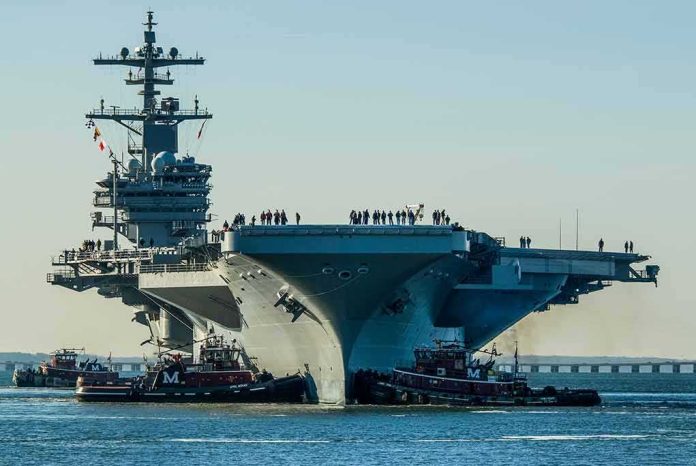
The USS Abraham Lincoln came home to San Diego carrying two irreconcilable stories at once: a combat record the Navy calls historic, and a human toll the Navy itself was forced to confirm in writing to Congress.
Key Points
- The Lincoln and its strike group returned after more than 300 days deployed, among the longest carrier deployments since Vietnam, built around a 40-day combat campaign the Pentagon named Operation Epic Fury.
- Acting Navy Secretary Hung Cao touted 266 days deployed, 200 in a combat zone, over 10,000 sorties, and 1.5 million pounds of ordnance dropped — framing the cruise as an unqualified success.
- In a letter to Senator Kirsten Gillibrand, Cao confirmed eight attempted suicides across the strike group during the deployment, alongside acknowledged food, water, and resupply shortfalls.
- Lawmakers from both chambers have demanded Pentagon inspector general and GAO reviews of why the deployment ran so long and how sailor welfare was managed.
- The episode fits a documented pattern: the Navy’s nominal seven-month deployment target has been repeatedly blown through in recent years, most notably by the USS Gerald R. Ford’s 326-day cruise.
What the Navy Is Claiming, in Its Own Numbers
Strip away the controversy for a moment and the operational record is genuinely extraordinary. A Navy official told Military.com that the Lincoln and elements of Carrier Strike Group 3 steamed more than 85,000 nautical miles across the South China Sea, Indian Ocean, and North Arabian Sea during a deployment exceeding 300 days. Acting Secretary Cao’s statement credited the strike group with 10,000-plus sorties and 1.5 million pounds of ordnance dropped, declaring the crew had “crushed their deployment”. At the homecoming ceremony, Defense Secretary Pete Hegseth read a Presidential Unit Citation detailing 450 Tomahawk launches, 64 Iranian warships sunk, and 160 continuous hours of flight operations without a single aircraft mishap — by any conventional naval metric, a remarkable feat of sustained combat power.
The Navy’s framing was deliberate: this was not an improvised holdover but, in its telling, a “planned rotation” executed under extraordinary circumstances. That distinction matters institutionally, because an unplanned extension signals force-management failure, while a planned one signals command and control under pressure. The problem is that the public record offers abundant detail on what the ship accomplished and almost nothing on the internal calculus — the threat assessments, extension orders, and readiness tradeoffs — that would show why 300-plus days was the only option rather than simply the chosen one.
The Cost the Navy Itself Confirmed
What keeps this story from settling into a simple homecoming narrative is that the human cost did not come only from anonymous family complaints — it came from the Navy’s own paperwork. In a letter to Senator Gillibrand, Cao acknowledged eight suicide attempts, and no suicides, among sailors assigned to the strike group during the deployment. Reuters independently confirmed the figure, and NBC News reported the same tally. Cao’s letter also conceded that meal options were reduced when fresh resupply was unavailable during combat operations, though he maintained no meal was ever missed. Families and sailors quoted across multiple outlets described broken plumbing, water shortages, disrupted mail, and roughly 286 consecutive days without a port call — conditions serious enough that the carrier eventually diverted to Diego Garcia and later made an emergency relief stop in Thailand, its crew’s first time ashore in nearly seven months.
President Trump, for his part, waved off the criticism, telling reporters the deployment was “not nearly long enough”, while Hegseth dismissed critical coverage as “bullshit headline from some fake news outlet” and insisted the Navy provides “every ship, every crew, every captain” with everything it needs. That posture — confirming the hard numbers while rejecting the interpretation attached to them — is the fault line running through the entire controversy. The eight attempted suicides are not in dispute. Whether they represent an acceptable cost of a necessary mission or evidence of mismanaged force generation is where the Navy’s narrative and the families’ narrative genuinely diverge, and the public record does not yet resolve it either way.
How the Navy Got Here: A Pattern, Not an Anomaly
Carrier deployments creeping past their intended length is not new, but it has become routine rather than exceptional. The Navy’s own planning target has long been roughly seven months; a CNN analysis of fleet-tracker data found the service increasingly exceeding that mark across multiple strike groups. The Lincoln itself previously held the post-Vietnam deployment record at 294–295 days in 2020, a COVID-era anomaly. That record did not stand long: the USS Gerald R. Ford logged a 326-day deployment beginning in 2025, the longest since Vietnam, when the USS Midway spent 332 days at sea in 1972–73 under very different strategic conditions. Seen against that arc, the Lincoln’s 2026 deployment is less an aberration than the continuation of a trend in which combatant-command demand for carrier presence in contested regions — the Western Pacific, the Gulf, the Strait of Hormuz — routinely outpaces the Navy’s preferred rotation model.
The Oversight Fight Now Underway
That pattern is precisely why congressional reaction has escalated beyond routine welcome-home statements. Senator Ruben Gallego, a combat veteran, has formally asked the Pentagon’s inspector general to investigate whether the deployment’s length and Hegseth’s handling of it reflect an isolated case or systemic Navy strain under sustained Iran-related tasking. Senate Armed Services Democrats and a bipartisan group in the House have sent parallel letters pressing for answers on logistics, mental health resources, and the decision to deny congressional members access to Middle East facilities during fact-finding visits. None of this amounts to proof of wrongdoing — oversight letters are requests for information, not findings — but the volume and bipartisan reach of the inquiries indicate that the Navy’s achievement narrative, however factually grounded, has not satisfied lawmakers who control its budget and legal mandate.
What It Means Going Forward
The Lincoln’s homecoming closes one chapter and opens a more consequential one: whether the Navy treats this deployment as a template or a warning. If extended, port-call-starved deployments become the default response to persistent threats in the Middle East and Western Pacific, the service risks normalizing exactly the conditions — fatigue, supply strain, eroded mental health support — that produced eight suicide attempts on this cruise. The requested inspector general and GAO reviews, if they proceed, would be the first independent look at the decision-making behind the extension rather than the after-the-fact messaging. Until that record becomes public, the Lincoln’s deployment will remain what it is now: a genuine military accomplishment and a documented human crisis, confirmed by the same officials who announced the sortie counts.
USS ABRAHAM LINCOLN HEADS HOME AFTER RECORD 265 DAYS AT SEA
The USS Abraham Lincoln returns to San Diego on Thursday, ending a record-long deployment of 265 uninterrupted days at sea.
The carrier supported the Iran war throughout. Reports of deteriorating conditions among the… pic.twitter.com/Jei33rra6k
— Diganta Guha (@diganta_guha) October 8, 2026
Sources:
military.com, gallego.senate.gov, rmb.reuters.com, padilla.senate.gov, reed.senate.gov, nbcnews.com, navy.mil, maritime-executive.com, reuters.com, economictimes.com