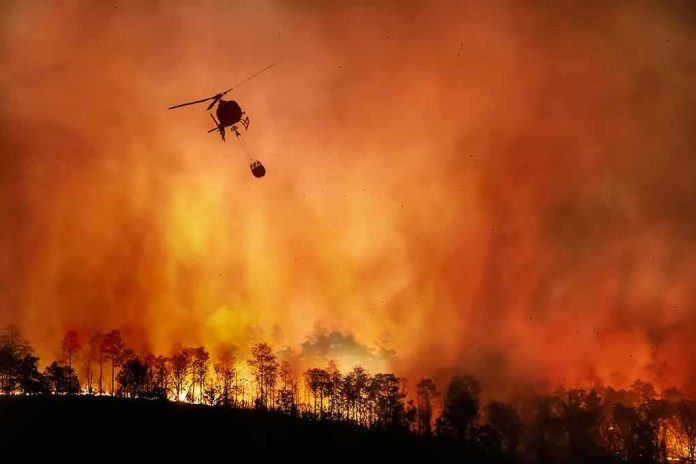
The Bouquet Fire case turns on a simple ignition sequence with outsized consequences: a cigarette reportedly landed on consumer fireworks near a rural porch, an explosion followed, and more than a thousand acres of national forest burned. When a federal arson charge rides on that chain, precision about cause, conduct, and jurisdiction is not academic; it is the case.
Key Points
- Federal prosecutors say a 70-year-old Santa Clarita man admitted he flicked a cigarette onto fireworks, triggering the Bouquet Fire.
- Investigators place the ignition behind his Bouquet Canyon Road residence around 2:13–2:15 p.m., matching witness accounts of an explosion.
- U.S. Forest Service investigators concluded the fire was probably caused by fireworks after excluding other sources.
- The blaze burned roughly 1,048 acres in Angeles National Forest, establishing federal arson jurisdiction tied to federal lands.
What the federal case asserts: ignition, location, and a direct admission
According to the federal criminal complaint, the defendant acknowledged throwing a cigarette from his porch onto fireworks, which detonated and set off the wildfire. Prosecutors anchor the timeline at approximately 2:13 p.m. on October 3, 2026, behind his residence on Bouquet Canyon Road—an ignition window that aligns with local reporting that cited about 2:15 p.m. and placed the origin behind the same home. That admission, if credited, provides the narrative spine: a negligent or reckless act, a ready fuel and spark, and immediate escalation from a small blast to a fast-moving brush fire under Southern California’s late-season conditions. The U.S. Attorney’s Office also reports that investigators recovered a lighter, cigarettes, ammunition, and an aerial mortar firework from the man’s cabin—items consistent with the account of fireworks at the scene and a ready ignition source. Together, the alleged statement, the origin location, and corroborative physical items form the core to which the rest of the government’s case is attached.
Witness descriptions dovetail with that mechanism. Neighbors reportedly heard an explosion—likened to a shotgun blast—near the ignition point and then heard the man yelling for help. In wildfire investigations, such coincident sensory reports matter; they narrow the origin both in space and time and help distinguish an explosive fireworks ignition from the quieter spread of a smoldering ember. Here, the auditory cue supports the allegation that fireworks, rather than a passive ember or downed power line, initiated the event.
Why federal arson, and how investigators reached fireworks as the probable cause
Federal jurisdiction turns on where the fire burned and what it affected. The complaint states the Bouquet Fire consumed approximately 1,048 acres of federally owned Angeles National Forest land—precisely the hook 18 U.S.C. arson theories look for when a blaze damages federal property. That is not a novel application; federal prosecutors regularly charge fires that reach national forests, parks, or other U.S.-owned tracts, drawing in U.S. Forest Service law enforcement and origin-and-cause specialists. Here, Forest Service investigators concluded the fire was probably caused by fireworks after excluding lightning, campfires, debris burning, and other candidates. “Probably” reflects standard origin-and-cause language: investigators apply a scientific-method approach, canvassing indicators at the origin area, eliminating inconsistent causes, and converging on the best-supported scenario rather than purporting omniscience over every spark in a dynamic burn environment.
Context matters. Early incident logs often list cause as “under investigation,” because the first 24–72 hours are about suppression and public safety, not forensic certainty. As crews gain containment, specialized teams refine origin, evaluate burn patterns and artifact placement, and track exclusions to reach a probable cause—precisely the sequence that appears to have unfolded here. The scale also matters: once a fire escapes initial attack and crosses into federal land, the investigative stakes rise, and so does the expectation of a clear jurisdictional trail in charging documents.
The legal elements: conduct, mental state, and how prosecutors frame intent
Arson under federal law requires proof that the defendant set a fire intentionally and without justification or lawful excuse—willfully and maliciously in the statute’s terms. That does not mean prosecutors must show a desire to scorch a thousand acres; it means they must prove deliberate ignition, not mere accident, coupled with the absence of lawful justification. In practice, the government builds that element from admissions, the inherent riskiness of the act, surrounding statements, and any prior knowledge of fire danger or restrictions. In this case, the alleged act—disposing of a lit cigarette onto consumer fireworks—is conduct that jurors can readily understand as creating a substantial and obvious risk of immediate combustion. The complaint’s reported admission puts deliberateness to the physical motion; the fireworks inference supplies the volatility; together, they sketch the malice the statute contemplates.
Prosecutors also align venue and property elements to the facts. Because the fire burned federal lands in Angeles National Forest, the federal nexus is not peripheral; it is central. That connection is what distinguishes a state-only reckless-burning case from a federal arson charge: it is not merely where the cigarette fell, but where the flame ultimately spread that supplies federal jurisdiction.
Evidence architecture: what supports the ignition chain
Three pillars carry the government’s theory. First, the defendant’s alleged admission directly links his act to the ignition. In any arson prosecution, such a statement is powerful because origin-and-cause work is typically circumstantial; when a suspect fills in the missing seconds, the mosaic sharpens. Second, investigators’ exclusion-based conclusion—probable fireworks—coheres with that account and with specific auditory witness reports of a blast. Third, physical items recovered at the cabin match the narrative: cigarettes and a lighter for ignition; an aerial mortar firework indicating fireworks were present; and ammunition that explains why bystanders might interpret an explosion as a gunshot, even if the sound came from fireworks detonating near a structure. None of these alone proves the entire case; together, they point the same direction.
Scale and timing provide the backdrop. The fire ignited in the early afternoon during hot, dry conditions, then quickly ran through chaparral and mixed fuels into national forest acreage. Angeles National Forest and county reports put the final footprint at roughly 1,048 acres. Evacuations followed, and by the time investigators were ready to articulate probable cause, the federal jurisdictional elements were already locked by the burn perimeter. That sequence—rapid ignition, early blast report, significant spread—reads like a fireworks-involved start rather than a slow-burn equipment fault.
How wildfire investigators work when “probable” is the right word
Wildfire origin-and-cause investigations are reconstructive. Teams start with the heel of the fire—the area that burned first—then read directionality indicators in vegetation and soil, interview witnesses, and sort potential causes using a structured elimination process. Contemporary guidance emphasizes clusters of reliable indicators and the scientific method because single artifacts are often ambiguous in a chaotic burn. In large datasets, even advanced models perform far better at distinguishing human versus natural ignitions than at pinpointing which specific human behavior lit the match; that is why disciplined fieldwork and credible admissions remain decisive in individual cases. In Bouquet, fireworks as the probable cause, an alleged firsthand account of a cigarette onto those fireworks, and co-located items that fit that mechanism amount to a coherent result rooted in that methodology.
As with any criminal case, a complaint is the start of litigation, not its end; guilt is adjudicated in court. But taken on its own terms, the government’s narrative of the Bouquet Fire is internally consistent: a rapid, explosive ignition at a specific back-porch origin; a matching statement by the man at that location; corroborative items in his cabin; and a burn scar that crossed into federal land, triggering the federal arson charge that now proceeds in court.
Santa Clarita man charged with federal arson in the Bouquet Fire. Prosecutors say he flicked a cigarette onto fireworks. Full story:https://t.co/TBlatMPPJR
— The Southbound 105 (@Southbound105) October 11, 2026
What this means beyond one hillside
The Bouquet Fire charge illustrates the hard edge of fire weather, human behavior, and federal land management colliding at a doorstep. In the wildland–urban interface, small acts can have federal consequences within minutes. For residents in similar canyons, the mechanics here are the cautionary lesson: consumer fireworks are explosive ignition sources; a lit cigarette is not inert; and on a hot afternoon, the space between the two can be a thousand acres wide.
Sources:
nypost.com, justice.gov, foxla.com, hometownstation.com, nbclosangeles.com, rollingout.com