The hard question raised by Rachel Maddow’s warning is not whether the United States can build very large detention sites—it can—but what those sites, paired with expansive executive detention powers, practically mean for due process and for the boundary between immigration enforcement and the rights of citizens.
At a Glance
- Maddow articulated a concrete scenario: seven to ten large-capacity facilities—on the order of 10,000 detainees each—used for prolonged, lawyerless confinement; she tied the warning to reported mega-site proposals and asked whether their use would remain confined to noncitizens.
- Federal habeas cases show that prolonged immigration detention is not theoretical; courts have ordered releases and bond hearings, underscoring that detention authority is contestable in practice.
- The record documents mistaken detention of U.S. citizens in the immigration system over time, establishing a nonzero risk that mass detention infrastructures can sweep in Americans in error.
- What is established today: expansion pressures and due-process friction in civil immigration detention; what remains a prediction: indefinite, lawyerless confinement of American citizens in newly built mega-facilities.
What Maddow actually said—and why it resonated
On a late-2026 appearance, Rachel Maddow moved beyond vague dystopian imagery and sketched a capacity-and-authority model: if you give the president “seven to ten” prisons holding roughly 10,000 people apiece—spaces where people could be held without trial and without access to lawyers—do you really think he’ll “only leave immigrants in there?” The provocation wasn’t merely rhetorical. Coverage that followed linked her comments to specific proposals for very large detention facilities, including warehouse-like sites described as capable of holding thousands. The scenario she posited—scale plus weakened process—was built from numbers, not adjectives.
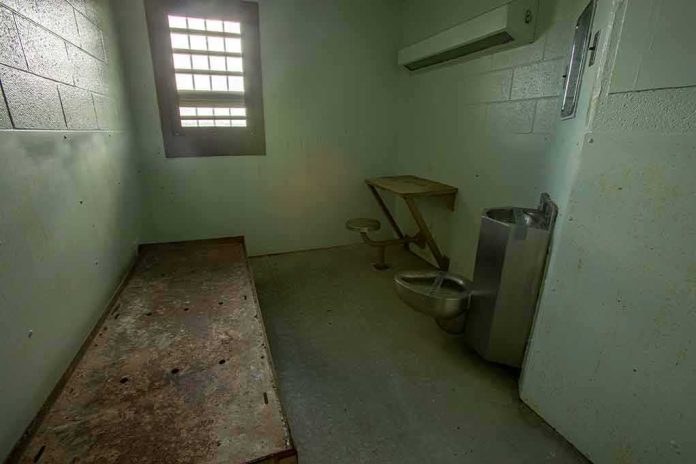
That scale matters. Detention systems change character when they move from hundreds to tens of thousands. Intake logistics harden. Attorney access and adjudication timetables become throughput problems. With that shift, the legal line between civil detention for immigration purposes and the constitutional guarantees owed to anyone the government locks up grows central to public risk assessment.
The legal spine: civil detention, due process, and what courts are doing
Immigration detention is civil, not criminal, but it still triggers constitutional due-process constraints. That is not academic; it is litigated in real cases where judges weigh the government’s interests against a person’s liberty interest in avoiding prolonged physical restraint. In Duran Linarez v. Warden, the court summarized this framework bluntly: civil detention demands “special justification” that can outweigh fundamental liberty, and prolonged custody provokes serious Fifth Amendment questions.
Recent habeas rulings capture the system’s friction points with precision. In Ortega Frederick v. Warden (California City), a federal court ordered release and required notice plus a bond hearing before any future re-detention—an implicit acknowledgment that process, not just paper authority, governs lawful custody. In Shaikh v. Warden (Otero County), the court ordered release within 24 hours—a timeline that tells you how courts view prolonged detention without timely, individualized adjudication. These are not isolated thought experiments; they are operational corrections to overbroad or overlong custody in real facilities, showing that the authority to detain is both powerful and judicially contestable.
Scale and infrastructure: proposed mega-sites and why capacity is not neutral
Reporting around the time of Maddow’s remarks pointed to contemplated or proposed mega-facilities, including an industrial-scale site in Social Circle, Georgia, described as a warehouse capable of holding thousands. The concept sketches mentioned capacities in the five-figure range—“five, six, seven, ten, 14,000” detainees—illustrating the logistical ambition behind the buildout. While not every proposal reached completion or operation, the planning logic is clear: aggregating custody into fewer, larger nodes that promise cost and control advantages, but that also magnify the stakes of any due-process shortfall.
Large nodes create systemic effects. Attorney access depends on travel, staffing, and communications capacity; court calendars strain under block hearings; and the practical availability of bond or parole can narrow if facility design and operations treat counsel and adjudication as exceptions rather than the core workflow. That is the mechanism by which “capacity” becomes “risk.”
Citizens and mistaken detention: the documented, narrower risk
The historical record does not support the claim that the United States presently operates concentration camps for citizens. It does, however, document something narrower and concrete: Americans have been mistakenly swept into the immigration enforcement machinery and detained, sometimes for days or longer, when agents questioned citizenship or could not promptly verify status. Investigative tallies and government records have identified hundreds of such cases over time; several oversight and research bodies have detailed the phenomenon and its drivers—database errors, identity confusion, and process gaps that delay verification and release.
That base rate matters for assessing any expansion of detention infrastructure. If a system with modest capacity can mistakenly confine citizens, a scaled-up system—especially one sited far from counsel and courts—raises the probability-weighted risk even if policy never targets citizens as such. This is the sober middle ground the evidence supports: the risk is documented as error and process failure, not as official doctrine that American citizens may be held indefinitely without counsel.
What the recent litigation tells us about “indefinite” and “lawyerless” detention
Maddow’s specific fear hinges on two predicates: detention without lawyers and without time limits. The litigation record undercuts the inevitability of either extreme. Federal courts have ordered releases and bond hearings from inside the very facilities at issue, which demonstrates that detainees can reach counsel and courts sufficiently to trigger judicial remedies—at least some of the time. The American Immigration Council’s filings in the Supreme Court further underscore a persistent debate over statutory authority and constitutional limits, indicating that prolonged detention is bounded by judicial review rather than free-floating executive power.
That said, “on paper” access to counsel is not the same as reliable, timely, practical access to counsel. Scholars and practitioners have documented how distance, call restrictions, language services, and churn can turn nominal rights into delayed or sporadically realized rights. The most accurate stance, anchored in the evidence, is therefore twofold: the system is meaningfully contestable in court, and its day-to-day operations can, and do, impede timely counsel and hearings—problems courts then partially correct after the fact.
MSNBC host Rachel Maddow expressed concern during an appearance on The Daily Show that large-scale ICE migrant detention centers planned by the Trump administration could eventually be repurposed to imprison U.S. citizens without trial pic.twitter.com/VhawISqCx7
— Sandy (@SD73660) November 11, 2026
Parsing the analogy: why “concentration camps” obscures more than it clarifies
“Concentration camp” is a moral alarm bell, not a legal designation. The court records and filings here analyze habeas jurisdiction, bond, and due process; none classifies U.S. detention facilities as concentration camps. Using that label invites readers to focus on rhetoric rather than the verifiable mechanics that should guide judgment: who can be detained, for how long, with what access to counsel and courts, and under what statutory and constitutional checks. The strongest case the evidence supports today is not semantic; it is procedural and institutional. Expansion pressures tend to push detention farther and longer, and courts then force recalibration.
How we got here—and what to watch
Mass immigration detention in the United States did not spring up overnight. It consolidated over decades through statutory expansions and administrative practice, especially from the 1980s through the 1990s, when detention shifted from an ad hoc tool to an entrenched infrastructure. That history teaches two recurring patterns: (1) capacity builds tend to beget usage, and (2) judicial oversight, often via habeas, curbs the outer edge of executive detention after harm has begun to accrue.
Going forward, the consequential questions are empirical and legal, not rhetorical. Which facilities are actually funded, built, and activated at five-figure capacity? What are their operating rules for attorney access, communications, and individualized custody review? How quickly do detainees reach counsel and hearings in practice, measured in days, not policy memos? And how effectively do internal safeguards prevent the mistaken detention of citizens in a scaled system with accelerated intake? The answers to those questions—tested in procurement files, operating procedures, inspection reports, and court dockets—will tell the public far more than any label can.
Bottom line
Maddow’s scenario draws power from two truths: the government has contemplated very large detention capacity, and the immigration detention system has a documented record of due-process friction, including mistaken detention of citizens. But the evidence also shows a live, functioning check: federal courts are ordering releases and hearings, and the law does not license indefinite, lawyerless detention as a matter of course. The risk to watch is not a sudden flip to citizen “concentration camps,” but the incremental tightening of capacity and process that, if left unscrutinized, erodes rights in practice long before doctrine admits it.
Sources:
thegatewaypundit.com, supreme.justia.com, law.justia.com, supremecourt.gov, govinfo.gov, foxnews.com, foxwilmington.com, silive.com, warren.senate.gov