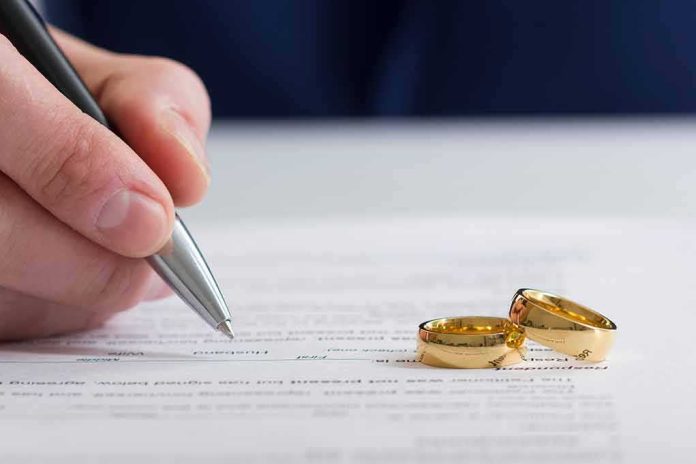
The fight over judges and gay weddings in Texas is not really about weddings at all — it is about whether a judge who holds a government commission can treat the bench as a pulpit, picking which citizens get full service and which get a referral slip.
Key Points
- Texas Supreme Court Chief Justice-elect Ellis, the first openly LGBTQ+ person elected to lead the court, wants an all-or-none officiating rule: judges either marry every legally eligible couple or none at all.
- The proposal would undo a two-line comment the Texas Supreme Court added to the judicial conduct canons in October 2025, which shields judges who decline weddings for “sincerely held religious belief” reasons.
- That comment grew directly out of Justice of the Peace Dianne Hensley’s case, in which she refused same-sex ceremonies while continuing to perform opposite-sex ones and referred same-sex couples elsewhere.
- Hensley ultimately won a $640,000 judgment and a permanent bar on discipline, giving the religious-accommodation side a significant legal and financial foothold.
- With Republicans still holding a 5-4 majority on the court, Ellis cannot act alone — and First Liberty Institute, which represented Hensley, has already signaled it will fight any rollback.
What Ellis Is Actually Proposing
The mechanism here is simple, which is precisely the point. Ellis wants to amend the judicial conduct orders so that a judge’s choice is binary: perform weddings for everyone who is legally entitled to marry, or perform none at all. “One thing I’d like to do is work with the other justices to amend these orders to say either you perform all marriages, or none,” she has said. There is no carve-out contemplated for case-by-case religious objection under this framework — the judge opts entirely in or entirely out of officiating as a civic function, removing the discretion to serve some couples and decline others on the basis of who they are marrying.
Ellis frames the current accommodation as “back-door discrimination” — a way for a judge to keep the convenience and goodwill of officiating weddings generally while excluding one class of citizens from that service. The rationale rests on a basic equal-treatment principle: a judge who continues to marry opposite-sex couples while declining same-sex couples is not abstaining from an activity, she argues, but selectively withholding a government function from specific people. What the record does not yet show is a filed rule change, a vote count, or a legal memo reconciling the proposal with the Texas Religious Freedom Restoration Act — this remains a stated intention, not an enacted policy.
How the Current Accommodation Came to Exist
The rule Ellis wants to repeal did not emerge from nowhere; it was the court’s direct response to a years-long legal fight. Dianne Hensley, a justice of the peace in McLennan County, announced she would not perform same-sex wedding ceremonies because of her Christian faith, while continuing to officiate opposite-sex weddings. She built a referral list of other local officiants willing to perform same-sex ceremonies at her price, arguing that no couple in the county was actually denied a wedding. The State Commission on Judicial Conduct issued her a public warning. Hensley sued, and after years of litigation, a Texas court entered final judgment in her favor: $10,000 in damages and $630,000 in attorney’s fees, plus a permanent injunction barring the Commission from disciplining her over the refusal.
In October 2025, the Texas Supreme Court responded by adding a comment to the judicial canons stating it “is not a violation of these canons for a judge to publicly refrain from performing a wedding ceremony based upon a sincerely held religious belief”. That comment is the specific target of Ellis’s proposal. It did not emerge in a vacuum — it followed a half-million-dollar judgment against the state’s own disciplinary body, a signal that institutional and legal momentum had already shifted toward the accommodation Ellis now wants to erase.
The Unresolved Legal Question Underneath the Dispute
Strip away the politics and a genuine, unsettled legal distinction remains: is a same-sex couple entitled to a marriage, or to a particular officiant? A concurring opinion in the Hensley litigation framed the right at stake as access to marriage itself, available through referral, not a guarantee that any specific judge must perform the ceremony. Ellis’s position treats selective officiation by a sitting judge — a public official exercising a state function — as discrimination regardless of whether a substitute is available nearby. Both framings have intuitive force, and the available record does not resolve which one controls future rulings. No count of statewide refusals, affected couples, or documented delays has been produced to show the referral model fails in practice.
This is not a new argument in American law. The same structural question — whether a state can let a government employee opt out of a core civic duty on religious grounds, so long as another official fills in — animated the Kim Davis controversy in Kentucky after Obergefell v. Hodges, when a county clerk refused to issue marriage licenses to same-sex couples. Courts have generally drawn a sharper line for private religious officiants, who enjoy strong First Amendment protection, than for public officials performing a governmental function, whose obligations run to equal access rather than personal conscience. Texas has not yet settled definitively which side of that line judicial wedding officiation falls on.
Texas reprimanded Justice of the Peace Dianne Hensley for declining to officiate same-sex weddings because of her Christian faith.
The state commission ended up paying her damages and attorney’s fees.
Maggie Ellis, a Democrat just elected chief justice of the Texas Supreme… pic.twitter.com/NKXDlsns2L
— CURE News Blogger (@YourBCN) November 12, 2026
What Stands in the Way, and What Happens Next
Ellis’s ambition collides immediately with arithmetic. Even after Democratic gains in the 2026 midterms, Republicans retain a 5-4 majority on the Texas Supreme Court, meaning she needs at least one Republican colleague to cross over to amend the standing order. First Liberty Institute, which built Hensley’s case and secured her judgment, has already criticized the proposal and signaled it will continue defending judges who decline same-sex ceremonies. That is not an idle threat: the same organization has a proven record of taking this exact fight through the Texas courts and winning — a $640,000 judgment is a formidable deterrent to any commission or court inclined to discipline a judge under a reinstated all-or-none rule.
The practical stakes for Texans are narrower than the rhetoric suggests but still real. No judge is the only officiant available to marry a couple in Texas; county clerks, magistrates, ordained ministers, and notaries can all perform the ceremony. The genuine dispute is over principle — whether a sitting judge, as a representative of the state, may decline to serve part of the public while remaining fully in office — rather than over whether same-sex couples can find someone to marry them. That principle, not any single wedding, is what the next round of this fight in Texas will actually decide.
Sources:
lifesitenews.com, supreme.justia.com, law.justia.com, lgbtqnation.com, kxxv.com, christiantimes.com, firstliberty.org