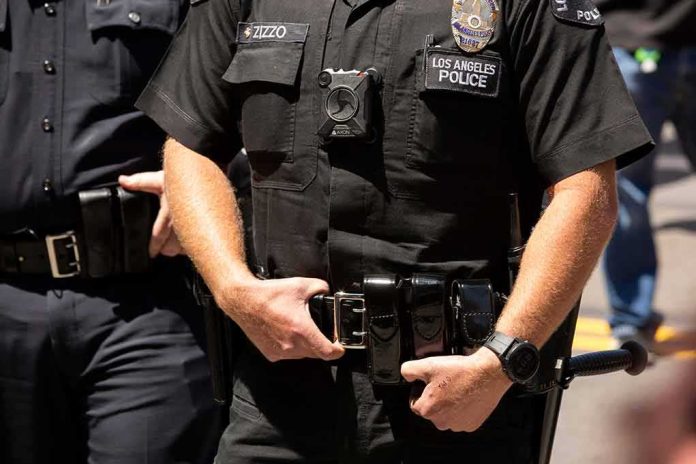
One painful bite on a sidewalk in Skid Row distills a larger truth about police–dog encounters: they are as much a test of split-second human judgment and tactics as they are a raw officer-safety hazard, and the public argument that follows often turns on what the camera did—or didn’t—show.
The Short Version
- An LAPD sergeant was bitten in the groin during a volatile street encounter that involved a pit bull, a leash dispute, and an attempted detention.
- Accounts diverge on how the struggle began; what is uncontested is the bite and a chaotic effort to control people and animal in tight quarters.
- Dog encounters routinely injure officers and civilians, but disagreements persist over whether harm was unavoidable or a product of tactics.
- LAPD policy and national best practices emphasize de-escalation tools for animals; applying them in real time amid human resistance is the hard part.
What happened and what isn’t in dispute
The core facts are straightforward. During an on-foot encounter in the Skid Row area, an LAPD sergeant engaged a woman while a man and a pit bull were close by. In the struggle that followed, the dog clamped down on the sergeant’s groin; the officer was hospitalized for treatment, and video of the bite circulated widely. Local television reporting, citing LAPD, frames the call-up as an officer stopping when a dog appeared to be involved in a dispute between a man and a woman, with the situation devolving as the officer attempted to detain the woman and manage the leash-bearing animal in the same moment. However one narrates the prior minute, the bite itself is documented and consequential.
Two threads of description have since traveled in parallel: one casting the bite as an unprovoked dog attack amid an arrest; another interpreting it as the dog defending its handler in a tug-of-war over control and custody of the animal. Those differences matter for accountability and training. But they do not erase the basic occupational risk: a distracted officer, a contested detention, and a powerful dog inside arm’s reach is a bad geometry for everyone involved.
Why dog encounters are uniquely unforgiving
Police–animal interactions sit in a narrow band between predictable and feral. Unlike human subjects, dogs convey intent through signals many officers read imperfectly under stress: eye-focus, tail set, hackles, and leash tension. Once aroused, a determined dog, particularly a strong-jawed breed, can transition from warning to bite in less than a second; disengagement is then a struggle against pain and physics. Across agencies, dog bites send more people to hospitals than several other common force categories, and those injured include suspects, bystanders, officers, and even K-9 handlers. That is not a referendum on any single incident; it is the base rate that makes the training stakes real.
Skid Row compounds that risk. Crowded sidewalks, overlapping crises, and contested property—pets are, legally, property—produce scenes where an officer must simultaneously stabilize a person and neutralize an animal without collapsing either task into panic or force escalation. Even dog-savvy officers get trapped by sequencing: if you hand-fight a resistant subject while the leash is in play, you have created an entanglement problem you now have to solve under duress.
Conflicting narratives: weighing the claims
Where the accounts diverge is the opening and the dog’s “why.” One report describes an officer halting for what looked like a dog biting a person, then recognizing it was actually a struggle over the dog, not a bite-in-progress; another frames the bite as the dog defending its owner during an attempted detention. The tabloid write-up leads with the injury and the arrest context but does not resolve sequence or intent with official footage. Taken together, these sources place the bite inside a human-leash struggle rather than as a distant lunge from a free-running animal. That distinction drives two different after-action lessons: either the officer misread the initial threat picture and collapsed human control and animal control into one risky scrum, or a compliant approach was impossible because one or more parties turned the leash into a weaponized uncertainty.
Skeptical readers often ask for the referees: body-worn camera and a use-of-force review. They are right to do so. In Los Angeles, internal reviews compare actions against policy that permits force against animals only when they pose an immediate threat of injury, and it catalogues non-lethal options to deter or control dogs before gunfire ever enters the picture. None of that guarantees a clean, linear resolution on the sidewalk; it does supply a standard against which the eventual findings will be judged.
The policy and training frame: what best practice requires
Modern guidance for police dog encounters emphasizes three ideas that look simple on paper and punishingly complex in a real brawl: separation, positioning, and tools. Separation means decoupling the human subject from the dog—physically and in your mental model—so that controlling one does not provoke the other. Positioning is basic tactics: avoid standing in the leash’s arc; use barriers, vehicles, or a second officer to create a lane of retreat; and keep hands off the collar unless you have leverage and a plan. Tools are the least glamorous, most effective piece: voice commands to the handler, citronella or OC spray directed near the muzzle, a fire extinguisher blast that disrupts advance, a shield, a Taser on the handler rather than the dog if the person is the vector of risk. These options are codified in LAPD training and public-facing guidance after high-profile pet shootings put a spotlight on non-lethal alternatives.
The catch is time. In a cramped, kinetic scene, sequencing those options demands at least one free officer and a moment to stage. If you are alone, hands on a resisting subject, and the leash is taut between you, your tool belt may as well be across the street. Which is why supervisors harp on pre-contact planning, even for “minor” street stops: if there is a large dog and a contested detention, call a second unit before you go hands-on. You are buying control with patience—hard medicine in an environment that punishes hesitation.
The broader pattern: injury is common; inevitability is not
It helps to hold two ideas at once. First, dog bites in policing are common enough to be a known hazard, not an anomaly; they produce serious wounds, and they happen to officers as well as to the public. Second, many of the worst outcomes in dog encounters are avoidable with better tactics, clearer sequencing, and disciplined use of tools—especially when policy and supervision reward patience over speed. Investigations and litigation around Los Angeles dog incidents in recent years have repeatedly forced the department to articulate and refine those standards, which now emphasize de-escalation and non-lethal options with animals well before deadly force is contemplated.
This is not a culture-war story about breeds, nor a morality play with perfectly innocent heroes and villains. It is a craft problem. In a city where pets are woven into street life, officers will keep colliding with dogs in moments of human crisis. The measure of progress is not whether bites vanish; it is whether the percentage of encounters that turn into chaotic scrums declines as call-handling, staging, and animal-control tactics improve.
An LAPD sergeant suffered a painful pit bull bite to the leg and groin while trying to arrest a woman on Skid Row.
Key details (Nov. 12, 2026):
• Location: Near 6th & Wall streets (Skid Row, downtown Los Angeles), close to the Central Division station.
• What happened: The… pic.twitter.com/cl6VL42nzm— Dare Adebayo (@DareAdebay43685) November 18, 2026
Practical implications for the next encounter
For departments: write policy that treats animal control as its own discipline; train to the policy with scenario work that involves leashes, handlers who resist, and narrow spaces. Equip patrol with low-tech animal deterrents that work in tight quarters and make their deployment reflexive, not exotic. For line officers: separate the problems; do not fight a person while you are inside the leash triangle. For the public: if you carry a powerful dog into a police encounter, you are carrying a force multiplier; keeping the animal seated, leashed short, and out of the officer’s lane is the fastest way to keep everyone uninjured.