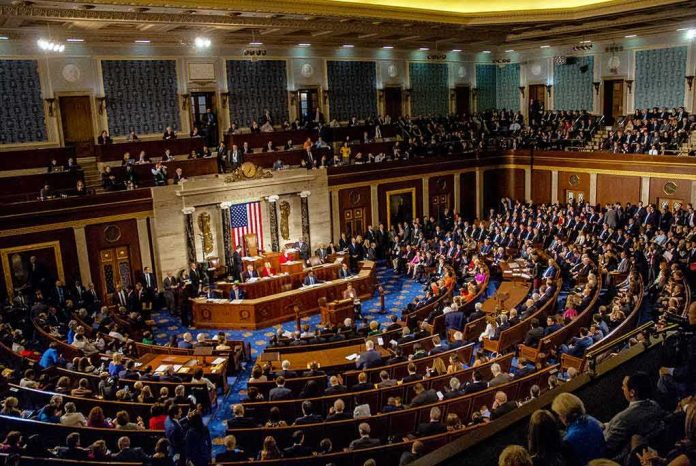
A federal appeals court ruled that House proxy voting could not create a quorum, putting a massive Biden-era spending law on shaky constitutional ground.
Story Highlights
- The United States Court of Appeals for the Fifth Circuit, sitting en banc, said the Constitution requires Members to be physically present for a quorum.
- The court held that “proxy presence” does not count toward the House quorum and cannot make absent Members “present”.
- The House passed the 2023 omnibus 225–201 with 226 proxy participants, far above the quorum margin.
- The ruling keeps an injunction stopping enforcement of the Pregnant Workers Fairness Act against Texas, while broader effects may head to the Supreme Court.
Fifth Circuit Says Quorum Means Physical Presence
The United States Court of Appeals for the Fifth Circuit ruled that the Constitution’s Quorum Clause requires Members of the House to be physically present to conduct business. Judge Cory Wilson wrote for the en banc majority that the clause’s text, history, and long practice point to one rule: you must be there to count for quorum. The court rejected arguments that House rules alone could redefine “presence” to include remote participation through proxy assignments.
The court drew a sharp line between voting choice and constitutional presence. The opinion explained that giving another Member your proxy may allow your vote to be cast, but it cannot make you “present” for quorum. The majority stated flatly that “proxy presence” does not count toward the quorum headcount. That distinction matters because the Constitution sets a floor for lawmaking. A chamber’s internal rule cannot erase a constitutional condition for doing official business.
Why the 2022 Omnibus Vote Is Under Fire
The case targeted the 2022 year-end spending package, the Consolidated Appropriations Act of 2023. The House recorded a 225–201 passage, with one voting “present.” But 226 lawmakers participated by proxy during that vote. The Fifth Circuit said those absent Members did not count toward the quorum because they were not physically present. That conclusion turns the fight from a simple vote tally into a constitutional question about who actually counted as “in the room” that day.
Texas challenged one slice of the omnibus: the Pregnant Workers Fairness Act. The Fifth Circuit affirmed an injunction that blocks the federal government from enforcing that law against the State of Texas. The court also rejected the “enrolled-bill rule” as a shield against review, explaining that Texas raised a constitutional issue, not a dispute about historical paperwork. The ruling leaves the rest of the omnibus on the books for now, even as the reasoning questions how it passed.
Dissent Warns Against Reading In a Physical-Presence Rule
Eight judges dissented. Judge James Graves argued that Article I does not spell out a physical-presence requirement. He called the majority’s reading “illogical, inexplicable, and invalid” and said it wrote a new rule into the Constitution. He also criticized the remedy, asking why only one part of a multi-trillion dollar law was blocked if the entire vote was unconstitutional. Those points preview likely arguments if this dispute reaches the Supreme Court.
Appeals Court, 9-8: Pelosi's House Unconstitutionally Passed the $1.7 Trillion Spending Bill Using Proxy Votes
The full Fifth Circuit ruled 9-8 on Friday that the House violated the Constitution's quorum requirement when it passed the $1.7 trillion Consolidated Appropriations… pic.twitter.com/cBxD2SEQLh
— Sami Nathaniel (@NathanielSami) November 22, 2026
Supporters of proxy voting pointed to Speaker Nancy Pelosi’s 2020 defense of the rule. She said the Constitution gives each chamber broad power to set its own procedures, and that proxy voting fit within that authority. The Fifth Circuit majority said that chamber rules cannot override a constitutional limit. It drew the line at counting absent Members as present to reach the quorum needed to pass laws that bind the country.
What This Means for Separation of Powers and Spending
This ruling checks a pandemic-era shortcut that became routine. Counting proxies as “present” let leaders move giant bills without the hard work of assembling a real quorum on the floor. The court’s message is simple: the Constitution still sets the guardrails. That benefits transparency and accountability. If Congress wants to spend trillions or change core policy, Members should show up, debate, and vote in person so citizens can see who stood where on the record.
The path forward runs through courts and Congress. The narrow 9–8 split increases the odds of Supreme Court review. Other parts of the omnibus could face copycat suits using the same quorum theory. For now, Texas won relief from one mandate it opposed. The bigger win for constitutional conservatives is the principle: no rule can swap physical presence for proxy headcounts when the Constitution says a quorum must be present to do the people’s work.
Sources:
news.bloomberglaw.com, reason.com, kohenavocats.com, gsmglobalnews.com, speakeremeritapelosi.house.gov