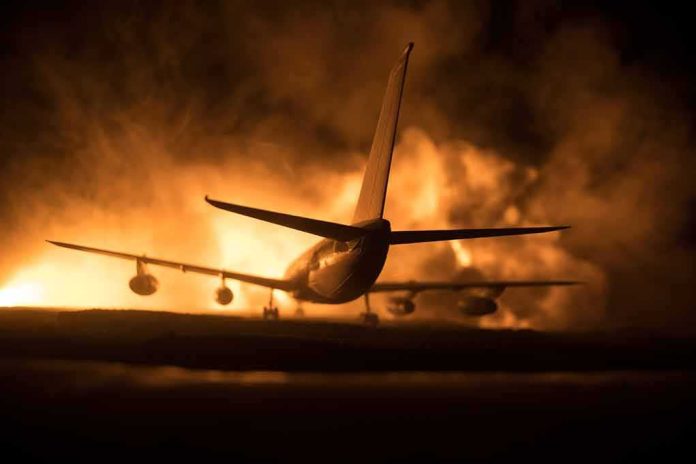
When a plume of black smoke rises from the fuel farm of a capital-city airport, it is not merely a local emergency; it is a precision hit on confidence—aviation confidence, energy-market confidence, and the narrative that layered air defenses can fully domesticate modern drone and missile threats.
At a Glance
- Black smoke and flames were seen near Riyadh’s King Khalid International Airport after overnight air-raid alerts, with flight disruption across the hub.
- Imagery and eyewitness accounts pointed to a fire at a fuel storage area serving the airport, consistent with the Houthis’ recent targeting patterns.
- The incident unfolded amid an escalation cycle in which Yemen’s Houthi movement has repeatedly struck Saudi aviation and energy infrastructure.
- Airport fuel depots are operational chokepoints: small, soft targets with outsized impact on safety, schedules, and public perception.
What happened near Riyadh’s main airport
Riyadh residents reported booms overnight; authorities issued air-raid alerts for the capital and then later gave an all-clear. Soon after, video and photographs captured a thick pillar of black smoke and visible flames rising near King Khalid International Airport, with runways, terminal approaches, and the airport highway identifiable in the foreground. Eyewitnesses and agency footage converged on the same locus: a fuel storage or handling area adjacent to the airport complex, with firefighters seen tackling a blaze consistent with a hydrocarbon tank fire. Commercial operations faced delays and cancellations as the airport and civil defense absorbed the shock and contained risk to airside movements.
The timing and location fit a pattern seen in earlier Houthi operations against Saudi aviation and oil logistics: aim at fuel infrastructure that sits outside hardened perimeters yet underpins flight operations. This is not happenstance; it is the logic of modern standoff attacks that maximize disruption per kilogram of explosive, especially where a fuel tank fire can be initiated without penetrating runway concrete or terminal glass.
Why fuel depots are the soft belly of aviation
Airports run on kerosene and redundancy. A typical major hub maintains multiple above-ground storage tanks, hydrant systems feeding gates, and tanker trucks as a fallback. These installations are engineered for operational reliability and fire suppression, not survivability against shrapnel-rich warheads or shaped charges. A small strike on a single tank can trigger a visible, photogenic outcome—a dark smoke column from burning jet-A—that forces operators to reduce movements, re-route hydrant lines, or suspend fueling while they isolate and depressurize sections of the system. Even when runways remain intact, the loss of assured fueling capacity can induce cascading delays across airline networks that rely on tight turnarounds and gate hydrants.
That vulnerability invites attackers who seek strategic effect with tactical means. The Houthis have repeatedly advertised and demonstrated that logic across Saudi infrastructure—oil handling at Jizan and Yanbu, and aviation nodes from Abha to Najran—using a mix of low-flying drones and missiles to hit high-impact, low-hardened assets. The Riyadh plume fits that operational grammar.
The escalation cycle that set the stage
The incident did not materialize in a vacuum. In the weeks leading up to the airport fire, the Houthi movement widened its target set inside the kingdom, claiming strikes on energy facilities and airbases and prompting retaliatory Saudi operations. Reuters and other outlets chronicled that renewed exchange after a multiyear period of relative restraint, noting Houthi statements targeting Saudi oil infrastructure and airports, and Gulf actors delaying diplomatic tracks as cross-border attacks resumed. Independent regional analyses and satellite imagery have traced damage to Saudi fuel facilities during this phase, underscoring both capability and intent to hit logistics nodes rather than only symbolic landmarks.
That history matters for attribution logic. In this theater, airport fuel farms and Aramco-branded depots have been struck before; the Houthis have named such sites as legitimate targets in communiqués; and cross-border alerting in the capital is typically sequenced to intercept or track inbound threats. When, within that context, a visible fuel tank fire erupts beside the busiest airport in the country after sirens and booms, the inferential chain is short. It is also operationally coherent with what the group has done elsewhere.
Mechanics of a strike: how a small munition makes a big fire
Fuel tank farms are protected by dikes, foam systems, and spacing rules that limit domino effects. Yet they remain susceptible to ignition from penetration or spall—fragments breaching the shell—and from secondary fires along piping or pump skids. A small explosive, guided with adequate terminal accuracy, can cause a roof or shell failure that vents and ignites vapors; submunitions or incendiaries can defeat foam blankets if applied after initial suppression. From a drone operator’s perspective, the tanks’ large thermal and visual signatures, plus their fixed coordinates and minimal overhead cover, make them unusually cooperative targets. Even if most inbound threats are intercepted, a single leaker can produce the impression—and the operational outcome—of success.
The observable signature in Riyadh—tall, black smoke consistent with jet fuel, firefighting in proximity to a marked fuel tank, and flight disruptions for a busy hub—matches the expected aftermath. That is precisely why defenders weight air defenses around such nodes and why alerts ripple widely when radar tracks suggest a threat to the capital’s airspace.
Strategic consequences: symbolism, markets, and deterrence
Hitting a fuel depot next to a flagship airport does triple duty for an attacker. First, it imposes immediate operational friction: diversions, cancellations, and a day or two of fueling workarounds until integrity checks clear pipelines and tanks. Second, it projects reach—proof to domestic and international audiences that the attacker can touch the capital despite layered defenses. Third, it unsettles energy and aviation markets, which price risk as much as damage. Saudi oil fields lie far from Riyadh, but investors infer resilience or fragility from how quickly such a visible blaze is controlled and how candidly operators communicate status. Recent reporting has highlighted that this escalation threatens Saudi export reliability not through direct destruction of upstream capacity, but via compounding hits on logistics, power, and morale.
Deterrence messaging cuts both ways. Saudi authorities are incentivized to rapidly contain and publicize defenses’ successes; the Houthis are incentivized to spotlight any breach—especially one that produces unmistakable visuals—to claim strategic parity. That is why these episodes so often anchor subsequent diplomatic postures: each side’s next move is constrained by what the images just taught their audiences to expect.
Yemen’s Houthis Claim Attack on Saudi Capital After Fuel Depot Burns at Airport (targeted with ballistic missiles – 24°58'50.0"N 46°40'50.7"E).
King Khalid International Airport, Riyadh Saudi Arabia.#KingKhalidInternationalAirport#Riyadh #SaudiArabia#Yemen #Houthis#IRGC pic.twitter.com/Ls8jR4SIZ8— Comte de Saint Germain (@StGermain1776) September 19, 2026
What to watch next: resilience and adaptation
Airports learn quickly. Expect incremental hardening: blast walls around vulnerable tanks, more robust overhead protection for pumping skids, dispersion of storage, and procedural changes that allow hydrant isolation without wholesale shutdowns. On the air-defense side, low-altitude radar coverage, counter-UAS jamming, and point-defense interceptors will continue to densify around fuel logistics and airbases. Offense adapts in parallel: smaller signatures, coordinated salvos to saturate point defenses, and timing attacks to exploit weather or busy air corridors.
Sources:
thegatewaypundit.com, english.ahram.org.eg, timesofindia.indiatimes.com, ajkerpatrika.com, ua.news, siasat.com, acleddata.com, reuters.com, euronews.com, theguardian.com