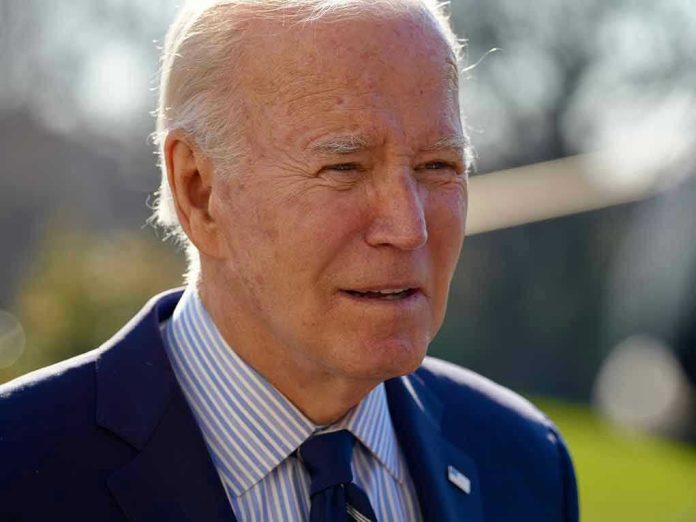
A single “joke” at a university podium can reveal how fast politics turns into a character trial in the age of viral clips.
Story Snapshot
- Joe Biden, speaking at Syracuse University on April 14, 2026, joked that a Black trustee chairman looked like Barack Obama.
- The line landed in the room as humor, but it spread online as a debate over racial stereotyping and respect.
- Conservative media framed the remark as another entry in a long list of Biden racial gaffes and verbal stumbles.
- No formal public response from Biden or Jeffrey Scruggs surfaced in the early wave of coverage.
The Syracuse moment that became a national Rorschach test
Joe Biden’s Syracuse University appearance carried the weight of legacy-building: a high-profile alum returning for an event tied to his presidential library or related commemorations. He singled out Syracuse University Board of Trustees Chairman Jeffrey Scruggs from the audience, then cracked a line about wanting to turn and say, “Barack, what are you doing?” Biden invited Scruggs onstage and added that they should swap sides for the visual.
The mechanics of the backlash were instant and familiar. A short clip, posted and reposted, did what modern media does best: it removed the temperature of the room and replaced it with the temperature of the internet. Some viewers heard a harmless, awkward attempt at levity—an older politician riffing on a bald-head resemblance. Others heard a timeworn stereotype: the insinuation that Black men look interchangeable if they share a broad feature.
Why the line stung: resemblance jokes and the “all look alike” trap
Resemblance humor works only when the similarity is obvious enough that the target can laugh without feeling reduced to a category. Here, the distinguishing factor mattered: the reporting emphasized that Scruggs and Obama share baldness and race, but not much else in a strong, unmistakable way. That gap between “obvious look-alike” and “generic grouping” is where people interpret intent, and where a joke can turn into an accusation.
The audience response at the event reportedly included laughter, which creates another complication. In a hall, laughter often signals politeness, relief, or social pressure as much as genuine amusement. On a screen, laughter becomes “proof” for whichever side needs it: defenders treat it as evidence the comment was fine; critics treat it as evidence public figures get away with comments that would draw harsher penalties if the speaker had different party registration.
Conservative critique: a pattern matters more than a single sentence
Conservative commentary didn’t treat the Syracuse crack as an isolated flub. It plugged into an existing narrative: Biden as a gaffe-prone politician with a documented history of racially charged remarks. Two lines often cited as precedent are his 2019 comment contrasting “poor kids” with “white kids,” and his 2020 remark to Charlamagne tha God suggesting that wavering support meant “you ain’t black.” Those earlier statements hardened suspicion about what Biden means when he ad-libs.
From a conservative, common-sense perspective, patterns count because they predict behavior. Americans forgive occasional clumsy humor; they distrust repeat offenses that sound like a worldview slipping out. The fairest critique sticks to verifiable facts: Biden said the words, the clip exists, and the public has prior examples that prime listeners to assume the worst. The weakest critique is mind-reading—declaring certainty about malice when the evidence also supports incompetence or habitual over-familiarity.
The “if a Republican said this” argument and why it keeps working
The story also rides on a durable political grievance: asymmetrical outrage. Many conservatives believe institutions and mainstream media apply different standards depending on party and ideology, especially on race. That belief makes a viral clip like this feel less like gossip and more like a test case. Even when the mainstream response is muted, the conservative argument doesn’t disappear; it simply shifts to, “The silence proves the double standard.”
That line of thinking resonates because it maps onto real experiences people have with workplace rules: the boss who enforces policy selectively, the HR handbook applied only to unpopular employees. The danger is that it can become self-sealing. If the clip gets major coverage, it’s proof of scandal; if it doesn’t, it’s proof of protection. The only antidote is insisting on consistent standards no matter who speaks.
Jeffrey Scruggs’ quiet role and the missing piece of most viral controversies
One detail gets overlooked in the churn: Scruggs’ own voice. Early reporting emphasized his presence and cooperation onstage, but didn’t include a direct statement from him reacting to the joke. That absence is common in viral political moments, and it matters. The person used as a prop—willingly or not—often becomes less important than the online narrative built around them. The internet argues about what was “done” to someone, while that person stays off-camera.
'All Black Guys Look Like Obama?' Biden's Awkward Gaffe Goes Viralhttps://t.co/MR9puRBNSy
He is a racist. Always was. He just got a pass from the media and his fellow racist Democrats.
— gtslade (@gtslade) April 15, 2026
The most grounded way to read the Syracuse moment is also the least exciting: an aging politician tried a risky joke in a formal setting, and the country litigated it through partisan lenses within hours. Conservatives should demand equal rules, reject racial stereotyping from any party, and still resist the temptation to treat every awkward line as proof of deliberate hatred. America can handle humor; it can’t handle standards that depend on who’s talking.
Sources:
Joe Biden: This black guy looks like Barack
Joe Biden Did Something Racist Again