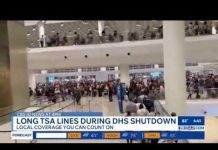
When federal agents show up at your airport gate during spring break, the real story isn’t the uniforms—it’s what the government is quietly admitting about a system that can’t absorb stress.
Story Snapshot
- ICE agents deployed to major U.S. airports on March 23, 2026, to support TSA amid severe spring break disruptions driven by mass employee callouts.
- Tom Homan framed the mission as basic operational help—crowd control and exit monitoring—while insisting ICE would not do specialized screening work.
- Sen. Cory Booker attacked the move as performative, saying agents were “roaming around” without clear purpose.
- Observers reported a gap between the official description of “help” and what travelers could actually see happening on the ground.
Airports Don’t Collapse from Terror Threats—They Collapse from Staffing
ICE’s airport deployment landed in the worst possible moment for traveler patience: spring break lines, delayed flights, and security checkpoints operating below capacity because TSA staff called out in large numbers. The numbers that triggered the response were stark, including reports of 41% absenteeism at Atlanta’s Hartsfield-Jackson and similarly high rates at other hubs. This wasn’t a policy debate at first; it was a logistics emergency with angry crowds.
Tom Homan’s explanation tried to keep the mission narrow and defensible: put ICE agents on “simpler tasks” so TSA officers can stay on screening. That distinction matters because it signals a boundary line the administration knows it cannot cross casually. Screening requires specific training and procedures, and Homan publicly emphasized a refusal to do work agents aren’t trained to do. The immediate question became whether “crowd control” actually reduces a four-hour line.
What ICE Can Do at an Airport Without Touching the Checkpoint
Airports run on choreography: passengers move, bags move, employees move, and every bottleneck compounds. When Homan talks about exit monitoring and crowd control, he’s talking about tasks that can keep corridors from turning into choke points and can help separate problems from panics. If a line snakes into a terminal walkway, it can jam other flows: boarding, deplaning, and even emergency access. In theory, extra personnel can prevent cascading failures.
CNN’s on-the-ground description, relayed in the research, complicates the tidy theory. A reporter in Houston described agents “standing around the edges” and not processing passengers. That doesn’t prove the deployment failed; it proves the public-facing optics failed. Crowd control is often invisible when it works and painfully obvious when it doesn’t. A traveler who misses a flight will not credit “exit monitoring” as meaningful help, even if it prevented a bigger mess.
The Booker-Homan Clash Is Really About Trust, Not Tactics
Sen. Cory Booker’s critique—that agents appeared to be “roaming around”—aims at a familiar worry: once ICE becomes visible in a non-immigration setting, some Americans suspect the real purpose is intimidation or opportunistic enforcement. That fear isn’t hypothetical, because President Trump also said immigration enforcement would continue and described airports as “fertile territory” for arrests, even while insisting that was not the reason for the deployment. Mixed messages invite suspicion.
Homan’s reported posture, by contrast, leans on common-sense triage: you deploy federal capacity where the system is breaking. Conservatives tend to respect that instinct when it prioritizes order, safety, and the basic function of infrastructure. If TSA cannot staff its own checkpoints during peak travel, Washington must either surge manpower or accept failure as normal. Booker’s line plays well on cable news, but it risks sounding like politics-first criticism when families are stuck in terminals.
The Security Angle That Quietly Changes the Story
Former TSA Administrator John Pistole added a different rationale: deterrence. A more conspicuous federal presence can discourage opportunistic crime in dense crowds, and it can complicate planning for anyone looking to exploit chaos. Pistole even referenced elevated safety concerns tied to conflict with Iran, which reframes the deployment as more than a staffing bandage. Conservatives generally accept visible deterrence as a legitimate public-safety tool, especially when police forces are stretched thin by crowds.
The unresolved tension sits right there: deterrence and enforcement can overlap. An ICE uniform communicates authority; it also communicates that immigration consequences might be close at hand. Democratic lawmakers argued the presence could make some travelers nervous, and that concern isn’t crazy—airports are stressful without adding uncertainty. Common sense says the government should not create needless panic in a crowded terminal, because panic itself becomes a safety hazard.
The Precedent Washington Is Testing in Plain Sight
This is the part most people miss while watching the partisan shouting: the federal government is trial-running a model where agencies fill each other’s gaps during domestic disruptions. Today it’s TSA staffing callouts; tomorrow it could be another chokepoint—weather, cyber outages, or coordinated sick-outs. If ICE can be used as a general-purpose federal “surge workforce,” then Congress and voters should demand clear limits, public guidance, and after-action transparency.
Airports cannot run on improvisation forever. If ICE’s visible presence helped stabilize crowds, officials should prove it with operational metrics—wait times, incident rates, checkpoint throughput. If it didn’t, leaders should say so and fix TSA staffing, not pretend a few uniforms solved it. The conservative position that best fits the facts is simple: keep the public safe, keep systems functioning, and stop using ambiguity as a political strategy.
Tom Homan Blasts Sen. Cory Booker for Fearmongering As ICE Is Deployed to Airports Across the US
https://t.co/iktsH5z302— Townhall Updates (@TownhallUpdates) March 24, 2026
The biggest open loop remains the one travelers care about most: will these deployments become normal every time TSA buckles, and will “help” quietly drift into enforcement-first activity as politics hardens? The administration says no, critics say yes, and the airport concourse becomes the stage where Americans test which side matches reality. If Washington wants trust, it has to show its work—especially when the badge says ICE.
Sources:
ICE agents are at airports to help TSA ease travel woes. Here’s what we know about their deployment