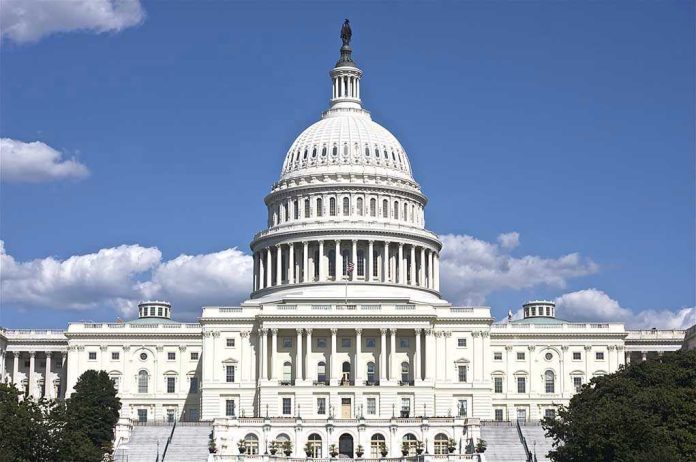
The House Oversight Committee just voted to hold a former president and first lady in criminal contempt of Congress for refusing to testify about what they knew regarding Jeffrey Epstein, a confrontation that could send Bill and Hillary Clinton into a legal battle unprecedented in American history.
Story Snapshot
- House Oversight Committee voted January 21, 2026 to advance criminal contempt resolutions against Bill and Hillary Clinton for defying subpoenas in the Epstein investigation
- The Clintons skipped scheduled depositions in mid-January, offering sworn statements instead, which Republicans rejected as insufficient
- Three Democrats broke ranks to support contempt charges against Hillary Clinton, signaling bipartisan concern over the subpoena defiance
- The full House vote looms within weeks, potentially referring the case to the Justice Department for prosecution carrying up to one year in prison and $100,000 in fines
- Attorney General Pam Bondi faces her own scrutiny for missing the Epstein Files Transparency Act deadline, complicating the partisan dynamics
When Congressional Subpoenas Become Constitutional Showdowns
Chairman James Comer made his position crystal clear: subpoenas are not suggestions. The Kentucky Republican orchestrated a committee vote that passed 34-8 for Bill Clinton’s contempt resolution, with surprising Democratic crossover support for Hillary Clinton’s resolution. The Clintons argue these subpoenas are legally invalid, pointing to their minimal contact with Epstein over two decades ago. Their spokesperson Angel Urena emphasized they offered sworn statements and proposed a closed-door interview in New York. Republicans dismissed these alternatives as attempts to dictate terms to Congress, noting Bill Clinton’s 1998 impeachment for perjury as evidence of a pattern of evasion under oath.
The Epstein Files Nobody Can Find
This confrontation stems from the Epstein Files Transparency Act, legislation President Trump signed in November 2025 requiring the Justice Department to release all remaining documents on Jeffrey Epstein and Ghislaine Maxwell by December 19, 2025. That deadline passed without compliance. The House Oversight Committee issued its own subpoenas in August 2025, targeting not just the Clintons but former FBI Director James Comey and others connected to government handling of the Epstein case. The investigation focuses particularly on international sex-trafficking efforts during Hillary Clinton’s tenure as Secretary of State, though no evidence has emerged proving substantial Clinton involvement in Epstein’s criminal network.
Where Democrats Split and Republicans Rally
The partisan divide cracked in unexpected ways. Ranking Democrat Robert Garcia of California blasted the proceedings as Republican obsession and political score-settling rather than serious investigation. Yet three Democrats voted for Hillary Clinton’s contempt resolution, with nine total Democratic votes crossing party lines across both resolutions. This fracture reveals deeper tensions within the party about accountability versus partisan loyalty. Meanwhile, Democrats attempted to flip the script by proposing an amendment to hold Attorney General Pam Bondi in contempt for the Justice Department’s failure to release Epstein files. Republicans blocked that amendment, creating an obvious double standard that Democrats gleefully highlighted during the contentious committee hearing.
The Precedent That Changes Everything
No former president has faced criminal contempt charges in this context. Previous attorneys general subpoenaed by Congress—Eric Holder, Loretta Lynch, Jeff Sessions, William Barr, Merrick Garland—avoided contempt by providing written testimony or negotiating alternative arrangements. The Clintons attempted similar maneuvers, offering flexibility on scheduling and formats throughout fall 2025 and early January 2026. Comer rejected every proposal, insisting on in-person depositions under oath in Washington. The February 9, 2026 virtual interview scheduled with Ghislaine Maxwell from prison adds another explosive element, potentially revealing information that could justify the aggressive pursuit of Clinton testimony or expose the investigation as political theater.
What Happens When the Full House Votes
Speaker Mike Johnson can afford to lose only two Republican votes when the contempt resolutions reach the House floor in the coming weeks. Passage seems likely given the committee’s strong majority and Democratic crossover votes. If the full House approves, the resolutions move to the U.S. Attorney for the District of Columbia, who decides whether to prosecute. Criminal contempt of Congress carries a maximum sentence of one year in prison and a $100,000 fine, though actual prosecution and imprisonment remain extraordinarily rare. The real damage may be political rather than legal, reviving decades-old associations between the Clintons and Epstein just as transparency advocates and victims’ families demand answers the Justice Department has failed to provide. The constitutional standoff between congressional oversight and executive privilege—even for former officials—will test whether America truly operates under the principle that no one is above the law, or whether partisan warfare has simply found a new weapon.
Sources:
House Oversight panel votes to hold Bill and Hillary Clinton in contempt of Congress
House committee set to approve resolutions holding Clintons in contempt
Chairman Comer blasts the Clintons unreasonable demands to evade contempt
House Republicans threaten Bill Clinton with contempt of Congress
Republican-led House Oversight Committee rejects Clintons bid for unofficial Epstein meeting
Hillary Clinton skips deposition