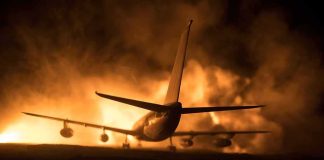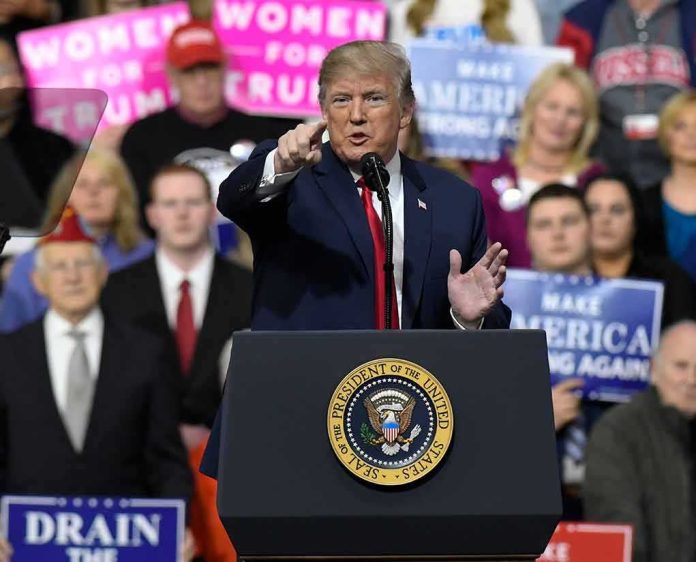
President Trump has made it crystal clear: if Iran ever succeeds in killing him, he says Iran will be “obliterated” and left with “nothing” standing.
Story Snapshot
- President Trump says he has left instructions for Iran to be bombed or “obliterated” if Tehran or its proxies ever assassinate him.
- U.S. prosecutors have charged an Iran-linked man in a plot to surveil and kill Trump before the 2024 election, citing ties to Iran’s Islamic Revolutionary Guard Corps.
- Iranian hardliners, including crowds at Ayatollah Khamenei’s funeral, have openly chanted and displayed banners promising to kill Trump.
- Iran’s government publicly denies involvement in assassination plots, but U.S. intelligence and law enforcement say the threats are real and ongoing.
Trump’s Standing Orders: What He Says Will Happen If Iran Kills Him
President Trump has bluntly warned that if Iran or its proxy groups ever manage to assassinate him, Iran will be “obliterated” and “there won’t be anything remaining” of the regime. He told reporters he has “left directives” for such a scenario and said he has instructed his advisers that Iran must be hit “at levels that they’ve never seen before” if they carry out their threats. In interviews, he has added that there would be “nothing left” of Iran if it crossed that line.
Trump has repeated the idea of a standing order more than once, describing how he has given firm instructions to his team for a devastating military response. He said that if “anything happens,” American forces should “wipe them off the face of this earth,” making clear he sees an attack on him as an attack on the United States itself. At the same time, legal experts note that any actual strike would still have to be decided by the next commander in chief under the Constitution, not by an automatic “dead man’s switch.”
Real Assassination Plots and the Islamic Revolutionary Guard Corps
Trump’s warning does not come out of thin air. In late 2024, the United States Department of Justice announced murder-for-hire and related charges against Farhad Shakeri, an Iranian national, and two American accomplices. Prosecutors said Shakeri was tasked by officials of the Iranian regime with surveilling and plotting to assassinate then President-elect Donald J. Trump. According to the criminal complaint, he was instructed to come up with a plan within seven days to monitor and kill Trump during the closing weeks of the 2024 campaign.
Justice Department officials linked the plan to Iran’s Islamic Revolutionary Guard Corps, the powerful arm of the regime that handles foreign terror operations and has long vowed revenge for the 2020 U.S. strike that killed General Qassem Soleimani. Time magazine reported that Trump has faced repeated threats from Iranian actors since that strike, including statements that “missiles are locked and loaded” and open talk of vengeance. Iran’s government has publicly denied that it ordered any assassination plots, but it has refused to hand over suspects or cooperate with the U.S. investigation.
Threats, Chants, and Denials from Tehran
Beyond criminal charges, Iranian officials and state-linked voices have used public threats against Trump as propaganda. A senior Iranian security figure warned Trump to “be careful not to get killed” after he threatened massive strikes if Iran tried to block oil in the Strait of Hormuz, a clear warning aimed at the American president himself. An ally of Supreme Leader Ayatollah Khamenei joked that Trump could be assassinated by a “micro-drone” while sunbathing at Mar-a-Lago, suggesting he “can no longer sunbathe” safely because he could be targeted at any moment.
Those words have been backed by hostile crowds. At Khamenei’s funeral processions, Iranian supporters held banners that read “Hey Trump we will kill you” and chanted for revenge, while performers called for Trump’s death during public ceremonies. U.S. and Israeli intelligence have also shared information indicating that elements of Iran’s hardline leadership desire to target Trump, even when there is no detailed operational plan attached. Iran’s foreign ministry calls media reports about assassination plots “malicious” and insists they are false, but the regime has not toned down its rhetoric.
What Happens Constitutionally If a President Is Assassinated?
Trump’s fierce language raises an important question for patriots: who actually makes the call if a president is killed? Under the 25th Amendment and the Presidential Succession Act of 1947, power transfers instantly to the vice president, who becomes commander in chief at the moment of the president’s death. Today that means Vice President JD Vance would take over and would have full authority over any military response, including whether to follow Trump’s instructions or choose a different course.
Experts quoted by the Public Broadcasting Service note that there is no legal way to set up an automatic attack that triggers the second a president dies. Any order must still pass through normal launch protocols and the judgment of the new president and senior military leaders. Trump can leave clear guidance and demand a hard line, but constitutional checks still apply. For conservatives who care about both strong defense and limited, lawful government, this balance matters: America can be ready to hit back, but cannot allow any leader to bypass the law in a moment of crisis.
Sources:
pjmedia.com, youtube.com, bbc.com, wsj.com, cnn.com, time.com, thehill.com, justice.gov, aljazeera.com