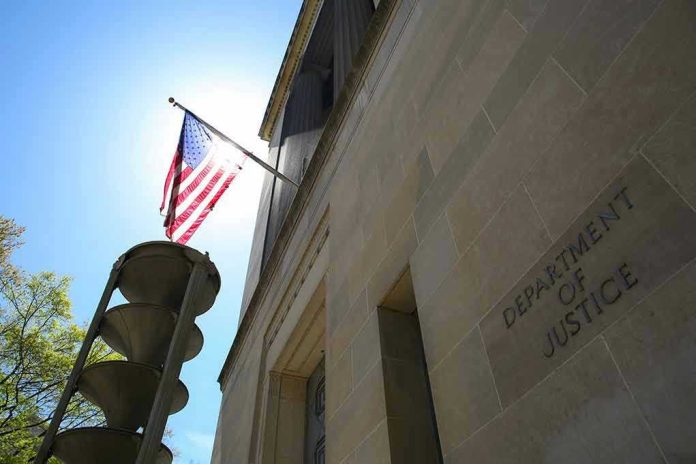
An Afghan national who allegedly ambushed two National Guard troops just blocks from the White House now faces federal charges that could put him on death row if convicted.
Story Snapshot
- Federal prosecutors have added death-penalty-eligible charges against accused National Guard shooter Rahmanullah Lakanwal.
- The alleged ambush killed 20-year-old Spc. Sarah Beckstrom and critically wounded Staff Sgt. Andrew Wolfe near the White House.
- The Justice Department is now weighing whether to formally seek the death penalty under federal law.
- The case highlights long‑running concerns about vetting Afghan nationals and protecting U.S. troops on American soil.
What Federal Prosecutors Say Happened Near the White House
Federal court records say 29‑year‑old Afghan national Rahmanullah Lakanwal drove from Bellingham, Washington, to Washington, D.C., with a stolen firearm in his car. Prosecutors allege that on November 26, 2025, he lay in wait near the Farragut West Metro station, about three blocks from the White House, where West Virginia National Guard troops were patrolling as part of a federal crime‑crackdown deployment ordered to secure the capital. They say he then carried out an ambush‑style attack on two uniformed Guard members walking on duty.
According to the indictment, Lakanwal approached Army Specialist Sarah Beckstrom and Air Force Staff Sergeant Andrew Wolfe from behind and shot them in the back of the head with a.357 Smith & Wesson revolver. Beckstrom, just 20 years old, died the next day from her wounds, while 24‑year‑old Wolfe was left critically injured and fighting for his life. Officials say both soldiers were part of the West Virginia National Guard, sent to D.C. to help restore public safety near key federal buildings.
New Charges Open the Door to the Federal Death Penalty
A new 17‑count superseding indictment filed in federal court goes far beyond the original firearms and murder charges. It now includes counts such as murder of a person assisting a federal officer, three counts of attempted murder of a person assisting a federal officer, discharge of a firearm causing death, and three counts of discharging a firearm during a crime of violence, among others. The Justice Department notes that several of these crimes are eligible for the death penalty under federal law if a jury finds him guilty beyond a reasonable doubt.
The same grand jury that returned the new indictment also issued “special findings” that are required to even consider capital punishment in a federal case. Those findings, according to prosecutors, include that the killing was intentional, that more than one person was targeted, and that the victims were assisting federal officers, all factors that can support a death sentence under federal statutes. Those findings trigger a formal review by the Department of Justice Capital Case Committee, which must advise whether the Attorney General should authorize seeking the death penalty.
Not Guilty Plea, CIA Partner Past, and Questions About Vetting
Despite the new charges, Lakanwal has pleaded not guilty to every count in both the earlier and superseding indictments. He remains in federal custody and is being held without bond as the case moves through pretrial hearings. A federal judge has not yet set a trial date, and the court docket shows the next hearing scheduled for later this year, underscoring how complex capital‑eligible cases can become long, drawn‑out battles. Under American law, he is presumed innocent unless a jury convicts him.
Media reports and court filings state that Lakanwal is an Afghan national who previously worked as a partner force with the Central Intelligence Agency in Afghanistan before entering the United States during the post‑withdrawal resettlement wave. Defense attorneys are pressing the government to turn over records on his past service and full mental health history, arguing those files could shape how a jury views his intent and responsibility if the case reaches a death‑penalty phase. Their push highlights deeper questions about how thoroughly Afghan partners were vetted before being resettled in American communities.
How the Federal Death Penalty Decision Will Be Made
Even with death‑eligible charges on the table, the Justice Department has not yet formally announced that it will seek a death sentence in this case. Under long‑standing federal policy, local United States Attorneys must submit a detailed package to the Department’s Capital Case Committee whenever charges allow the death penalty, laying out the facts, aggravating factors, and any reasons against a capital trial. Defense lawyers then get a chance to present their own evidence against seeking death, including mental health issues or past cooperation with the United States.
Only after that internal process does the Attorney General make a final call on whether to pursue the death penalty, and that decision has not yet been made public in the Lakanwal case. Separate from the federal process, it is also important that the local District of Columbia court system cannot impose the death penalty because the city abolished it years ago, which is why prosecutors moved key charges into federal court where capital punishment is still allowed in limited circumstances. For many Americans, especially military families, the case has become a test of whether the system can deliver real justice for an allegedly targeted attack on U.S. troops in the nation’s capital.
Sources:
cbsnews.com, thehill.com, abc7ny.com, abcnews.com, facebook.com, youtube.com