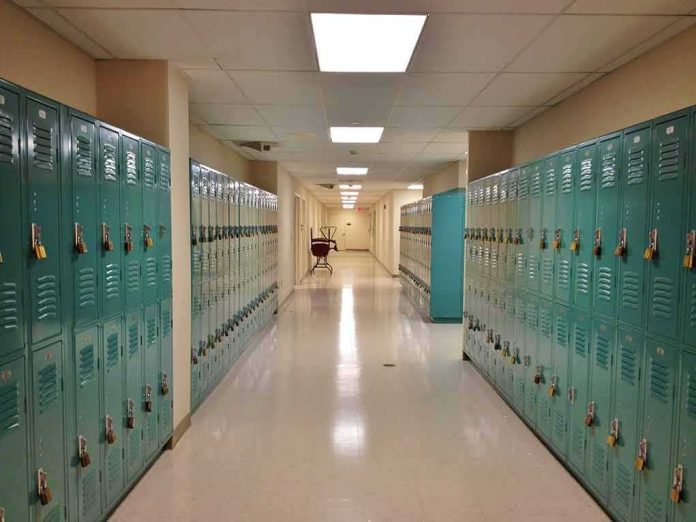
Students at Tracy High say they found a phone recording them in the boys’ locker room, and police arrested their head football coach less than a day later.
Story Snapshot
- Police say a student found a phone recording in a boys’ locker room and turned it in.
- Tracy Police Department announced the arrest of teacher and head coach Jeffrey Pribble, 48.
- Multiple outlets reported the phone belonged to Pribble and that students deleted the clip.
- Locker rooms carry a strong legal expectation of privacy under long-standing case law.
What Police Say Happened Inside the Locker Room
Tracy Police Department reported that a cell phone was discovered recording students while they changed in a boys’ locker room at Tracy High School on campus. The agency announced the arrest of a high school teacher related to the incident and identified the teacher as head football coach Jeffrey Pribble, age 48. Local reporting says students paused the recording, deleted it, and turned the phone over to staff before police were called. Authorities took Pribble into custody within roughly 24 hours of the discovery.
Police statements did not list charges in the early releases. News accounts consistently tie the device to Pribble by name, citing police as the source. Students were in various stages of changing when they noticed the phone. Staff contacted law enforcement after receiving the device, according to these reports. Formal charges and court filings will detail counts and potential enhancements if prosecutors pursue them; that process typically follows the initial arrest.
Why Locker Rooms Are Legally Different
Courts treat locker rooms as high privacy spaces where people undress and expect bodily privacy. A federal appeals court held that school video monitoring in locker rooms violates the Fourth Amendment rights of students. The ruling made clear that recording in these spaces is highly intrusive and unreasonable under constitutional standards. State voyeurism laws also prohibit filming people where they change clothes without consent. Schools that ignore these lines face legal risk and public backlash.
District policies echo that legal baseline. Tracy Unified School District handbooks restrict electronic recording devices on campus, with special sensitivity around areas tied to student privacy and instruction. The district also states that camera footage showing multiple students is confidential and shared with police when laws may be broken. These rules exist to set clear lines: public hallways are one thing; changing areas are another. Parents expect that line to hold every minute of the school day.
How the Arrest Fits a Wider Pattern
Hidden-recording allegations in locker rooms follow a common response path. Students or staff discover a device, school leaders secure it, and police take over. The timeline often moves fast, because the law strongly protects privacy in places where students undress. Tracy Police Department’s public announcement came the day after the locker room discovery, which matches that pattern of swift action when the facts point to on-campus filming of minors in private spaces. Media coverage signals intense parent concern and a trust breach that schools must address quickly.
🚦Tracy High School, CA
On Friday, September 12, 2026, the Tracy Police Department confirmed the arrest of Tracy High School Head Coach and Physical Education Teacher Jeffery Pribble, aged 48. According to a police press release, students discovered a cell phone recording them… pic.twitter.com/q9SVr7ryEQ— Matters of Accountability (@mattersofacct) September 14, 2026
American conservative values stress parental rights, student safety, and equal enforcement of the law. On these facts, the swift handoff from school staff to police and the quick arrest reflect common-sense boundaries. A locker room is not a gray area. If investigators confirm a willful recording in that setting, that crosses both legal and moral lines. If evidence later complicates the picture, that will come through court records. For now, the police account lays out a direct chain of events.
What Comes Next for Parents, Players, and the Program
Parents will want to know three things right away. First, whether their child appeared on any recording. Second, how the district supports affected students. Third, what guardrails now prevent devices from entering private areas. The district’s policy framework gives it tools to act, but practice matters. Many schools step up supervision, run surprise checks of changing areas, retrain staff, and set bright-line bans on personal devices in locker rooms. Clear steps rebuild trust and reduce risk.
Sources:
nypost.com, kcra.com, stocktonia.org, archive.org, cbsnews.com, abc10.com, localnewsmatters.org