Iranian state media announced that Supreme Leader Ali Khamenei was killed in joint United States–Israeli strikes, triggering mourning and a high-stakes power scramble in Tehran.
Story Snapshot
- State outlets reported Khamenei’s death after coordinated United States–Israeli strikes.
- Reports said his close family members were also killed in the attacks.
- Iran declared a 40-day mourning period and vowed revenge.
- No immediate successor was named, pointing to a tense transition.
State Confirmation and Immediate Aftermath in Tehran
Iranian broadcasters and news agencies said late February that Khamenei, 86, died during joint United States–Israeli strikes that hit targets in Tehran and beyond. Major international outlets relayed those state media announcements and noted the scale of the operation and its political shock inside Iran. BBC video captured the on-air moment the death was announced to the country. Officials and aligned media framed the event as an assassination, while security forces moved to maintain order in key sites.
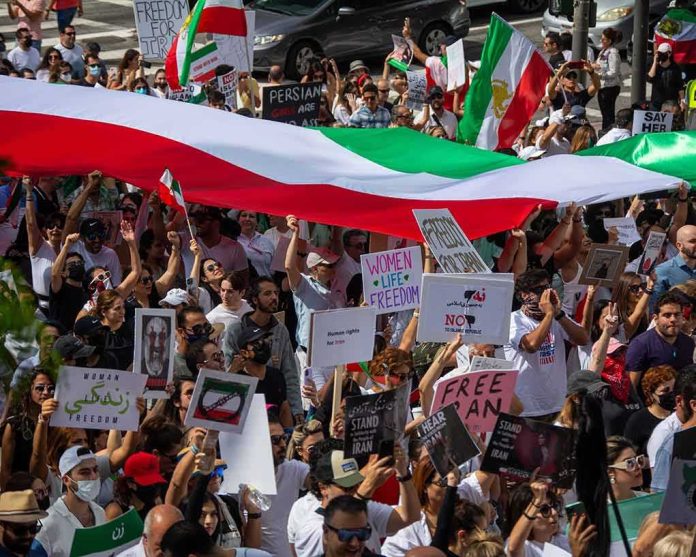
Follow-up reporting described the strikes as part of a coordinated campaign aimed at Iran’s top leadership and command nodes. Coverage emphasized that the death of the Supreme Leader, who held ultimate authority over the military and courts, created a sudden leadership vacuum at the very top of the system. State coverage and regional channels showed mass gatherings and mourning ceremonies in major cities. The announcements unified hardline factions in calls for a forceful response, while also exposing questions about succession rules and control.
Mourning, Retaliation Threats, and Signals of a Power Vacuum
Iran’s leadership declared national mourning, with several outlets reporting a 40-day period and urging public displays of grief. Senior figures promised revenge and called it a right and duty under the circumstances, signaling an official line that external enemies were responsible and would face consequences. Analysts highlighted that, despite the shock, Iran’s security apparatus, including the Islamic Revolutionary Guard Corps, remained operational. That reality raised the odds of retaliation while reducing the chance of immediate state collapse.
Reports also stated that close relatives of Khamenei, including his daughter, son-in-law, and a grandchild, were killed in the strikes, underlining the precision and reach of the attack into the leader’s personal circle. The government’s early messaging did not name a successor. That gap fueled uncertainty over whether power would consolidate around a single figure or shift to an interim mechanism. Several outlets referenced an interim arrangement to manage the transition, reflecting the state’s need to show continuity to its base and its rivals.
Succession Mechanics and What Leadership Loss Usually Changes
Iran’s constitution and clerical system point to bodies like the Assembly of Experts to handle succession, but immediate clarity was missing in the first hours after the announcement. This created a narrow but risky window when decisions about command, diplomacy, and security could be contested. Research on leadership targeting warns that removing the top figure rarely removes the system. When the wider coercive and bureaucratic networks stay intact, elites often regroup and reassign roles rather than surrender power.
Past studies on leadership decapitation show mixed outcomes. Some findings suggest a higher chance of conflict termination after such strikes, while others show organizations adapt and persist, especially when they have strong internal policing and patronage systems. In this case, international coverage stressed both the severity of the loss and the resilience of Iran’s security state. That means the most likely short-term path features mourning, internal alignment, and calibrated retaliation, rather than rapid regime change.
What This Means for Americans Watching a Fragile Moment
United States policymakers now face a period when missteps could widen war. Iran’s vow of revenge raises risks for United States forces, shipping, and partners across the region. Americans who worry about endless wars, high energy costs, and leaders who dodge accountability have reason to watch closely. A wider fight could hit oil markets, raise prices at the pump, and strain families already stretched by inflation and past policy errors at home. Clear goals and limits matter when the stakes are this high.
Limits and Open Questions in Early Reporting
Early information relied on state media announcements and international relays. The reports were consistent on the basic fact of Khamenei’s death and the absence of a named successor, but they lacked primary Iranian government documents, forensic records, or a detailed public list of additional senior casualties. That leaves open questions about the exact chain of command changes and the pace of the transition, even as the public story of mourning and promised revenge hardens.
Sources:
en.wikipedia.org, youtube.com, rt.com, dw.com, bbc.com