A 58-year-old New York man tried to hire a hitman with bourbon and pocket change to feed his girlfriend’s ex to hogs, but the farmer he contacted turned out to be an FBI informant wearing a wire.
Story Snapshot
- Jeal Sutherland sentenced to 87 months in federal prison for orchestrating a murder-for-hire plot against his partner’s ex, offering $1,450, Wild Turkey bourbon, and burner phones as payment
- The intended hitman was actually an FBI informant, a convicted murderer on lifetime parole, who recorded every conversation about luring the victim and disposing of his body by feeding it to pigs
- Sutherland arranged for a dead Canada goose with a threatening note to be placed on the victim’s mother’s doorstep as intimidation before the planned murder
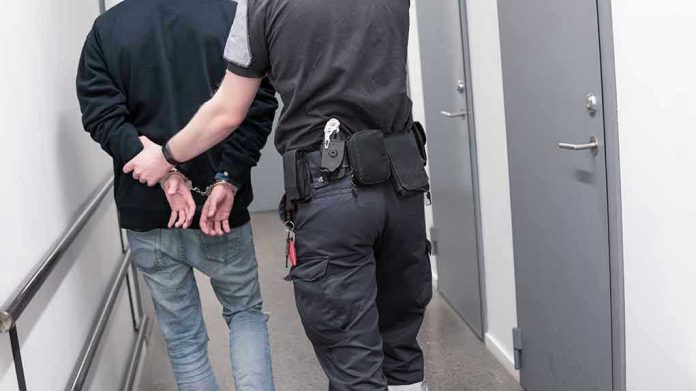
- FBI arrested Sutherland at a bowling alley sting operation in January 2025 after he handed over cash, phones, and bourbon to finalize the gruesome plot
Bourbon, Burner Phones, and a Bowling Alley Bust
Jeal Sutherland of Colonie, New York, discovered the hard way that ordering a murder from your cell phone leaves a digital trail even bourbon can’t wash away. Federal prosecutors revealed that Sutherland spent months plotting to eliminate a romantic rival—the father of his then-girlfriend’s child—through a scheme so bizarre it reads like rejected crime fiction. He contacted someone he believed was a Pennsylvania hog farmer willing to commit murder for money, debt forgiveness, and a bottle of Wild Turkey bourbon. That farmer was actually a convicted murderer turned FBI informant, recording every disturbing detail for federal prosecutors.
The Macabre Details of a Failed Murder Plot
Between November 2024 and January 2025, Sutherland meticulously planned the execution and disposal. He arranged for the victim to be lured with a fake job offer after his release from state prison, murdered, transported in a van rented from a nun for $250, then driven to Pennsylvania where the body would be fed to hogs. The plan involved burner phones for untraceable communication and over $1,000 in cash payments. Sutherland even directed the placement of a dead Canada goose carcass with a threatening note on the intended victim’s mother’s doorstep, a warning shot meant to terrorize the family before carrying out the final act.
On January 26, 2025, Sutherland met his supposed hired killer at a bowling alley in Latham, New York. He handed over $1,450 in cash, burner phones, and the promised bottle of Wild Turkey bourbon to seal the deal. The next day, FBI agents arrested him. He has remained in federal custody ever since, facing the consequences of a plot that never came close to succeeding but revealed the darkness of his intentions.
Federal Prosecution Under Interstate Commerce Laws
U.S. District Judge Mae D’Agostino sentenced Sutherland on February 10, 2026, to 87 months in federal prison, a $15,000 fine, and three years of supervised release. The case was prosecuted under 18 U.S.C. Section 1958, which targets murder-for-hire schemes using interstate commerce facilities like cell phones. First Assistant U.S. Attorney John A. Sarcone III emphasized the audacity of Sutherland’s actions, noting he thought he could orchestrate murder from his phone without consequences. The successful sting operation demonstrated how federal law enforcement intercepts violent plots before they claim victims.
Craig L. Tremaroli, Special Agent in Charge of the FBI Albany Field Office, described the plot’s details as deeply disturbing. The FBI’s proactive use of a cooperating informant prevented tragedy and protected an unsuspecting victim who had no idea he was targeted for death. This case underscores the effectiveness of sting operations in disrupting violence before it unfolds, reinforcing the deterrent power of federal prosecution for those who believe modern technology provides anonymity for their criminal schemes.
When Jealousy Turns Deadly and Law Enforcement Intervenes
The Sutherland case is a stark reminder that romantic jealousy can spiral into homicidal intent when individuals lack moral restraint and accountability. A man who should have walked away from a complicated relationship instead chose to plot the murder and grotesque disposal of a father simply because he fathered a child with Sutherland’s partner. The bizarre payment method—bourbon and cash—alongside the involvement of a nun’s rental van and hog farm disposal adds layers of depravity that reveal how far Sutherland was willing to go to eliminate his perceived rival.
The victim, whose identity remains protected, was spared due to the vigilance of federal law enforcement and the cooperation of an informant with his own dark past. The FBI’s ability to turn a convicted murderer into an asset that prevents future violence speaks to the complex realities of criminal justice, where redemption and public safety intersect. Sutherland’s partner and her child now live with the knowledge that someone they trusted was capable of orchestrating such horror, a betrayal that extends beyond the intended victim to an entire family.
The Broader Message About Murder-for-Hire Prosecutions
Federal authorities use cases like Sutherland’s to send a clear message: cell phones and interstate communication do not provide cover for murder plots. The conviction reinforces precedents that allow the Department of Justice to prosecute individuals who use modern technology to facilitate violence across state lines. While the specific details of bourbon payments and hog disposal are unusual, the underlying crime fits a pattern of murder-for-hire schemes thwarted through undercover operations. Law enforcement’s success here should reassure communities that proactive investigation prevents violence rather than merely reacting after tragedy strikes.
Sources:
Capital Region Murder Plot – WPDH
Colonie Man Arrested in Murder-For-Hire Plot Involving Hogs and Bourbon – CBS6 Albany