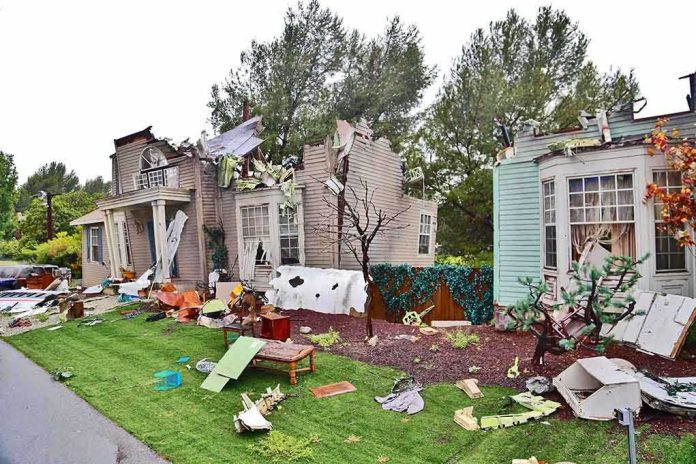
Wildfire survivors trying to rebuild their lives in Pacific Palisades are being victimized a second time — by thieves stripping building materials and copper wire from damaged properties while bureaucratic delays keep lots vacant and unguarded.
Story Snapshot
- Looting of building materials and copper wire from fire-damaged Palisades properties is an ongoing problem as recovery drags on.
- Permit delays have left the majority of destroyed lots vacant and exposed — early reports showed only about 10% of destroyed lots had any permit in process.
- Slow debris removal and displaced residents create ideal conditions for opportunistic theft, with normal neighborhood guardianship gone.
- City and county officials issued emergency orders to speed rebuilding, but progress on the ground remains uneven street by street.
Thieves Targeting the Rubble Left Behind
More than a year after the Palisades Fire tore through one of Los Angeles’s most storied neighborhoods, residents attempting to rebuild are confronting a grim secondary crisis. Opportunistic thieves are targeting vacant lots and partially demolished structures, stealing copper wire, lumber, and other building materials. For families already navigating insurance disputes, contractor shortages, and a maze of permits, discovering that their materials have been stripped away adds financial injury to an already devastating situation.
The conditions enabling this theft are directly tied to how slowly the official recovery has moved. Early in the process, reports indicated that only roughly 10% of destroyed lots had a permit at any stage of the process, with around 400 permits issued against thousands of destroyed structures. [1] That means the vast majority of fire-scarred lots sat empty, unsecured, and largely unmonitored — a straightforward invitation to anyone willing to exploit a neighborhood still reeling from catastrophe.
Bureaucratic Delays Created the Vulnerability
Governor Gavin Newsom and Los Angeles Mayor Karen Bass issued a series of emergency executive orders intended to streamline and expedite the permitting process. [2] Despite that political fanfare, the on-the-ground reality told a different story. Early reports documented that Los Angeles had approved as few as four permits to rebuild homes destroyed in the January wildfires. [7] Debris removal — the essential first step before any rebuilding can begin — was still getting underway at some sites months after the fire, including at the roughly 170-unit Palisades Bowl Mobile Home Estates. [3]
When recovery stalls at the bureaucratic level, the physical landscape stays frozen in disaster. Displaced residents cannot return to watch over their properties. Contractors cycle in and out on irregular schedules. Police resources remain stretched across evacuation logistics and infrastructure recovery. That combination of factors is precisely what post-disaster crime experts warn creates elevated property crime risk — and it is exactly what Palisades residents have been living with. [8]
Progress Is Real but Uneven — and the Gap Is Being Exploited
To be fair, some rebuilding progress has occurred. More than 1,070 rebuilding permits have been issued across the Palisades, over 340 projects have begun construction, and the first fully rebuilt home received a certificate of occupancy. [4] That showcase home — a four-bedroom, 4.5-bath house completed by a developer in six months — drew considerable media attention. [4] But one developer-built showcase does not represent the experience of the average family trying to rebuild on their own timeline with their own resources.
Driving through the devastated areas reveals a patchwork reality: story poles rising on some lots, foundations being poured on others, and block after block still sitting as bare, unsecured rubble. [6] That uneven landscape is exactly where thieves operate — moving between active construction zones and abandoned lots where no one is watching. Residents who lost everything to fire now have to worry about losing their rebuilding materials to criminals emboldened by the chaos of a slow and disorganized recovery. The city’s failure to move faster on permits and debris removal did not just delay rebuilding — it created the conditions that made looting possible.
Sources:
[1] Web – Opportunist ghouls looting stricken Palisades residents as they try to …
[2] YouTube – The Rebuilding Problem No One Is Talking About
[3] Web – Palisades Rebuild and Recovery – Los Angeles City Planning
[4] Web – Wildfire debris removal underway at Palisades Bowl Mobile Home …
[6] YouTube – Pacific Palisades homeowner talks rebuilding process
[7] Web – Letter From Los Angeles: ICE Raids and Fear Cloud Rebuilding Efforts
[8] Web – Los Angeles issues only 4 permits to rebuild homes after …