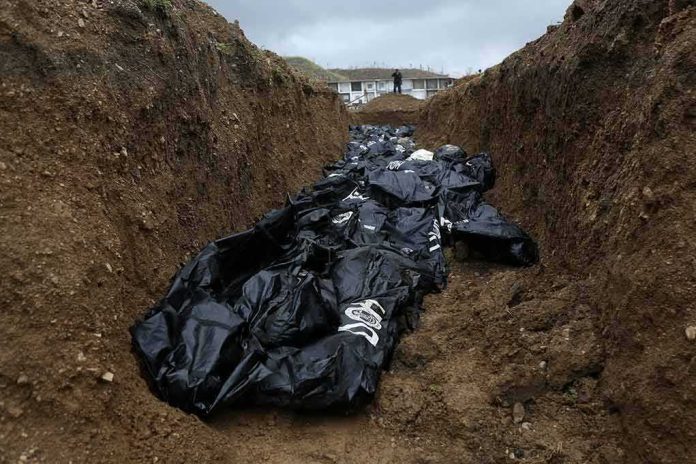
Gaza City carried 100 coffins through Zeitoun, closing a three-year wait to bury the dead recovered from crushed homes.
Story Snapshot
- Palestinians held a mass funeral in Gaza City’s Zeitoun neighborhood for about 100 people recovered from rubble.
- Local crews worked with the International Committee of the Red Cross to retrieve remains using heavy machinery.
- Many of the dead were children; mourners prayed and buried the remains after memorial addresses.
- Reports tie the deaths to Israeli strikes on residential homes during the early war period.
What Happened In Zeitoun
Palestinians in Gaza City held a mass funeral procession for about 100 people recovered from the rubble of destroyed homes in the Zeitoun neighborhood. Mourners carried caskets through streets lined with families who had waited years to lay their loved ones to rest. Crews had uncovered the remains during a recent recovery phase. The funeral followed prayers and community eulogies. The procession ended with burials at local cemeteries in Zeitoun after final rites.
Reports identify the dead as members of several families, including Rahim, Balawi, Malaka, Qanbour, and Salmi. Local authorities linked their deaths to strikes on residential homes in the early months of the war. Some outlets cited a time frame of roughly two and a half years since the strikes. Others dated the attack to late 2023. The coverage differs on exact counts, but every report describes a single mass funeral near 100 burials.
How The Remains Were Recovered
Local recovery teams, working with the International Committee of the Red Cross, used excavators, trucks, and bulldozers to clear collapsed structures and remove remains. The renewed push came as part of a staged effort to locate and recover the missing. Gaza Civil Defence described a second-phase project launched in mid-July to search sites that had remained inaccessible. The work led to the discovery of many children among the dead, a detail mourners repeated at the graveside.
Officials and volunteers faced a hard task in documenting fragments, grouping remains, and preparing them for burial. International guidance urges careful recovery, recording, and identification before burial whenever possible. Conflict settings often force shortcuts. Gaza’s situation matches that pattern. Limited equipment and disrupted labs slow identification. Families, civil defense teams, and the Red Cross stepped in to balance dignity for the dead with practical limits on forensic work.
Where The Burials Took Place
Processions in Zeitoun moved toward cemeteries used for mass burials in the neighborhood. Reports cited Al-Ahli cemetery and the Martyrs Cemetery as burial sites after funeral prayers and brief addresses by Gaza Civil Defence and community leaders. The shared services allowed families to mourn together and mark graves in one public moment. The scene underscored how recovery efforts aim to restore names, rituals, and a known place of rest after long uncertainty.
🚨 Mass Funerals Held in Gaza for Over 100 Recovered from Rubble.
Palestinians in Gaza City held mass funeral services today for 105 people whose remains were recovered from buildings destroyed by Israeli airstrikes.
Mourners gathered amid the ongoing conflict, as families laid… pic.twitter.com/fENbzZ0n5R— Headline Theory (@HeadlineTheory) October 2, 2026
Outlets varied on the total count, stating about 100, 105, or 112. That inconsistency is common in conflict recovery where teams collect remains over multiple days and from different buildings. Each newsroom anchored its figure to the phase of recovery it captured, but the core event was the same: Gaza City gathered to bury those found under collapsed homes from the early war period. One report detailed that 62 of the recovered were children, a fact that shaped the eulogies and prayers.
Why The Numbers And Methods Matter
Forensic standards call for a body-by-body record, chain-of-custody, and, when possible, dental, scan, or DNA identification before burial. Those methods create legal certainty and help families gain closure. War zones make that ideal hard to reach. The International Committee of the Red Cross guidance explains that even when full identification is not possible, teams should preserve every clue for later matching. Gaza’s crews followed that spirit while moving ahead with urgent burials.
The reports place the cause of death within the broader record of strikes on homes early in the war. That context aligns with past accounts from local authorities and families and with the civil defense recovery timeline. The public record here does what common sense expects in a disaster: recover the dead, honor them, and keep basic documentation so names can be confirmed over time. The graves in Zeitoun now give families a place to visit, even as technical identification work continues.
Sources:
youtube.com, aljazeera.com, npr.org, nbcnews.com, lusa.pt, english.wafa.ps