California’s own rules let people register to vote without a driver’s license or Social Security number—then prove who they are later.
Story Snapshot
- State guidance says you can register without a license or Social Security number; officials assign a unique ID instead.
- Most voters do not show identification at the polls; only certain first-time voters face an ID check.
- Acceptable ID for those first-timers can be a utility bill or government mailing, not just a photo ID.
- Officials say identity checks happen through databases and that fraud cases are rare in recent years.
What California Actually Requires To Register
California’s signup form asks for a driver’s license or state ID number, or the last four digits of a Social Security number. The Secretary of State says you can still register if you have none of these. The state or county will assign you a unique voter number to identify you in the system. State rules also say officials compare what you provide against Department of Motor Vehicles and Social Security records when available. This is the heart of the dispute.
Critics see a front door left propped open. They argue a system should verify identity before adding someone to the voter rolls, not after. California’s process does the opposite for a slice of applicants. It allows a record to be created first, with validation tied to later matching or a first-vote ID check. Common-sense readers ask a basic question: why not confirm identity up front, the same way banks and pharmacies do?
What Happens At The Polls
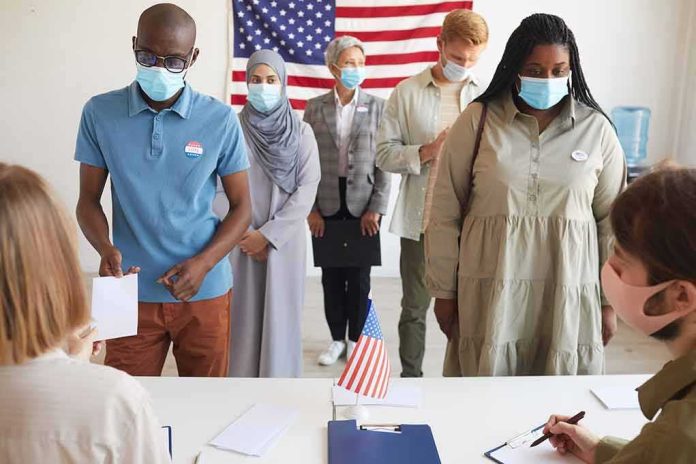
Most California voters are never asked for identification at a polling place. The state’s own summaries say so. The exception is a first-time voter who registered by mail and did not give a driver’s license, state ID, or last four Social Security digits. In that case, a poll worker may ask for identification. The list of acceptable documents includes a recent utility bill, the sample ballot booklet, a government notice, a passport, a driver’s license, a state ID, or a student ID.
That list matters. It means a non-photo document can clear the bar for those limited first-timers. It also undercuts claims that a gym card or random insurance card would work; those items are not on the official list. The line is looser than strict photo-ID states but not a free-for-all. A fair reading is this: California defaults to trust, then asks for extra proof only in a narrow, first-time scenario tied to federal rules.
Why The State Says This Is Safe
California’s election office cites database checks as the backbone of security. Officials say they match driver’s licenses with Department of Motor Vehicles records and Social Security digits with Social Security Administration records. They also say they update death and felony records often. The state’s regulations require proof of identity the first time flagged voters cast a ballot in a federal election. The Secretary of State has told lawmakers that in-person impostor fraud is rare.
Happy to share that I have been volunteering for over a year now to support the Voter ID Initiative over here for my home state of California. Fighting for election integrity is the right thing, regardless of party lines.
— Andy V Renditions (@artsymammotech) September 2, 2026
On outcomes, the Secretary of State pointed to a small number of recent fraud cases, compared with millions of eligible voters statewide, to argue the system works. That does not settle the design question for everyone. Low case counts may reflect strong controls. They may also reflect the limits of detection under light front-end checks. Both can be true. The real issue is where to place the burden: before a ballot is cast or after a record exists.
The Practical Tradeoffs Voters Should Weigh
Registration-first, verify-later speeds access. It also shifts risk to the back end, where county staff must cure mismatches and chase paperwork. That adds workload and invites human error. Tighter front-end rules slow down some signups but raise assurance that each new voter tied their name to a hard document. American conservative values lean toward clear rules, equal treatment, and proof before trust. Many readers will see California’s model as inverted on that score.
Two claims get exaggerated in the noise. First, the state does not let a random card work at the polls; it offers a specific list, and only for certain first-timers. Second, “no ID ever” is not quite right. The system uses signatures, database matches, and, when flagged, documentary proof on the first federal vote. Still, the everyday experience for most Californians is simple: no one asks for ID at the polling place, and that fuels doubts among skeptics.
What Would Settle The Debate
Sunlight would help. Publish counts of registrations created with no license and no Social Security digits. Release match-failure rates and how counties resolve them. Show how many first-time voters got asked for ID, what they presented, and how many ballots were rejected or cured. These are routine administrative metrics. If the state’s process is tight, the numbers will prove it. If the gaps are real, the fixes become obvious and hard to demagogue.
Sources:
sos.ca.gov, elections.cdn.sos.ca.gov, voteriders.org, ballotpedia.org