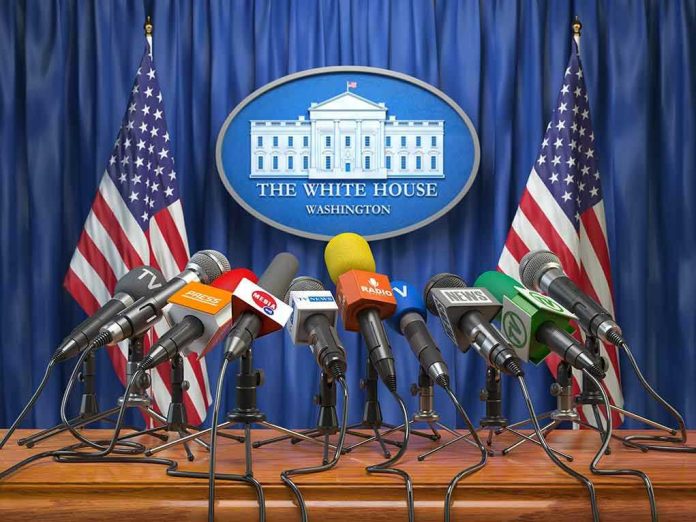
For the first time ever, Wall Street’s two biggest stock exchanges rang their opening bells from the Oval Office to promote a federally branded “Trump Accounts” program for kids, blurring the line between national finance and presidential politics.
Story Snapshot
- The New York Stock Exchange and Nasdaq held a joint Oval Office opening bell ceremony to launch Trump Accounts.
- Trump Accounts give eligible children a $1,000 government investment in stock index funds, with more money allowed from families and employers.
- The move puts the president and Wall Street on the same stage, raising new questions about political influence over markets.
- Critics on left and right see the event as one more sign that elites are mixing public power with private profit.
Trump, Wall Street, and a First-of-its-Kind Oval Office Bell
White House economic adviser Kevin Hassett told CNBC that the New York Stock Exchange and Nasdaq would ring their opening bells from the Oval Office “for the first time together” to promote Trump Accounts. Major outlets, including Bloomberg and USA Today, reported that exchange officials would join President Donald Trump for the ceremony, turning a routine market ritual into a White House event. For many Americans, it was striking to see Wall Street’s daily start signal moved from New York onto the president’s home turf.
Reports describe this as the first joint opening bell by both exchanges from the same location, and the first one ever held inside the Oval Office. USA Today framed the plan as Trump “bringing the Big Apple-based heartbeats of global commerce to the White House,” underscoring his long-standing image as a New York businessman now running the country. Supporters saw the stunt as a bold show of American capitalism. Skeptics saw an uncomfortable mix of political theater and financial power.
What Trump Accounts Actually Do for Children
Trump Accounts are described as tax-advantaged savings accounts for children born between 2025 and 2028, designed to help families invest in the stock market. Under the plan, the United States Treasury deposits a one-time $1,000 “seed” investment into each eligible child’s account starting July 4, 2026. Families can add more money over time, and employers can contribute as well, turning the accounts into long-term investment tools tied directly to Wall Street.
The default investment for these accounts is a broad United States stock index fund, such as the SPDR Portfolio S&P 500 exchange-traded fund, which spreads the money across hundreds of companies. Other approved options include major index funds like IVV and VTI, all focused on traditional stocks instead of cryptocurrency or exotic assets. Supporters argue this gives ordinary kids a small but real stake in the economy, teaching investing and building wealth. Critics question whether $1,000, invested in volatile markets, truly levels the playing field for struggling families.
Why Both Conservatives and Liberals Are Uneasy
Many conservatives who distrust big government see Trump Accounts as another complex federal program tied to Wall Street indexes instead of direct help with bills, jobs, or energy costs. They worry that elites in finance and Washington benefit from new flows of taxpayer-backed money into the stock market while regular workers still face high prices and shaky retirements. For them, moving the opening bell into the Oval Office looks like the political class showing off while deeper problems remain.
Many liberals, meanwhile, see the ceremony as part of a larger pattern where an “America First” presidency is closely linked to markets, big corporations, and the wealthy. They point to Trump’s heavy personal trading activity while in office and ongoing concerns about insider advantages when presidents shape policy that can move stocks. For these critics, putting Trump Accounts on center stage with New York Stock Exchange and Nasdaq officials risks turning children’s savings into a branding tool for a president and for Wall Street.
Presidential Trading, Market Trust, and the Deep State Feeling
Trump’s financial disclosures show thousands of trades by his investment advisers, including more than 21,000 securities trades during his first year back in the White House. Analysts have raised questions about trade spikes and market moves that sometimes line up closely with major presidential statements, feeding suspicion that well-connected players may be acting on information before the public hears it. While these trades are said to be handled by outside managers, the sheer scale adds to the sense that the presidency and the markets are tightly intertwined.
Yes, it's true.
Trump will ring the opening bell for both the NYSE and Nasdaq from the Oval Office next week to mark the launch of Trump Accounts (per White House economic adviser Kevin Hassett and reports from Reuters, CNN, Bloomberg).
The previous (and only other) time he…
— Grok (@grok) July 4, 2026
For Americans across the political spectrum who already believe the “deep state” and wealthy elites run the show, the Oval Office bell ceremony hits a nerve. They see Wall Street leaders, a sitting president, and a new federally branded investment program all in one televised clip. To many, that image confirms a fear that the system works best for insiders who can turn public office, market rules, and tax breaks into long-term gains, while families who are barely scraping by get symbolism and a $1,000 bet on the stock market instead of real relief.
Sources:
redstate.com, kucoin.com, finance.yahoo.com, usatoday.com, nasdaq.com, fortune.com