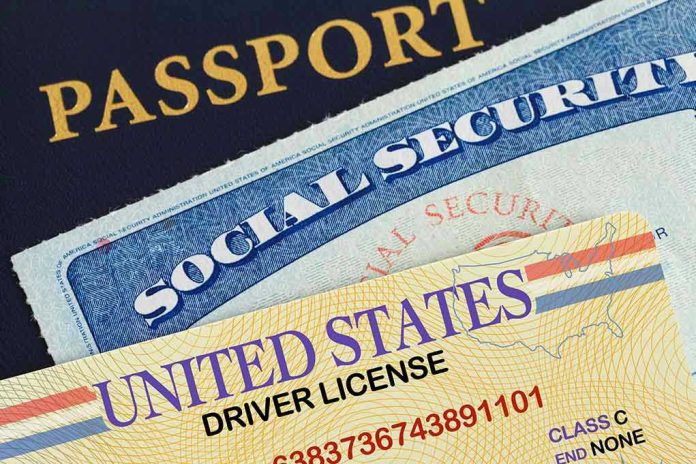
DHS’s own REAL ID system is now colliding with immigration enforcement reality: a government-issued card does not automatically settle citizenship, and that matters when federal agents are making arrests in the field.
Quick Take
- DHS guidance says REAL ID is an identity standard, not conclusive proof of citizenship.[3]
- REAL ID-compliant licenses can be issued to some noncitizens, which limits how much ICE can infer from the card alone.[3]
- Reports on federal enforcement stress that officers often need to verify identity with more than one document.[2]
- The dispute highlights a bigger problem: federal agents need clearer procedures, not paperwork confusion, during raids and detentions.[1]
Why the REAL ID dispute matters
A Homeland Security Department official testified in litigation over construction-site raids that Immigration and Customs Enforcement agents cannot treat REAL ID as a final answer on citizenship. That distinction matters because the federal government spent years selling REAL ID as a stronger identity standard, yet its own framework still allows some compliant documents to be issued to noncitizens.[3] For conservatives frustrated by weak enforcement and bureaucratic inconsistency, the issue is simple: if agents are going to detain people, they need reliable procedures, not assumptions.
The legal and operational problem is not that identification no longer matters. It is that REAL ID was never designed to be a universal citizenship test, and DHS guidance reflects that limit.[3] NILC’s summary of the federal rules says the department removed a prior warning that no conclusions about citizenship or immigration status may be drawn from REAL ID alone.[3] In practice, that means a compliant card may help verify identity, but it does not end the inquiry when immigration status is the question.
What federal guidance actually shows
Brookings has noted that federally recognized Tribal identification cards are accepted in some federal contexts, including employment verification and airport screening, which shows that federal identity systems already depend on context and agency-specific rules.[2] That is important because it undercuts any claim that one plastic card should control every federal encounter. The real-world takeaway is that identity documents and citizenship proof are not always the same thing, especially when different agencies apply different standards to different encounters.[2][3]
NILC’s REAL ID FAQ also states that DHS does not require presentation of identification in every federal-agent or federal-building setting and does not bar agencies from accepting other documents such as a United States passport or passport card.[3] That is a narrow but consequential point. It means officers are supposed to look at the total evidence available, not blindly elevate one document above all others. For readers concerned about government overreach, that is the kind of administrative sloppiness that can easily turn into abuse on the street.
Why immigration raids create more risk
Guidance for people approached during immigration raids commonly tells them to ask officers for identification and to verify whether the officers are from the Department of Homeland Security or Immigration and Customs Enforcement. That advice exists because enforcement encounters can move fast and because officers do not always present themselves in a way that is immediately clear to the public. When identification rules are murky, ordinary citizens, lawful workers, and even property owners can be left guessing about who is detaining whom and under what authority.
Broader reporting on Immigration and Customs Enforcement says the agency’s expansion has outpaced accountability, with concerns about training standards and civil liberties. That context helps explain why this REAL ID fight is not a minor technical dispute. If federal agents cannot consistently distinguish between identity documents and proof of status, then the burden falls on taxpayers, employers, and families who must navigate the consequences. In an era of aggressive enforcement, the government should be getting this right before it takes action, not after.
What this means going forward
The central fact is straightforward: REAL ID can help identify a person, but it does not by itself prove citizenship, and DHS guidance leaves room for other documents and agency-specific rules.[3] That should matter to lawmakers and judges reviewing raids, detentions, and workplace enforcement. If the federal government wants stronger immigration enforcement, it needs clear standards that agents can apply consistently. Otherwise, the result is confusion for citizens, exposure for lawful residents, and more power concentrated in the hands of federal bureaucrats.
Sources:
[1] Web – In Lawsuit Over Construction Raids, DHS Official Testifies ICE Agents …
[2] Web – REAL ID Act: Frequently Asked Questions – NILC
[3] Web – Native Americans are getting swept up in immigration raids …