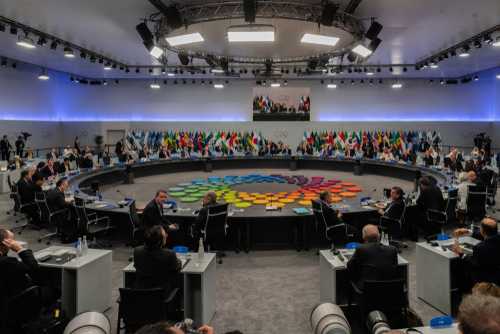
Leaders at the G7 touted an Iran “peace deal,” but key terms remain unpublished and enforcement is unproven.
Story Snapshot
- Trump and Macron said the Iran agreement ends the conflict and reopens Hormuz, with nuclear limits claimed [4].
- Reports describe a 60-day memorandum, not a final treaty, with details still undisclosed [3].
- Shipping through the Strait of Hormuz is said to be reopening, though verification is pending [2].
- The full text is expected after the signing ceremony in Switzerland later this week [5].
G7 stagecraft meets murky paperwork
President Donald Trump arrived at the G7 in France saying the Iran deal is done and the war is ending. French President Emmanuel Macron praised a “very important” agreement that he said fixes nuclear risks, brings peace to Lebanon, and reopens the Strait of Hormuz [4]. Broadcasts from the summit echoed that the strait is partially open now and will fully reopen by week’s end, with British and French personnel helping maritime traffic restart [2]. These are big claims that demand proof.
Trump’s framing sounded final. He said Iran “will not have a nuclear weapon,” and he pointed to “strong policing powers” to enforce that promise [4]. That would be a major win for security and for drivers tired of high fuel costs. Cheaper oil helps every family budget. But the public still has not seen the enforcement playbook. Without the text, Americans must take these assurances on faith, which is not how serious national security deals should be sold.
What is actually signed—and what is not
Several outlets describe the arrangement as a memorandum of understanding that launches a 60-day window for more talks, not a finished peace treaty. Reporting says the text remains unpublished, and some core questions are deferred, including how to handle Iran’s enriched uranium and how inspectors will verify limits [3]. A network report said the administration plans to release the full text later this week after a formal signing in Switzerland [5]. That gap matters for trust and accountability.
The memorandum reportedly ties ceasefire extensions to reopening the strait and starting nuclear talks. It also suggests that any sanctions relief would be conditioned on behavior during the 60-day period [3]. That is prudent in theory. It keeps leverage until Iran performs. But it also means this is not “mission accomplished.” It is a test phase. Americans should expect regular updates, clear red lines, and consequences if Tehran cheats. Promises without proof invite backsliding.
Strait of Hormuz: signal or substance?
Summit coverage relayed that shipping lanes are partially open now and would be fully open by Friday, with allied help on the water [2]. Trump also said oil prices were dropping on the news [4]. If tankers are moving safely again, that is welcome relief for our economy. Still, independent confirmation is needed. Maritime authorities, insurers, and shipping data can verify whether traffic is flowing at scale. Until then, the claim stands, but it is not yet confirmed by neutral evidence.
Zelenskyy, Trump, and Macron held a closed-door meeting on the sidelines of the G7 summit.
For Zelenskyy and Trump, it was their first face-to-face meeting in nearly four months.
— Saint Javelin (@saintjavelin) June 16, 2026
Americans remember past deals that sent cash to hostile regimes while they kept building missiles and funding terror. Trump’s team says this framework bars a nuclear weapon and uses “strong policing powers” to enforce it [4]. That aligns with conservative priorities: peace through strength, no blank checks, and zero tolerance for terror finance. To lock that in, the White House should publish verification terms, inspection access, snap-back penalties, and a clear ban on funding proxy militias.
Guardrails Congress and the public should demand
First, release the full memorandum and annexes before any funds move. Second, secure written, time-bound steps for Iran to transfer or neutralize enriched uranium under outside supervision. Third, detail naval security rules that keep the strait open without new tolls or harassment. Fourth, require public reporting every two weeks during the 60-day period on compliance and incidents. These steps match what officials themselves describe as a provisional, to-be-finished framework [3][5].
The G7 brings many issues at once. Trump also met leaders about Ukraine and regional stability, even as Iran dominated headlines [4]. Big summits can fuel “deal hype,” but public safety rests on documents, not podium talk. This agreement could be a real step toward peace if it enforces hard limits and deters aggression. Conservatives should back progress that protects American families, keeps energy affordable, and defends our allies—while insisting on proof, not press releases.
Sources:
[2] Web – 2025–2026 Iran–United States negotiations – Wikipedia
[3] YouTube – Trump unveils Iran peace deal at G7 summit | 7NEWS
[4] Web – Live updates: US, Iran confirm peace deal, official signing on June 19
[5] YouTube – Trump says Iran deal will bring ‘a lot of success to the world’ in …