A downed U.S. F-15E pilot says he faced a “jellyfish” drone swarm over Iran—yet Washington still won’t say what brought the jet down.
Story Highlights
- Pilot reported a “jellyfish” swarm of drones before ejecting; officials have not confirmed the cause [13]
- Iran claims a shoulder-fired missile, not drones, downed the jet, fueling a narrative battle [3]
- Pilot had been shot down weeks earlier in a friendly fire event, confirming repeated combat exposure [5]
- Both crew members were rescued in a rapid special operations mission after the crash [6]
What The Pilot Reported In The Minutes Before The Shootdown
CNN reported that four sources familiar with the debrief said the F-15E pilot saw a “minefield of drones” in a “jellyfish” shape, with small drones hanging below larger ones like legs. The pilot called them “alien type” drones. That description suggests a group acting as one system and trying to blind or confuse sensors. The account has sparked debate inside the intelligence community, but it remains unconfirmed by the Pentagon [13].
Analysts told CNN such a formation could overwhelm radar warning receivers and demand faster, smarter countermeasures. They pointed to swarming tactics that act like a single organism. That points to artificial intelligence and mesh networking, which link many small drones under a larger “mothership” concept. If true, that is a shift on the battlefield. It would challenge old defenses that burn money firing missiles at cheap fliers [13].
What We Know For Sure About The Jet, The Crew, And The Rescue
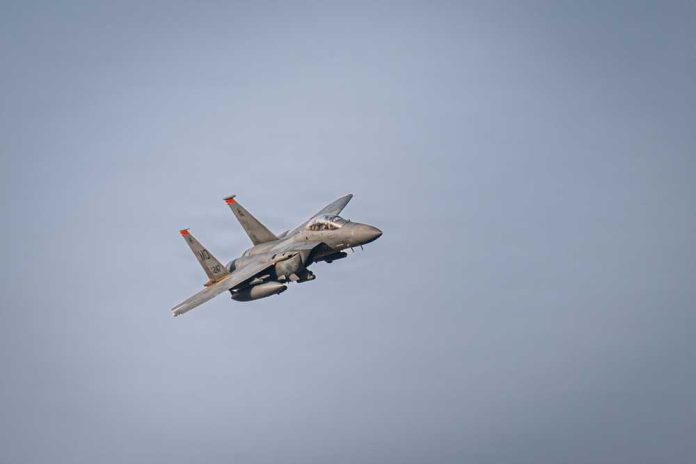
Records confirm an F-15E Strike Eagle, call sign “Dude 44,” went down over western Iran on April 3, 2026. The pilot and the Weapon Systems Officer survived ejection. U.S. special operations forces reached them about seven hours after the crash and lifted them out. Open-source incident logs and after-action summaries describe the mission as precise and fast, a bright spot in a tense situation [6].
Separate reporting states the same pilot was shot down less than five weeks earlier in a friendly fire case over Kuwait. That detail places the pilot repeatedly in harm’s way and explains why some officials weigh concussion and stress when reviewing his observations. It confirms combat exposure but also adds a caution about how trauma can affect what someone thinks they saw in a fast, chaotic fight [5].
The Cause Dispute: Drones Or A Shoulder-Fired Missile?
Officials in Washington have not released a final cause. They have not confirmed that the drone swarm downed the jet. Iranian media and some outlets claim a shoulder-fired missile brought the aircraft down. NBC News reported early that the jet was probably hit by a Chinese-made shoulder-launched system, though it offered no public forensic proof such as recovered fragments. The gap fuels dueling claims on both sides [3].
Here is the core problem: there is no public radar log, wreckage analysis, or helmet footage that proves a swarm took part. There is also no public debris photo that proves a missile kill. That leaves a pilot’s dramatic account on one hand and a rival state’s talking point on the other. Until data is released, the cause remains open. That ambiguity invites spin, and Americans deserve better [13].
Why This Matters For U.S. Air Power And Taxpayers
Drone swarms are rising worldwide and are getting cheaper. They can saturate defenses and drain expensive interceptors. China studies swarms for future war, and Russia uses massed drones to probe gaps. If Iran fielded even a crude swarm with basic mesh control, it would signal a wider shift. Our forces would need layered defenses that jam, spoof, burn, and shoot—without breaking the bank on every intercept [22].
#ufox #uapx #ufotwitter Downed U.S. F-15E Pilot Reportedly Observed Unusual Iranian Drone Swarm Moving In ‘Jellyfish’ Formation https://t.co/1KGiyuRtiO
— Black_Triangle (@BlackTriangle16) June 24, 2026
Conservatives should press for facts and accountability. The administration should release declassified portions of the pilot’s debrief, flight data, and radar warning logs, with sensitive pieces removed. Congress should demand a clear plan to counter swarms that does not waste money or bow to defense industry habits. We need American-made solutions that protect pilots, respect taxpayers, and keep our technological edge without endless blank checks [13].
What To Watch Next: Proof, Policy, And Procurement
Watch for three things. First, any official release of cockpit or helmet video and avionics data that shows many small contacts near the jet. Second, any photo or lab report of missile fragments from the crash area that would back the missile claim. Third, a clear acquisition plan that shifts funds toward electronic warfare, directed energy, and low-cost interceptors suited for swarms, instead of relying only on pricey missiles [6].
Our pilots fly into risk so the rest of us do not have to. They deserve clear answers and the best tools. If a “jellyfish” swarm helped blind a front-line fighter, we must adapt fast. If a shoulder-fired missile did it, we must harden our tactics against that threat. Either way, truth comes first. Data beats rumor. And American power stays strong when leaders level with the people footing the bill [3].
Sources:
[3] YouTube – How a US F-15 Jet Was Shot Down & it’s Pilot Rescued
[5] Web – A US F-15 pilot who ejected from his aircraft over Iran … – Facebook
[6] Web – F-15E pilot downed over Iran had been shot down a month prior
[13] Web – Was Iran’s ‘jellyfish’ drone swarm behind US F-15E jet crash?
[22] YouTube – Top 3 Military Drone Swarms in Development Now