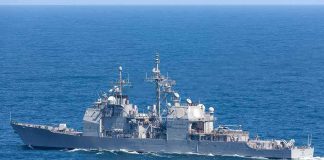
Three commercial ships were hit near the Strait of Hormuz just days after a ceasefire deal, dragging the U.S. and Iran back toward open confrontation and reminding many Americans how little control they have over decisions that can shake the global economy and their own wallets.
Story Snapshot
- Iranian forces are accused of firing missiles and a drone at three commercial ships near the Strait of Hormuz, damaging tankers from Qatar, Saudi Arabia, and Liberia.
- The United Kingdom Maritime Trade Operations agency reported one tanker struck by an “unknown projectile” off Oman, raising fears that shipping lanes critical to global energy are no longer safe.
- The United States military responded with large-scale strikes on Iranian targets and moved to cut off Iran’s ability to sell oil, escalating tensions despite a recent memorandum of understanding to pause attacks.
- Qatar and Saudi Arabia publicly blamed Iran and called the attacks a clear violation of international law, while Iran’s own media hinted at responsibility but stopped short of an official admission.
What Happened To The Ships Near Hormuz
On Monday night, according to United States officials, Iran’s Islamic Revolutionary Guard Corps fired at least two missiles at commercial ships moving through the Strait of Hormuz. Two vessels took heavy damage but reported no deaths among crew. Around the same time, the United Kingdom Maritime Trade Operations agency said a tanker traveling south near Limah, Oman was hit on its port side by an unidentified projectile, setting off a fire but causing no spill or injuries. Early reports left unclear whether this tanker was one of the missile-hit ships or a separate target.
Follow-up information from United States Central Command and regional governments showed the scale of the incident was larger than first thought. U.S. officials now say three commercial vessels were attacked within about 24 hours, including the Marshall Islands-flagged liquefied natural gas tanker Al Rekayyat, the Saudi crude tanker Wedyan, and the Liberian-flagged Cyprus Prosperity. Qatar’s Foreign Ministry said the strike on Al Rekayyat was an “unacceptable attack” on global energy security and held Iran “fully legally responsible,” while Saudi Arabia’s government said Iran “bears full responsibility” for attacks on both their ship and Qatar’s.
How The U.S. And Iran Escalated After The Attacks
The United States military quickly framed the ship strikes as clear Iranian aggression and a violation of a recent ceasefire arrangement. Central Command announced that American forces launched a “new round of offensive strikes” against Iran, hitting over 80 targets linked to air defense, command and control, coastal radar, and anti-ship missiles, as well as more than 60 small boats used by the Revolutionary Guard in and near the strait. At the political level, the Trump administration also revoked a waiver that had allowed Iran to sell oil internationally, directly squeezing Tehran’s main source of cash and signaling a broader economic confrontation, not just a narrow military reply.
Iranian leaders pushed a very different story to their own public. Iranian state television said a Qatari liquefied natural gas tanker was attacked only after it ignored warnings, suggesting that Iran was enforcing what it sees as control over nearby waters. However, the broadcast did not clearly admit that Iranian forces carried out the strike, and neither Iran’s Foreign Ministry nor the Revolutionary Guard released a full official statement accepting or denying responsibility. This gap between state media hints and formal silence adds to the uncertainty and gives room for both sides to shape the narrative for their own goals.
Why This Matters For Ordinary Americans
The Strait of Hormuz is a narrow chokepoint where a large share of the world’s oil and gas passes every day. Since February 2026, attacks on ships in and near the strait have become more common, with at least thirteen commercial vessels targeted and Iran’s Revolutionary Guard openly saying in March that the strait is “closed” to certain traffic. For families in the United States, that means every missile, drone, or “unidentified projectile” in this region can push fuel prices higher, unsettle retirement savings, and raise the risk that America gets pulled deeper into yet another overseas conflict driven by elite decisions far from their daily lives.
The Strait of Hormuz was quiet the way a rattlesnake is quiet. Then Iran moved.
By Francis Gauthier
Three commercial vessels tied to Qatar, Saudi Arabia, and the United Arab Emirates were targeted near the narrow waterway that carries a major share of the world’s oil traffic.… pic.twitter.com/SjuI2lbbSL— Hillbilly (@JamesHu27192912) July 9, 2026
Both conservatives and liberals at home see familiar patterns in this crisis. Many on the right point to years of “globalist” policies and weak deterrence that left vital shipping lanes exposed, while many on the left see another case where military strikes and sanctions come faster than honest public debate or proof shared with citizens. In this Hormuz incident, the facts confirm that three ships were hit and that the U.S. and its Gulf partners blame Iran, yet open-source evidence tying specific missiles or drones to specific impacts has not been fully released, keeping room for doubt and making people wonder whose interests are really being protected.
Deep State Fears And The Growing Trust Gap
The way this crisis unfolded also taps into a broader fear: that the “deep state” and entrenched elites, not voters, truly steer U.S. foreign policy. United States officials relied on classified intelligence to say Iran fired missiles and a drone, and then used that claim to justify large military strikes and economic penalties that could affect global markets and American jobs. At the same time, major media outlets largely echoed the official story and framed the attacks as a violation of ceasefire terms, while Iranian outlets offered shadowy counter-stories built on unnamed sources.
For citizens who already think the federal government is failing them, this latest clash near Hormuz looks less like a clear fight between good and evil and more like another high-stakes game played above their heads. They see commercial ships burned, energy routes threatened, tens of billions of dollars in trade at risk, and yet almost no space for everyday Americans to question evidence, weigh costs, or demand a different path. Whether you blame Iranian hardliners, Washington hawks, or both, the message many people hear is the same: powerful players keep making choices that could push the country toward war and economic pain, while ordinary workers and small businesses are expected to simply absorb the fallout.
Sources:
insiderpaper.com, cnn.com, npr.org, upr.org, youtube.com, pbs.org, apnews.com, thehill.com, crisisgroup.org