A deadly run of quakes hit five regions in days, but scientists say only Venezuela’s twin shocks were physically linked.
Story Highlights
- Two huge Venezuelan quakes came 39 seconds apart in a confirmed doublet sequence.
- Venezuela declared an emergency as deaths and damage mounted after the double hit.
- Experts say other quakes in Japan, Afghanistan, the Philippines, and California were separate events.
- U.S. officials urge readiness at home; quake risk follows known plate zones, not panic myths.
Venezuela’s Doublet: Foreshock Then Mainshock
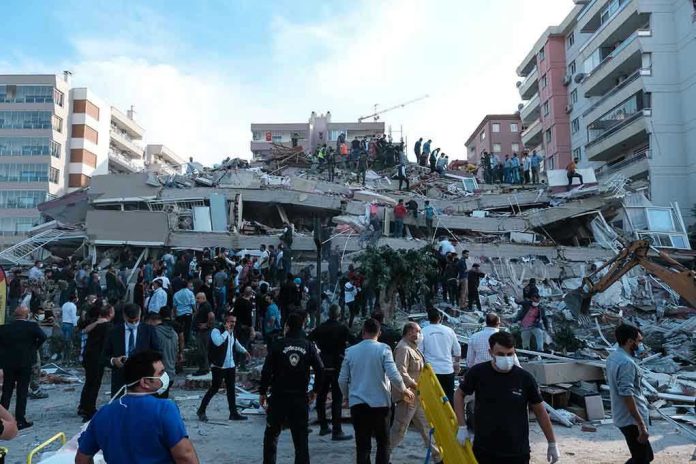
The United States Geological Survey confirmed Venezuela’s magnitude 7.5 quake was the mainshock in a doublet, coming 39 seconds after a magnitude 7.2 foreshock. The back-to-back strikes shook northern and central regions, toppling buildings and cutting power. News outlets reported swift scenes of rescue and road closures as aftershocks followed. The close timing points to linked ruptures on the same fault system. Officials warned people to stay away from damaged structures and to expect more shaking.
Venezuela declared a state of emergency after the twin shocks. Reports described rising casualties and widespread damage across multiple states. Emergency teams searched collapsed homes and offices. Hospitals treated the injured while coping with power issues. Airports and ports checked runways, towers, and cranes. Aid groups tracked needs for water, tents, and generators. The scale underscored why strong building codes and quick response save lives when major faults rupture so close together.
Global Cluster Without a Global Trigger
In the same week, large earthquakes struck Japan, Afghanistan, the Philippines, and California. Many asked if one event set off the others. The U.S. Geological Survey explains that earthquakes often appear in clusters by time, but they follow known plate zones and are not linked across oceans. Seismology shows separate tectonic systems release stress on their own schedules. That means the week looked busy, but only Venezuela’s two quakes were a true pair.
Confusion grows when people see quick headlines or dramatic maps. Global catalogs record many magnitude 7 or larger events in a typical year. That creates windows when two or more hit close together in time. Scientists warn against “chain reaction” claims without physical links. They focus on local faults, stress transfer on nearby segments, and aftershock patterns. That is the hard evidence. It fits the view that this week’s far‑flung quakes were separate events, not a single global cascade.
What This Means for Americans at Home
U.S. communities near the San Andreas system, the Cascadia subduction zone, and the New Madrid region face real risk every year. Agencies say families should store water, food, flashlights, and medicines for several days. Homeowners should strap water heaters, secure tall furniture, and check plans with loved ones. Local leaders should review building codes, retrofit bridges and schools, and harden hospitals. These steps protect life and liberty by keeping families safe and reducing chaos after a major shock.
Facts Over Fear: Media Myths Versus Plate Boundaries
Some viral posts claim a “global trigger” or a “planetwide stress phase.” Those claims do not match field data or fault models. Earthquakes break where plates meet or where old faults store stress. The pattern repeats over decades. Scientists have mapped these zones and updated hazard models many times. The lesson is simple: prepare for the right hazard in your town, not for rumors. Focus on local faults and proven steps. That is how you cut losses and save lives.
Conservatives value self-reliance, strong families, and local control. Earthquake readiness fits that ethic. Families make plans. Churches and civic groups run drills and help neighbors. Counties fix weak bridges before they fail. The federal government can support research and early warning, but states and towns must lead. Venezuela’s tragedy shows minutes matter. Linked faults can strike twice fast. Calm planning beats panic. Clear facts beat noise. That is the path to resilience.
Sources:
miyamotointernational.com, earthquake.usgs.gov, reuters.com