The fight over the Postal Service’s new mail‑in ballot rule is not just about barcodes and voter lists; it is about whether an executive‑branch agency can insert itself into the core question of who gets to vote in federal elections.
Key Points
- A federal appeals court has temporarily allowed the U.S. Postal Service to move forward with a proposed rule that conditions delivery of federal mail‑in ballots on states providing voter lists and serialized barcodes tied to individual voters.
- The rule implements President Trump’s Executive Order 14399, which directs federal agencies to build verified citizen voter lists and forbids USPS from transmitting ballots to anyone not on those lists.
- Supporters, including senior Justice Department officials, describe the change as a “win for election integrity,” arguing serialized Intelligent Mail barcodes and federal voter lists will deter fraud and aid law enforcement.
- Opponents—23 states, voting‑rights groups, and bipartisan election officials—warn the rule is unconstitutional federal overreach that will disenfranchise lawful voters and force USPS to decide who may vote by mail.
- The appeals court’s stay is provisional; multiple lawsuits and prior rulings against similar Trump election orders mean the rule’s legal fate remains highly uncertain.
What the Appeals Court Just Allowed USPS to Do
The immediate development is straightforward: a three‑judge panel of the D.C. Circuit Court of Appeals has temporarily lifted a district court order that had blocked the Postal Service’s proposed election‑mail rule. In practical terms, this “stay pending appeal” means USPS can continue developing and preparing to implement the rule while litigation over its legality proceeds. The appeals court did not decide the underlying constitutional and statutory questions; it merely found that the Postal Service met the legal standard to pause the earlier injunction while the case is heard.
The district court block the panel set aside arose from a separate case enforcing a 2021 settlement agreement between USPS and the NAACP over the handling of election mail. Judge Emmet Sullivan had earlier concluded that the new ballot rule would likely violate that settlement’s requirement that USPS expedite rather than restrict mail‑in ballots, and therefore enjoined the rule. The D.C. Circuit’s stay temporarily removes that barrier, but the NAACP dispute, and other constitutional challenges filed around the country, remain live.
How the Proposed Rule Would Change Mail‑In Voting
The Postal Service’s proposed rule, published in late May and early June 2026, would significantly alter how states conduct mail‑in and absentee voting for federal elections. At its core, the rule does three things:
First, it requires every state election authority that uses mail‑in or absentee ballots for federal contests to submit to USPS a “Mail‑In and Absentee Participation List”—a roster of voters approved to receive a ballot by mail for each election. That list must include each voter’s name, address, and a uniquely serialized Intelligent Mail barcode assigned to that voter’s ballot envelope. States must transmit the list at least 30 days before they begin mailing ballots under state law.
Second, USPS would check each mailing of ballot envelopes against the participation list at the point when election officials present it for acceptance at a postal facility. Ballots addressed to individuals not on the list—or ballot mailings whose envelope design and barcode placement fail to meet the new standards—would be turned back and not carried. Postmaster General David Steiner has told Congress and state officials that USPS will simply refuse to deliver ballot mail for states that decline to provide voter rolls or do not comply with the rule’s format requirements.
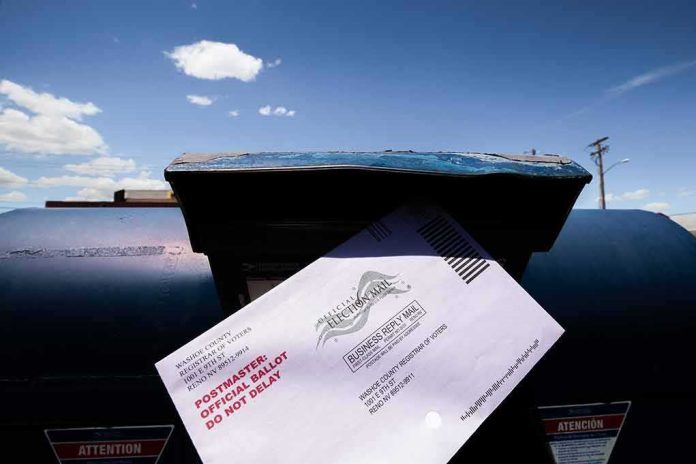
Third, the rule would make mandatory a suite of technical standards that USPS had previously treated as voluntary best practices: use of the Official Election Mail logo, specific envelope design elements, and Intelligent Mail barcodes to track ballots in transit. What is new is not the barcode technology itself, which is already widely used in postal operations, but the requirement that each ballot’s barcode be uniquely tied to an individual voter and stored in a federal data system.
The Executive Order Behind the Rule
The ballot rule does not arise in a vacuum; it is the implementing mechanism for Executive Order 14399, “Ensuring Citizenship Verification and Integrity in Federal Elections,” which President Trump signed on March 31, 2026. That order directs the Department of Homeland Security, working with the Social Security Administration, to build state‑by‑state lists of verified U.S. citizens eligible to vote in federal elections, and instructs the Postal Service not to transmit mail‑in or absentee ballots to any individual who is not enrolled on those lists.
The administration has framed the order as a response to concerns about noncitizen voting and alleged vulnerabilities in mail‑in systems. Homeland Security Secretary Mark Wayne Mullen and other officials have argued that federal verification of citizenship and centralized voter lists are necessary tools to prevent unlawful voting, even while acknowledging that documented cases of noncitizen voting are exceedingly rare. Critics note that the order closely follows failed legislative attempts, such as the SAVE Act, which would have imposed proof‑of‑citizenship requirements through Congress; when those stalled, the White House turned to executive action and administrative agencies instead.
This strategy—using the Postal Service as a gatekeeper for ballot distribution—marks a departure from USPS’s historical posture. For more than a century of American mail voting, the Postal Service has insisted that it does not judge who may vote; it simply carries election mail according to state and local officials’ instructions. Under the new order and rule, USPS would, for the first time, condition service on federal determinations of who is “enrolled” on an approved list.
Supporters’ Case: A ‘Win for Election Integrity’
Supporters of the rule present it as a long‑overdue modernization of mail‑in voting safeguards. First Assistant U.S. Attorney Bill Essayli publicly hailed the D.C. Circuit’s stay as “a win for election integrity,” arguing that requiring states to submit voter lists and embedding serialized barcodes on federal ballots will strengthen guardrails around who receives and returns mail‑in ballots.
In its Federal Register notice, USPS itself asserts that uniquely serialized Intelligent Mail barcodes “will assist in ensuring compliance with federal regulations and support law enforcement activities.” A multistate comment letter, quoting the Postal Service’s own language, notes that USPS claims these barcodes will “facilitate the tracking of individual pieces of Ballot Mail to and from individual voters” and “provide visibility into ballot mail transmission based on scan data.” The agency further suggests that envelope identifiers and barcodes can help confirm that “only citizens receive and cast ballots, reducing the risk of fraud and protecting the integrity of Federal elections.”
Supporters also point to recent controversies and tight races to bolster their case. In California, where mail‑in ballots dominate statewide elections, critics of the existing system have alleged “rigging” and expressed distrust of ballot handling, though they have offered little concrete evidence. They argue that federal standards and traceable barcodes will reassure skeptical voters that ballots are being accounted for accurately, even if the rule imposes additional burdens on election administrators.
The Trump administration’s broader narrative ties the rule to concerns about noncitizen voting, double voting, and ballot harvesting. Officials emphasize isolated anecdotes—such as Maryland voters receiving multiple party ballots in a single election—to suggest systemic vulnerabilities and argue that tighter controls and federal oversight are necessary to maintain public confidence. Yet government reporting and independent analyses consistently describe noncitizen voting as very rare and already illegal, leaving a gap between the scale of documented problems and the scale of federal intervention proposed.
Where the Evidence Is Thin for the Integrity Claims
The integrity case, however, rests more on assertion than on empirical data. Neither the Postal Service nor the rule’s supporters have produced primary‑source evidence quantifying election fraud that would have been prevented by serialized barcodes or federal voter lists. There are no published USPS audits demonstrating that Intelligent Mail barcodes, when tied to individual voters, reduced double voting or uncovered tampering in past federal elections.
USPS has not historically operated infrastructure to decide which voters receive ballots; its role has been logistical, not regulatory. The proposed rule presumes that the agency can verify outbound mailings against voter lists and enforce eligibility determinations, yet there is no public documentation of existing systems, staffing, or testing to perform that gatekeeping function reliably at national scale. The Federal Register notice describes what barcodes can do on postal sorting equipment but does not explain how USPS would prevent misuse of the resulting voter‑linked data, or how it would correct errors before lawful voters are denied ballots.
Equally important, the administration’s own rhetoric concedes that noncitizen voting—its primary justification—is exceedingly rare. Federal and state law already make it a crime, and there is no evidence presented that existing state‑run checks, such as ID requirements at registration and signature verification on returned ballots, are failing in ways that barcodes and federal lists would uniquely fix. From an evidence perspective, the rule is a heavy hammer swung at a relatively small, poorly documented nail.
Opposition: Constitutional Power, Disenfranchisement, and Privacy
Opposition to the rule is broad, bipartisan, and rooted in both constitutional principle and practical election administration concerns. Legally, nearly two dozen Democratic‑led states and the District of Columbia have sued to block Executive Order 14399 and the USPS rule, arguing that the Constitution allocates control over election rules to state legislatures and Congress, not the president or executive agencies.
In Boston, U.S. District Judge Indira Talwani halted key parts of Trump’s earlier mail‑voting order, finding that “the Constitution does not grant the President any specific powers over elections.” Another federal judge has prohibited USPS from carrying out aspects of Trump’s mail ballot strategy, ruling that the initiative violates a settlement reached in a 2020 election‑mail case. These decisions fit a pattern: previous executive orders seeking to centralize election control—such as using the SAVE database for voter verification or imposing proof‑of‑citizenship requirements—have been blocked or limited by federal courts.
State election officials echo these constitutional concerns and add operational and civil‑rights objections. All Senate Democrats and two independents signed a letter urging Postmaster General Steiner to withdraw the rule, warning that it would impose “significant operational burdens on election mail processing systems” and effectively conscript USPS into a national voter data collection program. Bipartisan leaders of Wisconsin’s election commission, including Republican chair Don Millis and Democrat Ann Jacobs, jointly oppose the rule, stating it would “likely disenfranchise a significant swath of Wisconsin voters” by denying ballots when data errors or tight timelines prevent accurate list submission.
Experts like David Becker of the Center for Election Innovation and Research argue that existing mail voting systems are already secure, pointing to 150 years of practice, paper ballots in nearly all jurisdictions, and multiple verification steps—registration checks, signature matching, and audit trails. Becker notes that Trump himself has successfully voted by mail in Florida, a state with robust protections, underscoring that mail voting can be both secure and widely used.
Privacy advocates and legal scholars add another layer: tying every ballot envelope’s barcode to a named individual and storing that information in federal systems creates the ability to “pinpoint ballots being sent to or received from specific voters,” as one multistate comment letter warns. The Postal Service’s notice does not explain how it will prevent abuse of this capability or protect sensitive personal data from misuse by political actors or hackers. Critics see the rule as the foundation of a de facto national voter file housed in a delivery agency, without clear statutory authority or privacy safeguards.
Mechanism Risks: Error Rates and Bureaucratic Gatekeeping
Beyond constitutional and privacy concerns, the mechanism of the rule itself carries risk. Because USPS would reject ballot mailings that do not match participation lists, any error in those lists—a misspelled name, a wrong address, a late registration update—could result in a lawful voter simply not receiving a ballot. Under current systems, those errors are handled within state election offices, which can issue replacement ballots or correct records; under the proposed rule, a mismatch at the postal acceptance point becomes a hard stop.
The requirement that states submit lists at least 30 days before mailing ballots also interacts poorly with real‑world election timelines. Many states permit late registration, party changes, or address updates close to election day, and their systems are designed to keep up with those changes. Forcing a fixed federal list weeks in advance risks freezing the electorate and leaving late registrants without mail‑in options, particularly in jurisdictions where mail voting is the primary or default method.
Smaller and rural election offices may struggle to retool envelopes, printing workflows, and data systems to generate unique Intelligent Mail barcodes linked to each voter on tight timelines and limited budgets. During earlier election cycles, delays in postal processing of ballot mail have already caused significant anxiety; adding new barcode requirements and federal matching checks could lengthen mail paths further, compounding timing risks for voters.
Historical Pattern: Executive Overreach via Administrative Channels
Seen in context, the USPS rule is part of a wider pattern of attempts by the federal executive to centralize election administration through administrative mandates rather than legislation. In the past four years, at least three major executive initiatives—creating federal voter databases, imposing proof‑of‑citizenship conditions, and now conditioning ballot delivery on federal participation lists—have run into substantial judicial resistance.
Analysts at institutions such as Brookings note that the Postal Service has long insisted that it does not judge voter eligibility, and that pushing USPS into that role is a fundamental shift in the relationship between federal logistics and state election sovereignty. Each time the executive has tried to bypass Congress and state legislatures on election rules, courts have stepped in to reaffirm the constitutional allocation of power. That history is central to understanding why so many legal observers anticipate further court limits on the current rule, even after the D.C. Circuit’s provisional green light.
For voters and election administrators, the stakes are immediate. If the rule ultimately takes effect, USPS will become a gatekeeper for federal mail‑in ballots, armed with serialized barcodes and federal participation lists. If courts strike it down or narrow its scope, the episode will serve as yet another reminder that election integrity measures must be built on clear legal authority, transparent data practices, and demonstrable benefits—not merely on fears of fraud or confidence‑building rhetoric.
🚨 MASSIVE ELECTION INTEGRITY WIN
Trump admin just scored a huge court victory: DC Appeals Court greenlights USPS rule requiring voter registration lists + serialized barcodes for mail ballots.
No more shady unchecked mail-in chaos.
This is happening for 2026. pic.twitter.com/oMitM7kM0H
— QPatriot (@QPatriot67212) July 19, 2026
Where This Leaves Mail‑In Voting Now
For now, the appeals court’s decision means the Postal Service can continue drafting, publishing, and preparing to implement its mail‑in ballot rule, including responding to public comments and seeking any required review by the Postal Regulatory Commission. The rule is not yet in force nationwide; its final adoption and any practical impact on upcoming federal elections will depend on the outcome of ongoing litigation in multiple jurisdictions.
States, election officials, and voters are operating in a period of legal uncertainty. Some jurisdictions are already warning USPS that they cannot or will not comply with the rule, citing state laws, constitutional objections, and operational constraints. Others are preparing contingency plans in case they are forced to submit participation lists and adopt barcoded ballot envelopes on short notice.
Whatever the ultimate legal resolution, this episode illustrates the delicate balance between securing elections and respecting the architecture of American self‑government. Technical tools like barcodes and data matching can, in theory, strengthen the integrity of mail‑in voting. But when deployed through executive fiat, without clear evidence of necessity or robust safeguards for rights and privacy, they risk undermining the very trust they are claimed to restore.
Sources:
nypost.com, lynnwoodtimes.com, reuters.com, govexec.com, krishnamoorthi.house.gov, cyberscoop.com, protectdemocracy.org, content.govdelivery.com, youtube.com, facebook.com, njlm.org, democracydocket.com, jsonline.com, wpr.org, npr.org, brookings.edu, verdict.news, campaignlegal.org, attorneygeneral.gov, newsweek.com