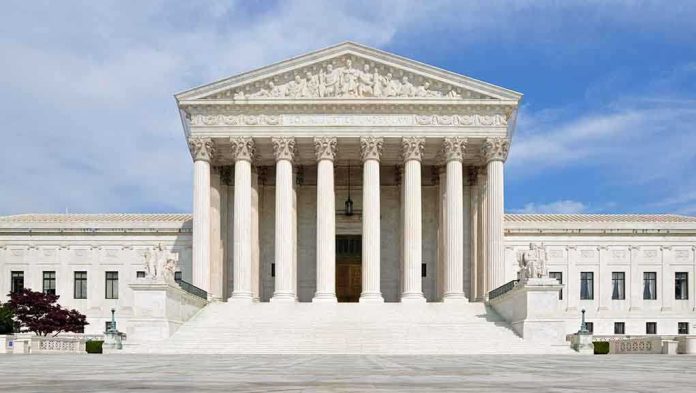
Hours after the Supreme Court’s ruling, President Trump warned that “citizenship scams” are already surging and pressed the Court to rehear the case.
Story Snapshot
- Supreme Court issued Trump v. Barbara on the Citizenship Clause; both sides claim vindication.
- Trump says the ruling is fueling new “citizenship scams” and wants a rehearing.
- The fight centers on what “subject to the jurisdiction thereof” means in the Fourteenth Amendment.
- Advocates say the Constitution still guarantees birthright citizenship for nearly all U.S.-born children.
What The Supreme Court Decided And Why It Matters
The Supreme Court’s opinion in Trump v. Barbara focused on the text of the Fourteenth Amendment’s Citizenship Clause. The opinion stated that the Clause has two parts: a person must be born in the United States and be “subject to the jurisdiction thereof” to be a citizen at birth. That framing keeps the key dispute alive. The question remains how far “jurisdiction” reaches for children of noncitizens. The Congressional Research Service notes the Court has rarely interpreted this Clause.
President Trump argued that common views of birthright citizenship ignore the second condition. He has said long-running abuse turns citizenship into a “scam,” and he framed Executive Order 14160 as a lawful reset to the Clause’s “original meaning”. The government’s brief said the order would apply only going forward and would cover children of those here unlawfully or only temporarily. Trump now says the Court’s ruling is already driving more fraud and wants the justices to rehear the case.
The Text Versus The Tradition Around Birthright Citizenship
Legal groups and many scholars counter that the Constitution’s promise is clear. They point to a long tradition that children born on U.S. soil are citizens, with narrow exceptions like children of diplomats or occupying forces. They argue that the 1898 case about Wong Kim Ark supports that view and that today’s dispute should not undo settled rights. A Brennan Center analysis says the Fourteenth Amendment guarantees birthright citizenship for almost everyone born here.
That clash of views turns on the same thirteen words: “subject to the jurisdiction thereof.” The administration reads those words to exclude children of undocumented and temporary visitors. Opponents answer that “jurisdiction” means being governed by U.S. law while present here, which covers almost all noncitizens. The Supreme Court’s opinion acknowledged the two-part structure of the Clause but left the precise reach of jurisdiction as the central issue to resolve through text and history.
Why Both Sides See Urgency — And What It Signals About Government
Trump argues that fast action is needed to stop new abuses tied to birth tourism and fraud rings, which he says the ruling has encouraged. He wants a rehearing to clamp down on schemes that he believes cheapen citizenship and strain public services. Civil rights groups say the greater risk is the government denying citizenship to babies who have called this country home since birth, which could create stateless children and chaos in records and benefits systems.
The Supreme Court set four o'clock this afternoon as the deadline, so an answer on mail voting could come within days.
Trump v. California asks the justices to let the President's executive order on mail ballots and citizenship verification take effect before the November…
— @DMartinoLaw (@DMartinoLaw) August 3, 2026
Across the spectrum, people see a deeper pattern. Leaders in Washington keep pushing fights to the edge while failing to fix the system. Conservatives see unsecured borders and rising costs for schools and hospitals. Liberals see families targeted and rights at risk. Both sides doubt that the federal government listens. The Supreme Court’s rare step into this Clause shows how old promises meet new pressures. The words are short, but the stakes include identity, belonging, and trust in the rules that bind us.
Sources:
pjmedia.com, brennancenter.org, npr.org, scotusblog.com