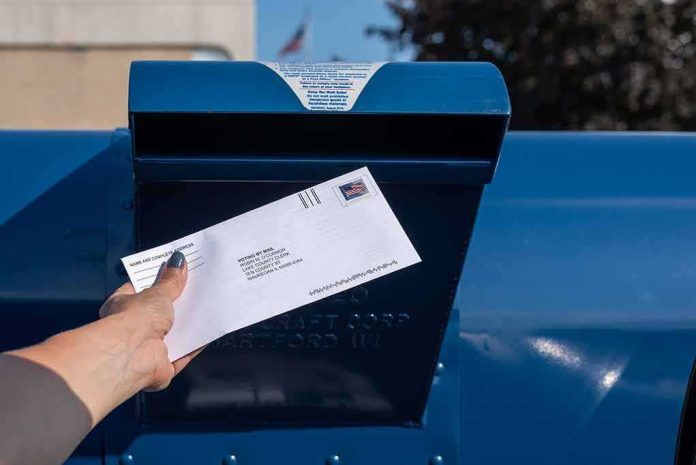
A Supreme Court block has frozen a Postal Service election system, keeping new mail-ballot limits off the table for 2026.
Story Snapshot
- Postmaster General David Steiner says USPS stopped work due to a court injunction.
- The Supreme Court left a lower-court block in place, so 2026 rules will not change.
- The administration argues the rule was a lawful, modest fix to secure ballot mail.
- Judges questioned USPS authority to impose nationwide ballot-mail requirements.
USPS Confirms Work Halt Under Court Order
Postmaster General David Steiner said the United States Postal Service stopped work on a computer system tied to new mail-ballot requirements because an injunction is in force. “There’s an injunction so we’re not doing anything,” he told the Associated Press, confirming the pause across the project. The halt means the agency is not advancing the tool that would have supported enforcement of new standards during the 2026 election cycle. Agency communications signaled that, for now, election mail handling stays the same.
The suspension follows a rapid legal fight over a Postal Service rule meant to standardize ballot envelopes and data fields across states. A federal district judge blocked enforcement in early September. The judge wrote that Congress had not delegated authority over voting to the Postal Service and that the rule likely conflicted with federal law and the Constitution. The ruling pressed pause on using a centralized system to track and validate mail ballots before the November elections.
Supreme Court Leaves Lower-Court Block in Place
The Supreme Court declined to let the Postal Service enforce the new rule for 2026, leaving the lower-court injunction in place while litigation continues. That decision locks in the current status quo for this year’s contests. States will rely on their existing processes, and the Postal Service will continue normal election mail practices. The outcome is a setback for the administration’s push to add uniform standards in the federal mail stream before ballots go out nationwide.
The practical effect is clear. Without the computer system and the rule behind it, there will be no new national barcode, envelope design, or data requirements this fall. Supporters of the rule saw these steps as common-sense tools to help track ballot mail and cut errors. Opponents argued the agency overreached and risked burdening state-run elections. The high court’s move keeps those arguments on hold while lower courts work through the case.
What Each Side Says About Authority and Security
The administration has said the changes were modest, legal, and tied to the Postal Service’s power to set rules for mail piece design and addressee information in the federal mail system. Solicitor General John Sauer argued that states using federal mail cannot claim exemption from Postal Service standards that protect the handling of sensitive items, including ballots. That case for authority framed the rule as housekeeping for mail integrity, not a bid to run elections.
Opponents targeted the question of who sets election rules. The district court said Congress did not give the Postal Service power to regulate the manner of elections and found the rule likely clashed with the nation’s legal framework for voting. Civil groups also cast the rule as a threat to mail voting access and urged courts to keep the pause through 2026 while merits are decided. With the Supreme Court’s stay denial, that view controls the near-term reality on the ground.
What It Means for Voters, States, and 2026 Operations
Voters will see the same mail processes they used in recent cycles. States will keep their own ballot envelope designs and data practices. Election offices will not face a last-minute systems change. The Postal Service will handle election mail under its standing guidelines. That continuity may avoid confusion close to Election Day, but it also leaves open gaps that uniform standards might have addressed, such as tracking consistency and envelope readability across the network.
The system built to gatekeep mail-in voting just got frozen – and its own chief seems relieved.
Postmaster General David Steiner confirmed to the AP that USPS has halted work on the computer system central to Trump's mail-voting restrictions, days after the Supreme Court rejected…— Top Stories (@TopStories77) September 18, 2026
For readers who want secure elections and clear rules, the fight is not over. The courts will still weigh whether the Postal Service can set national handling standards when states use the federal mail. The administration’s case says yes, within normal mail-design powers. The lower courts say not like this, not now, and likely not at all without Congress. For 2026, the justices chose stability over new requirements. After November, lawmakers may need to clarify roles to strengthen ballot-mail security without stepping on state authority.
Sources:
washingtontimes.com, newser.com, nytimes.com, apnews.com