France tightened public-order powers after days of violent unrest left hundreds injured and led officials to restrict gatherings in several cities.
Story Snapshot
- President Emmanuel Macron empowered local officials to ban some gatherings to protect public safety.
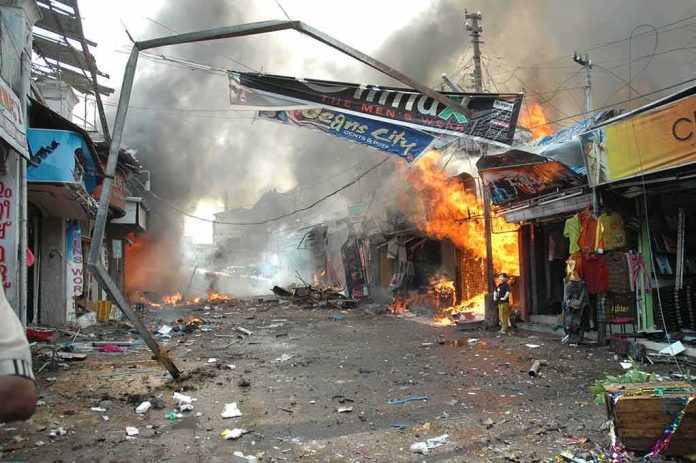
- Police records cited injuries to security forces and widespread looting and arson across multiple cities.
- Marseille banned protests during peak hours; parts of Paris saw demonstration limits and curfews.
- Macron condemned the violence while promising talks on cost-of-living and public-service grievances.
Macron’s Response: Safety Powers and a Call for Dialogue
President Emmanuel Macron told the country that mayors and prefects could ban certain gatherings when needed to protect people and property. He called the violence “unbridled” and said officials would act with local leaders to secure cities, public buildings, and businesses. He also asked the government to bring students, teachers, lawmakers, unions, and business leaders together to craft concrete proposals that address rising costs and social strain. His message paired public-order tools with outreach on core grievances.
Prime Minister Sébastien Lecornu said curfews should be partial and local, not citywide, and stated his resolve to restore order. Local authorities began to issue targeted measures. Marseille barred protests and other gatherings in the afternoon and evening. Paris police set time and place limits on demonstrations and imposed partial curfews in some districts. These steps show that the government framed the crisis as a security emergency, while avoiding a national state of emergency at this stage.
Scale of Unrest: Arrests, Injuries, and Damage
The Élysée described looting, arson, and attacks on shops, town halls, and public buildings in multiple cities and overseas territories. Paris police documented a large number of arrests and hundreds of injured officers and gendarmes amid repeated fires and projectile attacks. Officials said the violence came from ultra-left groups and criminals, though the full mix of actors and motives remains under review. The documented injuries and property damage support claims of serious disorder, not routine protest.
Authorities stressed that many protesters had peaceful motives tied to living costs and services, even as they condemned looting and assaults. Macron said officials would “make examples” of those who smashed shops or attacked police. This dual track—punish violent acts and hear social concerns—matches past French crises. France has seen major waves of protest before. The country’s institutions stayed intact then, but the near-term pressure on policing, courts, and local services was real and costly.
Civil Liberties and Public Trust: The Tightrope
Targeted bans and curfews carry trade-offs. On one hand, they can reduce flashpoints and protect neighborhoods. On the other, they risk sweeping in peaceful assembly if overused or poorly tailored. Macron’s approach leaves discretion with local leaders, who can fine-tune rules by area and time. That can limit harm to civil liberties if applied carefully. It also puts the burden on local officials to justify each restriction and to lift it quickly once risks ease.
“I was very scared,” he said. “I’ve been a Parisian since I was born, so when I got here, it almost made me want to cry because I find it so bad, it hurts me.”
Margaux Eude, 26, said she supports the protest movement but “didn’t think it would escalate like this”.
“It’s the…
— Udochukwu Nnadi (@Chiefudo) October 19, 2026
For many people across the political spectrum, the deeper issue is trust. Citizens see leaders move fast to ban gatherings yet struggle to tackle long-running problems like high prices, weak services, and safety. The government promised a review of possible intelligence or preparedness failures. That matters because early warnings and smart deployment often decide whether protests stay peaceful or tip into riots. Follow-through on that review will shape public judgment in the weeks ahead.
Sources:
afp.com, uk.news.yahoo.com, independent.co.uk, irishtimes.com